
When Innocence Was Never Enough
The Story of Violet and the Failure to Protect Black Children in Jim Crow Mississippi

The Story of Violet and the Failure to Protect Black Children in Jim Crow Mississippi
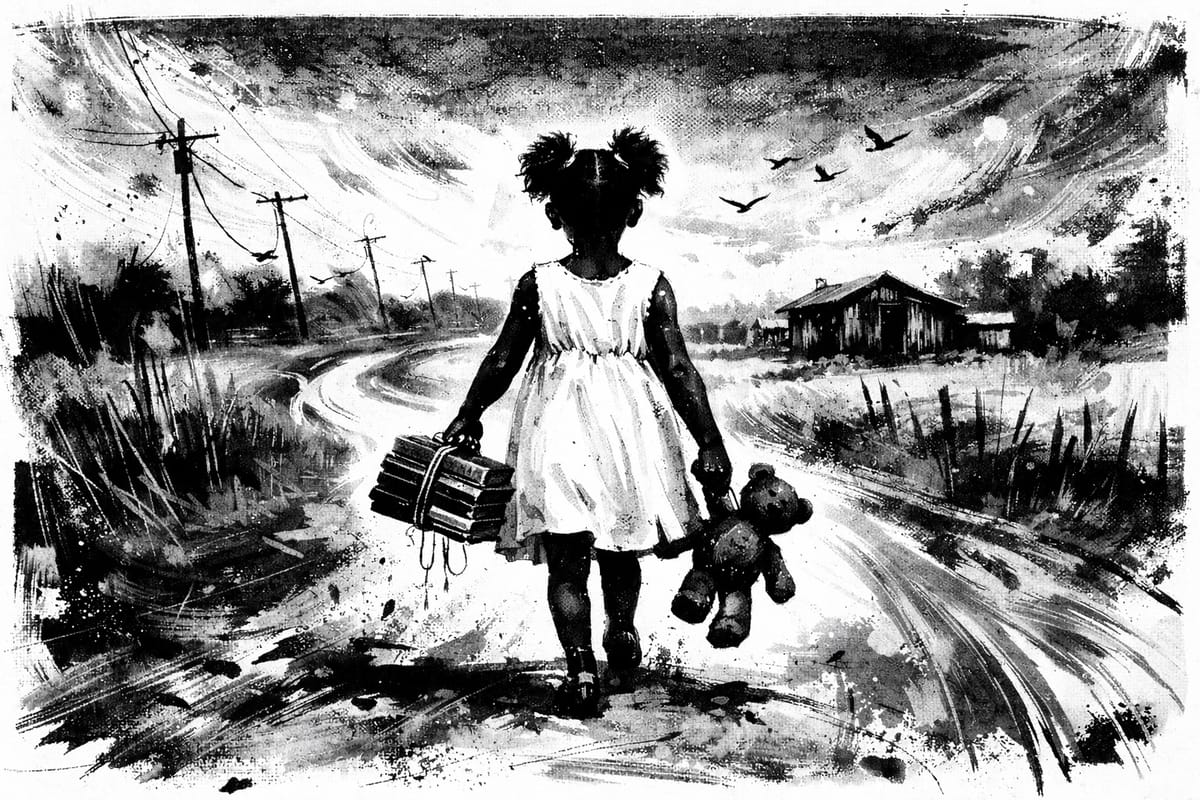
The walk home from school should have been safe. It was a familiar path through rural Mississippi that seven-year-old Violet had taken countless times before, her five-year-old sister and two young friends at her side on that February morning in 1930. The cotton fields stretched endlessly in every direction, the same fields where generations of Black families had labored under an oppressive system that reduced human beings to economic calculations. For Black children in this landscape, every journey beyond the protective boundaries of home carried an unspoken weight of danger, a reality their parents tried desperately to prepare them for without destroying whatever fragments of childhood innocence they might briefly know.
When Emmett Norwood stopped them on the road, knife gleaming in the winter sun, those four children discovered what their parents already understood with terrible clarity: in the Jim Crow South, Black childhood itself was a crime, and innocence offered no protection. Norwood forced Violet and her sister to walk into the woods, away from the road, away from witnesses, away from any possibility of intervention. What happened in those woods was an act of violence so profound that the legal system, designed explicitly to maintain white supremacy, could not entirely ignore it even as it worked systematically to minimize its significance.
Violet survived. This fact itself represents a form of resistance, though at seven years old she could not have understood the broader implications of her survival. She testified in court, a Black child standing before an all-white jury in Mississippi, describing what had been done to her. The remarkable outcome was that Emmett Norwood was found guilty and sentenced to life in prison. For a brief moment, it appeared that the system might recognize the humanity of this child, that justice might extend its protection even to those the law had systematically excluded from its full benefits. That moment was an illusion.
To understand what happened to Violet requires understanding the systematic construction of Black expendability in Jim Crow Mississippi. This was not merely a collection of discriminatory laws but rather a comprehensive system designed to maintain racial hierarchy through every conceivable mechanism of social control. Sexual violence against Black women and children functioned as a cornerstone of this system, a deliberate tool wielded to enforce submission and demonstrate the complete absence of legal protection for Black bodies.
Research examining narratives from 92 African Americans who lived through Jim Crow reveals that sexual assaults committed by ordinary white men systematically terrorized Black families with complete impunity from Reconstruction through the 1960s. These were not isolated incidents but rather normalized features of daily life, requiring Black families to develop elaborate protective measures that still proved inadequate against a system designed to render them perpetually vulnerable. The interviewees in this research discussed not just individual assaults but the normalization of sexual violence, the protective measures families frantically tried to implement, and the long-term consequences of assaults on children whose trauma would echo across generations.
The legal architecture made this violence essentially risk-free for white perpetrators. The Jim Crow criminal justice system was entirely white-controlled—police, prosecutors, judges, juries, and prison officials all committed to maintaining racial hierarchy. Black people had virtually no legal recourse against assaults because the system was explicitly designed to protect white impunity rather than Black safety. When violations of Black humanity occurred, the question was never whether the system would provide justice but rather whether it would acknowledge the violation at all. In most cases, it did not.
What made Violet’s case unusual was not the violence itself but the fact that Norwood was initially convicted. White men who assaulted Black women and children rarely faced prosecution, and convictions were extraordinary enough to be noted in the national Black press. The New Pittsburgh Courier reported on Norwood’s conviction in 1930 precisely because such outcomes contradicted the normal functioning of Mississippi’s justice system. That a seven-year-old’s testimony could convince an all-white jury to convict a white man demonstrated both the severity of the crime and the temporary disruption of standard practice.
But the Jim Crow system contained mechanisms designed to correct such disruptions, and those mechanisms activated swiftly in Norwood’s case. His family petitioned Mississippi’s governor for clemency, arguing that life imprisonment represented excessive punishment for violating a Black child. Supporters mobilized to declare that Violet’s suffering, trauma, and permanent psychological injury did not warrant destroying the life of her white assailant. In a development that perfectly illustrated the inverted values of the Jim Crow legal system, even the prosecutor who had secured Norwood’s conviction later requested clemency, apparently deciding that the seven-year-old victim’s trauma mattered less than the convicted perpetrator’s future prospects.
Mississippi’s gubernatorial pardon power during this period operated with virtually no constraints or oversight. Governors used clemency liberally, particularly when the interests of white criminals conflicted with the theoretical rights of Black victims. This was not corruption or abuse in the conventional sense—it was the system functioning exactly as designed, with the governor’s pardon power serving as a final mechanism to ensure that white supremacy overrode any temporary appearance of equal justice. Historical records from early 20th century Southern states show that governors routinely granted pardons based on political connections, racial considerations, and the belief that white criminals deserved second chances while Black victims deserved nothing.
The timing of Norwood’s pardon reveals the system’s priorities with brutal clarity. Less than two years after attacking a seven-year-old child with such violence that even an all-white jury in Jim Crow Mississippi initially convicted him, Emmett Norwood walked free. The speed of his release communicated an unmistakable message to Black families across the Delta: your children have no value that white society is bound to respect. The conviction had been an aberration; the pardon represented the system’s natural equilibrium.
Violet’s case occurred within a broader pattern of sexual violence that scholars have documented extensively but that remained largely hidden for decades due to the deliberate silencing of Black victims. During the Jim Crow era, white men used rape and rumors of rape not only to justify violence against Black men but also to remind Black women and girls that their bodies were not their own. As one legal analysis explains, white men in positions of power over Black women—police officers, employers, insurance salesmen, shopkeepers—used sexual assault and rape to dominate them, knowing that the legal system would provide no recourse for their victims.
This sexual terrorism operated through multiple mechanisms simultaneously. Individual assaults demonstrated personal power while collective impunity reinforced social hierarchy. Black families developed protective strategies that proved inadequate precisely because inadequacy was built into the system’s design. Parents warned children about the dangers they faced, tried to limit their exposure to white spaces, attempted to teach them the elaborate etiquette of submission that might theoretically protect them. But no amount of caution could overcome a system where innocence itself offered no protection and where childhood for Black children was perpetually conditional.
The normalization of this violence created intergenerational trauma that extended far beyond individual victims. As research from the “Behind the Veil” oral history project documents, Black families carried stories across generations of white men who invaded homes with impunity, of children who learned early that privacy was a myth and safety an impossibility, of women who developed elaborate evasion strategies that still proved insufficient. One interviewee described a white insurance salesman who walked into Black homes without permission, forcing children to hide when he arrived and parents to submit to his presence because resistance carried deadly consequences.
The Mississippi Delta in 1930 exemplified this normalized terror particularly intensely. The region was among the poorest in the nation, with Black families surviving under conditions barely distinguishable from slavery. Economic opportunities for Black people were essentially nonexistent outside of sharecropping arrangements that kept them perpetually indebted and vulnerable. The average income for Black families was a fraction of that for white households, while state spending on Black education represented only a tiny percentage of funding for white schools despite Black children comprising the majority of school-age children. This economic vulnerability compounded the legal vulnerability, creating a comprehensive system of control that operated through both material deprivation and physical violence.
What happened to Violet after Norwood’s pardon? The historical record largely goes silent, as it does for most Black victims of Jim Crow violence. This silence was not accidental but systematically produced. White-controlled newspapers rarely covered crimes against Black victims except to note convictions (as in Violet’s case, which made the news precisely because of its exceptional outcome). Black newspapers documented what they could, but they operated under constant threat and lacked resources to cover every assault, every trauma, every destroyed childhood. The vast majority of sexual violence against Black children during this period went completely undocumented, leaving no trace in the historical record beyond the collective trauma carried by Black communities.
Scholars have begun to uncover these hidden histories through oral history projects, court records that survived despite efforts to destroy them, and careful reconstruction of fragments that white supremacy tried to erase. The Burnham-Nobles Digital Archive, for instance, houses case files and documents for more than 1,000 cases of racial homicides in the Jim Crow South between 1930 and 1954. These represent only documented cases where some record survived—the actual number of attacks, assaults, and murders was undoubtedly far higher. Sexual assaults were even less likely to be documented than homicides, creating what one researcher calls “America’s disappeared”—hundreds or thousands of Black victims whose experiences were deliberately written out of history.
The decision by civil rights attorneys and historians to investigate these cases decades later represents an attempt at what they call “restorative justice”—not in the sense of restoring what was lost, which is impossible, but in the sense of restoring to the historical record the names and experiences that white supremacy tried to erase. When researchers met living relatives of lynching victims in Mississippi, they found families that had been forced to flee as “refugees in their own country,” losing property and community connections, carrying trauma across generations. The impact of racial violence extended far beyond individual victims to reshape entire family trajectories, forcing migrations, destroying economic stability, and creating psychological wounds that persisted long after the immediate danger passed.
After Norwood’s pardon, he went on to live what newspaper accounts described as a full life. He married, had children, built what his community regarded as a respectable career. The system that had briefly acknowledged his crime quickly restored him to full participation in white society, his assault on a seven-year-old child treated as a temporary setback rather than a permanent moral disqualification. This pattern repeated across the Jim Crow South—white men who committed horrific violence against Black victims received pardons, clemency, and community support that reintegrated them into respectable society while their victims carried permanent trauma with no social acknowledgment or support.
The contrast illuminates the fundamental values embedded in Jim Crow’s legal architecture. Justice was not blind but explicitly racial, designed not to protect the vulnerable but to maintain hierarchy. When the system convicted a white man for violence against a Black child, that conviction represented a malfunction requiring correction rather than justice requiring defense. The governor’s pardon power existed precisely to provide such corrections, ensuring that temporary departures from white supremacy would not permanently disrupt the racial order.
This instrumental use of law to maintain racial hierarchy rather than provide justice explains why Black families could not rely on legal protection even when laws ostensibly covered their situations. Rape laws existed, assault laws existed, laws against violence toward children existed—but their application depended entirely on the race of perpetrator and victim. Legal scholar Angela Harris notes that Louisiana’s rape laws during slavery and Jim Crow explicitly excluded Black women and girls from protection, making the rape of enslaved women literally impossible under law. While formal exclusions like Louisiana’s were removed during Reconstruction, the practical exclusion of Black victims from legal protection persisted through discriminatory enforcement that left laws on the books while denying their application to Black complainants.
The 1930s represented a particularly brutal period in this history. More than 4,000 African Americans were lynched in the South between 1890 and 1930, with Mississippi maintaining among the highest rates of racial violence in the nation. These lynchings decreased somewhat during the Depression, but the violence did not disappear—it became more covert and individualized, shifting from public spectacle to private terror that still functioned to maintain white supremacy through fear. Sexual violence against Black women and children operated alongside lynching as mechanisms of social control, reminding Black families that no sphere of life was protected from white intrusion and violence.
Violet survived. The historical record tells us this much, though it tells us little else about her life after 1932. We know that she eventually moved north, joining the millions of Black Americans who fled the South during the Great Migration, seeking safety and opportunity in cities where Jim Crow’s formal apparatus did not extend. We know she married and raised a family, finding strength and joy even after what had been taken from her. These facts represent their own form of resistance—the determination to build a life despite trauma, to create family and community despite systematic efforts to destroy Black families, to maintain humanity in a system designed to deny it.
But survival came at tremendous cost. The psychological impact of childhood sexual assault creates lifelong challenges, disrupting the development of trust, safety, and self-worth. For Black girls in Jim Crow America, this individual trauma intersected with collective trauma—the knowledge that the assault was not an isolated incident but part of a systematic pattern, that no legal protection existed, that the perpetrator would likely face no consequences while the victim would carry permanent wounds. Research on the long-term impact of Jim Crow violence shows how these traumas reverberated across generations, shaping family dynamics, community relationships, and individual mental health in ways that persisted long after the formal end of legal segregation.
The fact that Violet had to leave Mississippi to build a life speaks to the impossibility of recovery in the location of trauma. The Delta where she had walked to school, where she had loved learning, where her childhood ended on that February morning—that place could never be safe for her again. The Great Migration represented not just economic opportunity but escape from places saturated with trauma, where every road might hold memories of violence and every public space reminded Black families of their vulnerability. Historians estimate that six million Black Americans fled the South between 1916 and 1970, creating what Isabel Wilkerson calls “the biggest underreported story of the twentieth century.” Each of those six million individuals and families carried reasons for leaving—personal experiences of violence, witnessing attacks on neighbors and relatives, or simply the accumulated weight of living under a system designed to deny their humanity.
Violet’s story was not unique, and that fact may be its most devastating aspect. Thousands of Black children experienced similar violence during Jim Crow, and the vast majority never saw their attackers face even temporary consequences. The sexual exploitation of Black children operated as a systematic feature of white supremacy, not an unfortunate aberration. White men understood that they could assault Black children with near-complete impunity, that families would have no recourse to justice, that the community would either ignore or actively support their actions.
This pattern extended beyond individual assaults to shape the entire architecture of childhood for Black families in the South. Parents had to teach children elaborate rules for interacting with white people—where to walk, how to speak, when to avert eyes, how to demonstrate submission without inviting further abuse. These rules proved inadequate because adequacy was impossible in a system where Black children’s very existence could be interpreted as transgression. A child walking home from school could be stopped by any white man for any reason or no reason at all. A child who loved learning could find that education itself made them vulnerable, that literacy and intelligence threatened white supremacy and invited violence.
The case of Ernest Green and Charles Lang in 1942 Mississippi illustrates this dynamic with horrific clarity. These two Black teenagers were lynched merely for being accused of chasing a white girl—not for any actual transgression but for the imagined possibility of inappropriate interest in a white child. Their murders sent an unmistakable message that even the appearance of crossing racial boundaries justified death. When compared with Violet’s case, where a white man actually assaulted a Black child and walked free after less than two years, the system’s values become starkly visible: imagined Black transgression against white supremacy warranted death without trial, while actual white violence against Black children warranted brief inconvenience followed by full restoration to society.
The speed with which Mississippi’s legal and political establishment rallied to free Norwood reveals institutional complicity that extended far beyond individual racism. The prosecutor who initially secured the conviction later requested clemency, demonstrating that even those ostensibly responsible for enforcing law viewed convictions of white men for crimes against Black victims as excessive and requiring correction. The governor who granted the pardon did so in full knowledge of the crime’s severity but with equal awareness that maintaining white supremacy required ensuring that white criminals face minimal consequences for violence against Black people.
This institutional complicity operated through apparently neutral mechanisms. The pardon power existed in most states as a legitimate executive function designed to provide mercy in exceptional cases or correct miscarriages of justice. Mississippi governors used this power regularly, granting clemency based on various considerations including prison overcrowding, political connections, and judgments about rehabilitation. But the application of this power revealed its fundamentally racial character—white criminals regularly received pardons while Black victims received no consideration, white futures mattered while Black suffering did not.
The institutional failure extended beyond the criminal justice system to encompass every structure that might theoretically have protected Black children. Schools were segregated and grossly unequal, with Mississippi spending only a tiny fraction on Black education compared to white schools despite Black children comprising the majority of students. Health care facilities maintained separate and unequal facilities for Black patients. Religious institutions that theoretically preached universal human dignity often explicitly supported segregation and white supremacy. The media ignored or minimized violence against Black victims while sensationalizing any allegations against Black people. Every institution that might have intervened to protect children like Violet instead participated in the system that rendered them vulnerable.
Perhaps the most insidious aspect of Jim Crow violence against children was how it stole childhood itself. Black children could not experience the relative freedom and innocence that characterized white childhood because survival required constant vigilance. They learned early that the world was dangerous, that adults could not always protect them, that innocence offered no shield against violence. Research on Black children’s experiences during Jim Crow reveals how they internalized these lessons at remarkably young ages, understanding before they started school that they needed to navigate a hostile world with elaborate care.
Parents faced impossible choices in preparing their children for this reality. Teaching children the rules of racial etiquette meant imposing restrictions that undermined their sense of self-worth and agency. Not teaching these rules meant leaving children vulnerable to violence that could erupt without warning. Either way, childhood was compromised, shaped by the necessity of survival in a hostile environment rather than by age-appropriate exploration and development. The famous conversation between Emmett Till’s mother and her son before he traveled to Mississippi in 1955 illustrates this dynamic—she tried to prepare him for a world where looking at a white woman wrong could cost his life, but such preparation was ultimately inadequate because the rules were designed to be impossible to fully follow.
Violet’s love of school makes the theft of her childhood particularly poignant. Education represented hope and possibility, the chance to develop knowledge and skills that might create opportunities beyond the limited options available to Black people in the Delta. But the walk home from school—that routine journey between education and home—became the site of violence that destroyed innocence and demonstrated that learning itself offered no protection. The message was clear: Black children could not safely occupy public space, could not move freely in the world, could not rely on the basic protections that childhood should provide.
For decades, stories like Violet’s remained hidden, erased from official history through the deliberate destruction of records, the suppression of Black voices, and the unwillingness of white institutions to acknowledge systematic violence. The newspapers that covered Norwood’s initial conviction rarely followed up on his pardon, allowing the conviction to stand in the historical record while his release disappeared. The trauma Violet carried found no public acknowledgment, no social support, no institutional recognition that she deserved justice and healing.
This erasure served crucial functions for white supremacy. By eliminating evidence of systematic violence, white society could maintain the fiction that America was fundamentally just, that extreme violence was aberrational rather than systemic, that racial inequality resulted from Black deficiency rather than white violence. The silence around sexual violence against Black women and children was particularly intense because acknowledging this pattern would have required confronting the hypocrisy of a system that lynched Black men for imagined threats to white women while protecting white men who actually assaulted Black girls.
The recent effort to document these hidden histories through projects like the Burnham-Nobles Digital Archive, the Civil Rights and Restorative Justice Project, and local memory justice initiatives represents an attempt to break this silence and force American society to confront uncomfortable truths. These projects face significant resistance from those who prefer to leave the past buried, who argue that documenting historical violence serves no useful purpose and only generates contemporary division. But as civil rights attorney Julian Johnson argues, these stories must be told “so the world cannot forget, so the silence does not win, so the names are remembered.”
The failure to protect Black children during Jim Crow created intergenerational patterns that persist despite the formal end of legal segregation. Black families still teach children about dangers that white families rarely need to address—how to interact with police, how to move through spaces where their presence may be viewed with suspicion, how to navigate systems that view Black childhood with less innocence and more criminalization than white childhood. Research consistently shows that Black children are treated as older and less innocent than their white peers, facing harsher discipline in schools, more aggressive policing in communities, and less protection from adults who might intervene to prevent harm.
These contemporary patterns cannot be understood apart from their Jim Crow roots. The systematic denial of protection to Black children during the 20th century created institutional habits, cultural assumptions, and legal frameworks that continue to shape how American society views and treats Black childhood. Studies show that Black girls are more likely to be seen as “fast” and less in need of protection than white girls, echoing the Jim Crow logic that rendered Violet and countless other Black children vulnerable to assault while their attackers faced minimal consequences. Black boys are perceived as threatening at younger ages than white boys, subjected to adult criminal prosecution for actions that would be handled in juvenile court for white children, and killed by police who claim to fear them even when they are children playing with toys.
The story of Mississippi’s use of Jim Crow-era laws to charge Black children as adults at disproportionate rates in the 21st century illustrates this continuity. Nearly 5,000 Mississippi children have been charged as adults in the past 25 years, with three out of every four being Black. These laws originated during the period when Violet was attacked and Norwood was pardoned, explicitly designed to criminalize Black childhood and subject Black children to adult prison systems where they faced severe abuse. The fact that these laws remain in effect nearly a century later, producing predictable racial disparities, demonstrates how Jim Crow’s architecture persists even after its formal legal structure has been dismantled.
The decision to tell Violet’s story now, nearly a century after the attack, represents more than historical documentation. It is an act of witness, an insistence that her childhood mattered, that the violence done to her was real and profound, that the system’s failure to protect her demands acknowledgment and reckoning. For too long, stories like Violet’s remained hidden in archives, reduced to brief newspaper mentions that captured convictions but ignored pardons, that noted crimes but silenced victims.
We know relatively little about Violet beyond the basic facts of her assault and survival. We don’t know her full name, protecting her descendants from the exposure that public identification might bring. We don’t know the details of her later life beyond the general outline—migration north, marriage, family. This incomplete knowledge reflects both the historical erasure of Black victims’ stories and the ethical complexity of telling stories that involve childhood trauma. But what we do know matters profoundly: Violet loved school, she walked home with her sister and friends on an ordinary February day, she survived an attack that should never have happened, she testified with courage that led to a rare conviction, and she carried on despite the system’s ultimate betrayal when her attacker walked free.
The newspaper clippings that document her case—from The Yazoo Herald reporting the trial, The New Pittsburgh Courier noting the conviction, and The Greenwood Commonwealth announcing the pardon—represent fragments of a story that was nearly lost. These documents survived when thousands of similar stories disappeared completely, their victims’ names and experiences erased as thoroughly as if they had never existed. The fact that we can tell Violet’s story at all is somewhat remarkable, a reminder that for every documented case of Jim Crow violence, dozens or hundreds more left no trace in the historical record.
Why does Violet’s story matter now, nearly a century later? Because the patterns it reveals persist. Because American society has never fully reckoned with the systematic violence perpetrated against Black children under Jim Crow. Because contemporary disparities in how Black and white children are treated by institutions cannot be understood without confronting this history. Because Violet’s name deserves to be remembered, her childhood honored, her survival acknowledged.
The uncertainty that characterized Black life under Jim Crow—never knowing when violence might erupt, never having confidence that institutions would provide protection, never being able to assume that childhood would be respected—created collective trauma that continues to shape Black communities’ relationships with American institutions. When Black parents today have “the talk” with their children about how to interact with police to minimize the risk of violence, they echo conversations their grandparents had about how to navigate Jim Crow. When Black communities respond with deep skepticism to official assurances that the system will provide justice, they draw on generations of experience that demonstrate otherwise.
The story of what happened after Norwood’s pardon—his return to normal life, his marriage and children, his “respectable” career—illuminates the inversion of values that characterized Jim Crow justice. The system that briefly acknowledged the harm done to a seven-year-old child ultimately decided that the perpetrator’s future mattered more than the victim’s trauma. This calculation reveals the fundamental truth about Jim Crow: it was not merely a system of inequality but rather a comprehensive framework designed to ensure that Black suffering would never be weighed equally against white convenience, that Black trauma would always be minimized and dismissed, that Black childhood would never receive the protection that white society considered natural for white children.
American society owes a debt to Violet and the countless Black children who suffered similar violence under Jim Crow. This debt cannot be repaid—what was stolen cannot be returned, what was damaged cannot be fully healed. But the debt can be acknowledged. The stories can be told. The names can be remembered. The institutional failures can be documented and examined. The contemporary patterns that echo Jim Crow’s logic can be identified and challenged.
Violet survived and ultimately found ways to build a life, to create family and community, to move forward despite what had been done to her. This survival represents remarkable strength and resilience, but it should not have been necessary. She should have been protected. The system should have maintained the conviction it briefly secured. Norwood should have remained in prison. These should-have-beens matter because they identify the gap between what justice required and what white supremacy delivered.
The broader pattern that Violet’s case exemplifies—the systematic sexual violence against Black women and children, the institutional complicity in this violence, the erasure of victims’ stories from historical memory—demands more than acknowledgment. It demands examination of how contemporary institutions continue patterns established during Jim Crow, how assumptions about Black childhood’s expendability persist in criminal justice systems and educational institutions, how the fiction of equal protection under law masks persistent disparities in who actually receives protection.
When civil rights attorney Julian Johnson writes “Violet. We remember you,” he performs an act of restoration that goes beyond individual commemoration. He insists that American history must include these stories, that the narrative of national progress must confront the systematic violence that Black communities endured, that the silence that once protected white supremacy will not continue to erase Black suffering from collective memory. This remembering is not comfortable. It does not allow for easy narratives about American justice or consistent progress. But it is necessary.
Justice delayed is justice denied, the old saying goes. But in Violet’s case, justice was not delayed—it was actively reversed. The conviction secured despite overwhelming odds was deliberately undone by a system that viewed protecting white impunity as more important than protecting Black children. This reversal was not a failure of the justice system but rather its successful operation according to Jim Crow logic.
Understanding this distinction matters for contemporary conversations about criminal justice reform. When we discuss problems in the justice system today—racial disparities in arrest and conviction, unequal sentencing, the school-to-prison pipeline—we often frame these as system failures or bugs that need fixing. But the history of cases like Violet’s reveals that many of these disparities represent the system functioning as designed, continuing patterns established when Jim Crow was explicit law rather than implicit practice.
The pardon power that freed Norwood exists today with many of the same features—gubernatorial discretion with limited oversight, broad authority to overturn convictions, political considerations that often determine who receives clemency. While contemporary use of this power is not as overtly racist as in 1932, research consistently shows that racial disparities persist in who receives pardons and clemency. Black defendants remain less likely to receive clemency than white defendants with similar records, while governors continue to emphasize Christian forgiveness and second chances primarily for those whose racial and social profile matches their own.
The prosecutor’s request for clemency in Norwood’s case reveals another pattern that persists: the unwillingness of even those charged with protecting victims to sustain that protection when the defendant is white and the victim is Black. Contemporary cases where prosecutors decline to pursue charges against police officers who kill unarmed Black people, or where district attorneys advocate for minimal sentences for white defendants who commit violent crimes against Black victims, echo the logic that led a Mississippi prosecutor to seek freedom for a man he had successfully prosecuted for assaulting a seven-year-old child.
Violet’s story demands that we confront uncomfortable truths about American history and its contemporary legacies. It demands that we acknowledge how recent this history is—Violet, if she survived to normal life expectancy, might have lived until the 1990s or early 2000s, carrying her trauma through the Civil Rights Movement, through the emergence of mass incarceration, through decades of continued struggle for Black children’s safety and recognition. The people who sought Norwood’s pardon, who argued that his punishment was excessive for violating a Black child, were not distant historical figures but people whose children and grandchildren walk among us today, potentially carrying forward the same values that rendered Violet’s suffering insignificant.
It demands that we examine how Black children are still denied the protections that should accompany childhood. Research consistently shows that Black girls are viewed as needing less nurturing, less protection, and less comfort than white girls. Black boys are perceived as older and more threatening than their white peers, subjected to aggressive policing in schools and communities, killed by officers who claim fear of children and teenagers. These patterns cannot be understood apart from the Jim Crow logic that treated Black childhood as inherently less innocent and less deserving of protection than white childhood.
It demands that we recognize how sexual violence against Black women and girls remains systematically under-prosecuted and under-acknowledged. While the #MeToo movement has increased attention to sexual violence and created space for some victims to tell their stories, Black women and girls remain less likely to be believed, less likely to see their attackers prosecuted, and more likely to face victim-blaming when they report assaults. The historical pattern that allowed white men to assault Black females with impunity has not been fully dismantled—it has evolved into forms that are less legally explicit but still functionally effective in denying justice.
It demands that we grapple with what accountability means for historical injustices whose direct perpetrators and victims are no longer living but whose effects persist across generations. We cannot undo what was done to Violet. We cannot restore her stolen childhood or erase her trauma. But we can acknowledge what happened, document the pattern it represented, examine how that pattern continues to shape contemporary institutions, and commit to transforming systems that still fail to protect Black children adequately.
Dr. Martin Luther King Jr. famously quoted Theodore Parker’s assertion that “the arc of the moral universe is long, but it bends toward justice.” Violet’s story complicates this hopeful vision. Nearly a century after her assault, many of the patterns that enabled her victimization and her attacker’s pardon persist in modified forms. The arc is indeed long—perhaps longer than King imagined—and the bend toward justice appears less inevitable than his rhetoric suggested.
Yet Violet’s survival, her migration north, her creation of family and community despite trauma—these facts represent their own form of justice, not delivered by institutions but achieved through the determination of Black people to maintain humanity and build lives even in the face of systematic efforts to destroy them. The fact that her story can now be told, that civil rights attorneys and historians work to document cases like hers, that memory justice projects insist on naming victims and commemorating their experiences—this too represents a form of justice, however incomplete.
The great challenge is transforming this historical acknowledgment into contemporary institutional change. Remembering Violet matters, but it is not enough if the systems that failed to protect her continue to fail Black children today. Documenting the sexual violence Black women and girls endured under Jim Crow matters, but it is not enough if contemporary victims still face the same institutional indifference and victim-blaming. Understanding the architecture of Jim Crow violence matters, but it is not enough if we do not use that understanding to dismantle its persistent structures.
Justice for Violet would have meant preventing the assault in the first place—building a society where Black children could walk home from school without fear, where they enjoyed the same protection as white children, where their innocence was recognized and defended. Since that prevention failed, justice would have meant maintaining the conviction secured against overwhelming odds, ensuring that Norwood served the full sentence for his crime, sending an unmistakable message that Black children’s safety mattered. Since that too failed, justice now means telling her story, acknowledging the systematic violence she endured, examining how that violence shaped the institutions we inherited, and committing to transformation that ensures contemporary children—all children, regardless of race—receive the protection that Violet was denied.
We remember Violet not just as a victim but as a survivor who carried on, who found strength to build a life after trauma, who represents the resilience of Black communities that endured systematic violence while maintaining humanity and hope. Her story is tragic, but it is not only tragic. It is also a story of courage—the courage to testify at seven years old, knowing that the system was designed to dismiss her, the courage to survive and move forward, the courage her parents showed in supporting her through trauma while navigating a hostile world.
Her story is a story of community, though the documentary record gives us few details about the support she received. Black communities under Jim Crow developed extensive mutual support systems precisely because white institutions provided none. Churches, neighbors, extended family networks—these sustained people through violence and trauma, providing care and solidarity that enabled survival. Violet’s ability to move forward likely depended on these community structures that held her when institutions failed.
Her story is a story about childhood stolen but not entirely destroyed, about innocence violated but resilience maintained, about systematic violence documented so that future generations might understand what came before and work to ensure it never happens again. When attorney Julian Johnson closes his account of Violet’s case with “Violet. We remember you,” he speaks not just for himself but for all those who understand that memory is resistance against erasure, that naming is power against silence, that telling these stories matters even when—especially when—they are painful and difficult.
The February morning in 1930 when Violet walked to school with her sister and friends should have been ordinary. Instead, it became a day that shattered her childhood and demonstrated with terrible clarity how completely Jim Crow had perverted American society’s professed values. The walk home should have been safe. The justice system should have protected her. The conviction should have been maintained. None of these should-have-beens came to pass, and their absence defines the gap between what America claimed to be and what it actually was for Black children under Jim Crow.
That gap remains visible today in the disparities that continue to mark Black children’s experiences—in school discipline that treats them as older and more culpable than their white peers, in policing that views them as threatening, in justice systems that charge them as adults at disproportionate rates, in health care that provides less pain management and assumes less sensitivity, in every sphere where innocence should provide protection but whiteness remains its prerequisite. Violet’s story demands that we see this continuity, acknowledge this legacy, and commit to transformation that finally delivers the protection that was denied to her and to countless other Black children across American history.
We remember Violet not just to document past injustice but to illuminate present struggle and future possibility. We tell her story not to dwell in trauma but to understand how that trauma shaped everything that came after. We name her not to reduce her to victimhood but to honor her survival and insist that her childhood mattered, her suffering was real, and the system that failed to protect her must be fundamentally transformed. This is what memory justice demands: not just acknowledgment but action, not just regret but repair, not just documentation but transformation.
An examination of systemic failure to protect Black children in Jim Crow Mississippi through the 1930 case of seven-year-old Violet, whose assault by white perpetrator Emmett Norwood resulted in rare conviction subsequently overturned through gubernatorial pardon. Analysis connects individual case to broader patterns of sexual violence, institutional complicity, and erasure of Black victims’ stories, exploring how Jim Crow’s hierarchy of disposability continues to shape contemporary treatment of Black childhood.