
Universities Under Siege
The Multimillion-Dollar Price of Academic Freedom in the Trump Era

The Multimillion-Dollar Price of Academic Freedom in the Trump Era
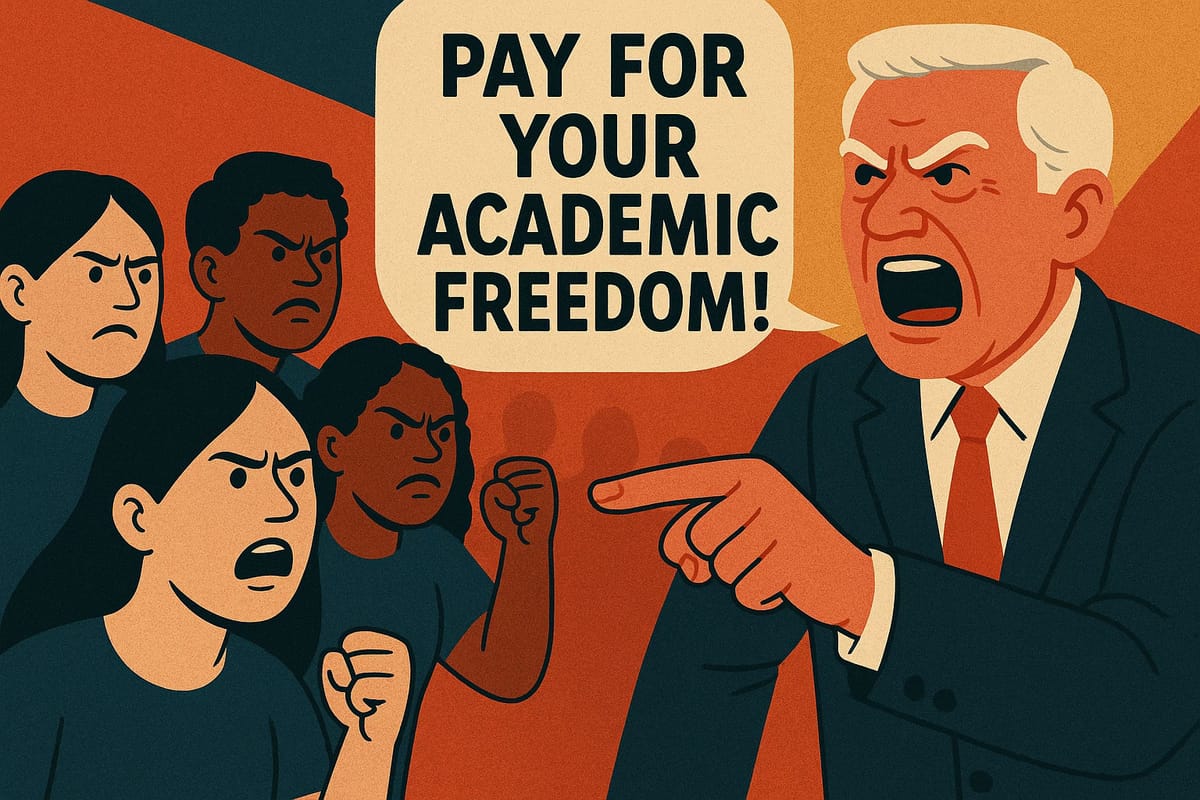
In an unprecedented attack on higher education, the Trump administration has weaponized federal funding to extract hundreds of millions of dollars from America’s most prestigious universities while forcing them to abandon core academic principles. Since taking office in January 2025, President Donald Trump has orchestrated what federal judges have called “a playbook of initiating civil rights investigations of preeminent universities to justify cutting off federal funding” with the explicit goal of “forcing them to change their ideological tune.”
This campaign has resulted in nearly $6 billion in frozen research grants across nine major universities, with settlements already totaling over $400 million and potentially reaching into the billions. The administration’s strategy represents a fundamental departure from traditional federal oversight, using antisemitism investigations as what one federal judge called “a smokescreen for a targeted, ideologically-motivated assault on this country’s premier universities.”
The Trump administration’s strategy has been both systematic and devastating. President Donald Trump’s administration had cut off $790 million in grants in a standoff that contributed to university layoffs and the resignation in September of Northwestern president Michael Schill. The administration justified these actions by claiming universities had failed to adequately address antisemitism on campus, particularly in response to pro-Palestinian protests following the Israel-Gaza conflict.
However, the reality behind these investigations reveals a broader ideological agenda. The administration has directly offered priority for federal funding to select universities that agree to a broad set of terms covering academics, tuition, speech and other areas historically left to institutions to decide. These demands extend far beyond antisemitism concerns to include eliminating diversity, equity and inclusion (DEI) programs, restricting transgender student rights, and overhauling admission policies.
The financial impact has been catastrophic for targeted institutions. Universities depend heavily on federal research funding, with some receiving over $1 billion annually in grants and contracts. When this funding is suddenly frozen, the ripple effects are immediate and severe, affecting ongoing research projects, faculty employment, and the institutions’ ability to attract and retain top talent.
Columbia University has agreed to pay the heftiest fine thus far, at $200 million over a three-year period related to antisemitism on campus that stemmed from protests over the Israel-Gaza war. Additionally, Columbia will also pay $21 million to resolve alleged civil rights violations against Jewish employees at Columbia following the Hamas terror attacks on Oct. 7, 2023.
The Columbia settlement became what the administration calls a “road map” for other colleges. Beyond the financial penalties, Columbia agreed to sweeping policy changes including:
Northwestern’s recent settlement represents one of the largest payments yet. Northwestern University has agreed to pay $75 million to the U.S. government in a deal with the Trump administration to end a series of investigations and restore hundreds of millions of dollars in federal research funding. The university was particularly vulnerable because the funding freeze resulted in more than 100 stop-work orders affecting federally funded research.
Northwestern’s situation was exacerbated by a previous agreement with pro-Palestinian protesters. The deal, which will last for three years, also means the Chicago-area private university will no longer abide by an earlier agreement it struck with pro-Palestinian protesters that included a commitment to dedicate space on campus for Muslim and North African students. This forced reversal of previously negotiated campus policies demonstrates the administration’s power to compel universities to abandon commitments made to their own student communities.
Key Northwestern Settlement Terms:
Cornell University agreed to pay the federal government $30 million over three years and provide it with extensive admissions data in return for three federal agencies closing their investigations into the Ivy League institution. Uniquely, Cornell said it would devote an additional $30 million toward agriculture research programs that “directly benefit U.S.” agricultural interests, effectively doubling their financial commitment to $60 million.
Cornell’s Commitments Include:
Brown University agreed to a $50 million deal. The school will pay that money over a 10-year period to state workforce development organizations in Rhode Island, to make sure that the initiatives are in compliance with anti-discrimination laws. This arrangement demonstrates how the administration has structured settlements to advance broader policy goals beyond the universities themselves.
The University of Pennsylvania and University of Virginia have also reached agreements, though with different terms. The University of Virginia agreed to comply with Justice Department guidance without a financial penalty but committed to quarterly compliance reports and elimination of certain DEI practices.
Several major institutions continue to face frozen funding or ongoing negotiations:
Harvard remains the administration’s most high-profile target, with over $2.6 billion in research grants frozen. The university has mounted legal challenges and won initial court victories, but the administration continues to seek a settlement that could exceed $500 million.
The Trump administration is seeking a $1.2 billion settlement from UCLA, the largest demand yet made. The University of California system has fought back in court and recently won a preliminary injunction blocking further funding cuts.
Additional universities including Duke University and Princeton University continue to face funding freezes and ongoing investigations, with the administration seeking similar compliance agreements.
The impact of these funding freezes extends far beyond financial spreadsheets. Universities have been forced to make devastating cuts to maintain operations while fighting for their survival. In July, Northwestern announced it was cutting 425 positions at the university amid the federal funding freeze. These layoffs represent not just job losses but the dismantling of research teams and academic programs that took years to build.
The psychological toll on academic communities has been equally severe. The administration’s campaign resulted in a significant and ongoing chilling of faculty’s actions, both in and out of the classroom. Faculty members have changed how they engage in public discourse and limited their participation in protest activities.
Documented Effects Include:
Students have also suffered directly. This fall a few dozen incoming students refused to take a new mandatory antisemitism training session, saying the framing was “unscholarly” and “morally harmful.” Those students were blocked from enrollment following a federal judge order. This example illustrates how the settlements have created new barriers to education and forced universities to implement policies that conflict with academic freedom principles.
While ostensibly focused on antisemitism, the administration’s demands reveal a much broader ideological agenda. Yet the terms of the agreement also address other conservative culture-war topics unrelated to antisemitism, including policies on race-based hiring and transgender athletes. These additional requirements expose the true scope of the administration’s goals: a comprehensive reshaping of higher education to align with conservative political priorities.
The administration has been remarkably explicit about its intentions. President Trump’s campaign website touted his plan “to reclaim our once great educational institutions from the radical Left and Marxist maniacs,” demonstrating that the current actions are part of a deliberate campaign promise rather than spontaneous responses to campus events.
Key Administration Demands Across Universities:
Not all universities have capitulated to the administration’s demands. Harvard University and UCLA have mounted legal challenges that have exposed the constitutional problems with the administration’s approach. A federal judge ruled on Sept. 3 that more than $2 billion in federal funding was taken from Harvard illegally. Similarly, U.S. District Judge Rita Lin found the administration’s actions unconstitutional, describing “a playbook of initiating civil rights investigations of preeminent universities to justify cutting off federal funding,” with the aim of “forcing them to change their ideological tune.”
Harvard University Victory:
UCLA/UC System Victory:
These judicial victories have provided a blueprint for resistance, but they come at enormous cost. Universities must spend millions on legal fees while enduring months or years of frozen funding, creating powerful incentives to settle rather than fight.
The financial arrangements vary significantly across settlements, revealing different administration priorities. That $200 million goes to the U.S. Treasury into a large pot of money — the same place where your federal tax dollars go. Congress then gets to decide how to appropriate that money, said Michael Dorf, a professor at Cornell Law School. However, some settlements direct funds to specific causes favored by the administration, such as workforce development programs or agricultural research.
Direct Treasury Payments:
Targeted Program Funding:
Compensation Funds:
Financial experts have noted that settlement amounts appear calibrated to institutional vulnerability rather than actual wrongdoing. “From what I’ve seen,” says one expert, “it’s almost like the amounts are being determined by how vulnerable the school is to the withholding of future federal funding than it is any actual problem that they’re being punished for.”
The settlements represent a fundamental assault on academic freedom and institutional autonomy. Universities have been forced to agree to external oversight of curricula, restrictions on faculty hiring, and limitations on student expression. These conditions go to the heart of what makes universities function as independent centers of learning and research.
Curricular Control:
Personnel Decisions:
Student Expression:
The long-term implications are staggering. “If our $790 million in federal research funding remained frozen, the freeze threatened to gut our labs, drive away faculty, and set back entire fields of discovery.” This statement from Northwestern’s interim president captures the impossible choice universities face: maintain their principles and watch their institutions crumble, or surrender their autonomy to preserve their research mission.
The administration’s campaign has created a chilling effect throughout higher education. Top universities are increasing lobbying efforts in response to President Trump’s actions on higher education, spending millions in Washington. Even universities not directly targeted are spending unprecedented amounts on legal and lobbying services, diverting resources from education and research to political defense.
Increased Lobbying Spending:
Defensive Measures by Non-Targeted Universities:
The impact extends beyond academia to the broader research ecosystem. By halting the flow of federal funding, the freeze creates a ripple effect extending beyond Harvard’s campus by stifling job creation in the research sector across the nation, reducing intellectual property development, and delaying scientific and medical advances that boost the national economy and improve patient care.
The assault on American universities has significant implications for the nation’s global competitiveness. American higher education has long been a key source of soft power and economic advantage, attracting the world’s brightest students and researchers. The current campaign risks undermining this advantage by creating an environment of political interference and ideological conformity that contradicts the principles of open inquiry that made American universities world leaders.
International Student Impact:
Research Collaboration Effects:
The damage to international partnerships and collaborations could take decades to repair. When universities are forced to implement politically motivated policies and submit to external ideological oversight, they become less attractive partners for international research collaborations and less credible as independent academic institutions.
The administration’s tactics raise profound constitutional concerns that extend beyond higher education. The use of federal funding to coerce ideological compliance represents a dangerous precedent for government overreach. In addition to teaching and conducting research differently, members of the plaintiff groups have also changed how they engage in public discourse and limited their participation in protest, Lin said. This chilling effect on free speech and academic inquiry strikes at fundamental democratic principles.
First Amendment Violations:
Due Process Concerns:
Separation of Powers:
The complete financial impact of the administration’s campaign extends far beyond the publicized settlement figures.
Total Confirmed Settlements: $406 million
Potential Total: $2+ billion
The current crisis represents a watershed moment for American higher education. The settlements being negotiated today will shape the landscape of academic freedom for generations to come. Universities that capitulate to current demands may find themselves subject to ever-expanding political interference, while those that resist face existential threats to their funding and operations.
Scenario 1: Complete Capitulation
Scenario 2: Sustained Resistance
Scenario 3: Permanent Division
The stakes could not be higher. American universities have been engines of innovation, discovery, and social progress for over a century. The current assault threatens to transform them into politically controlled institutions that serve ideological rather than educational purposes.
The Trump administration’s campaign against higher education represents an unprecedented assault on academic freedom and institutional autonomy in American history. Through the systematic weaponization of federal funding, the administration has extracted hundreds of millions of dollars from universities while forcing them to abandon core principles of academic independence.
The settlements reached so far—totaling over $400 million with potentially billions more to come—represent more than financial transfers. They constitute a fundamental reshaping of the relationship between government and higher education, establishing dangerous precedents for political interference in academic affairs.
The human cost has been devastating: faculty layoffs, cancelled research projects, departing scholars, and a pervasive climate of fear that undermines the open inquiry essential to educational excellence. The broader implications for American competitiveness, democratic values, and constitutional governance are equally troubling.
While some universities have successfully challenged these tactics in court, the financial and institutional costs of resistance remain enormous. The administration has created a system where universities face an impossible choice: surrender their independence or watch their institutions suffer catastrophic damage.
The current crisis demands urgent attention from Congress, the courts, and the American public. The principles at stake—academic freedom, institutional autonomy, and the independence of inquiry—are fundamental to both higher education and democratic society. The outcome of this struggle will determine not only the future of American universities but the broader health of American democracy itself.
As one federal judge observed, this represents “a concerted campaign to purge ‘woke,’ ‘left,’ and ‘socialist’ viewpoints from our country’s leading universities.” The question facing American society is whether we will allow this campaign to succeed, or whether we will defend the principles of academic freedom that have made American higher education a global leader and democratic beacon.
The millions of dollars being extracted from universities represent more than settlements—they represent the price of academic freedom in an era of authoritarian overreach. The ultimate cost, however, may be far higher: the transformation of American higher education from an independent force for knowledge and progress into an instrument of political control and ideological conformity.
The choice before us is clear: defend the independence of our universities and the principles they represent, or witness the dismantling of one of America’s greatest democratic institutions. The stakes could not be higher, and the time for action is now.
This analysis is based on publicly available information about university settlements with the Trump administration through December 2025. Settlement terms and figures continue to evolve as negotiations progress.