
Trump Administration Redefines "Professional" Degrees, Excluding Nursing and Other Key Fields
What does it mean and who does it affect?

What does it mean and who does it affect?
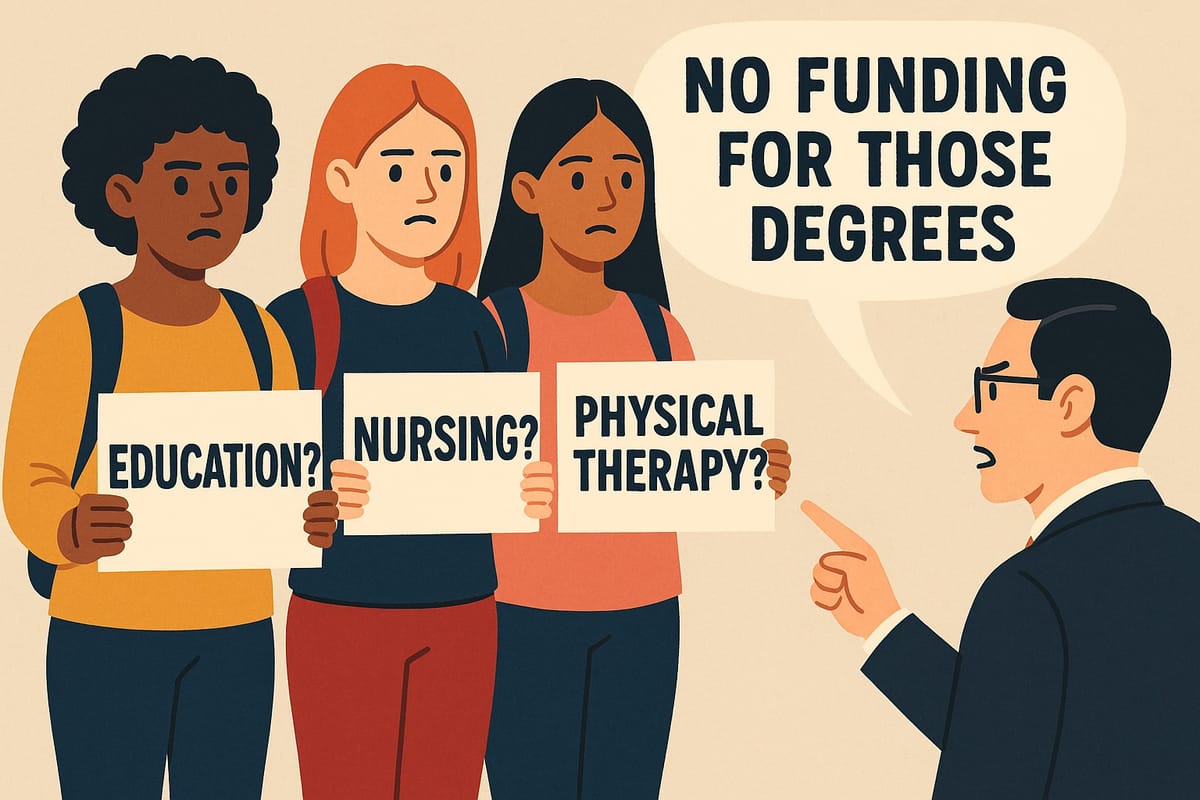
The Trump administration has sparked widespread controversy and concern among healthcare professionals, educators, and students with its new restrictive definition of “professional degrees” under the Department of Education’s implementation of the “One Big Beautiful Bill Act” (OBBBA). This policy change, set to take effect in July 2026, fundamentally alters federal student loan eligibility and has significant implications for multiple critical professions.
The Department of Education has implemented a narrow definition of “professional degree” programs as part of President Trump’s One Big Beautiful Bill Act, which eliminates the Grad PLUS loan program and creates new borrowing caps for graduate students. Under the new law, students in “professional degree” programs can borrow up to $50,000 annually with a lifetime cap of $200,000, while students in other graduate programs are limited to $20,500 annually with a $100,000 lifetime cap.
The changes were developed through a negotiated rulemaking process called the Reimagining and Improving Student Education (RISE) Committee, which reached consensus in November 2025 after two weeks of discussions. The administration frames these changes as necessary to “place commonsense limits and guardrails on future student loan borrowing and simplify the federal student loan repayment system” while holding universities accountable for outcomes.
The Department of Education now recognizes only 11 specific fields as “professional programs”: medicine, pharmacy, dentistry, optometry, law, veterinary medicine, osteopathic medicine, podiatry, chiropractic, theology, and clinical psychology. These programs qualify students for the higher borrowing limits of $50,000 annually and $200,000 in total.
The classification is based on four-digit CIP (Classification of Instructional Programs) codes developed by the federal government to classify programs across the United States. This technical approach means that programs sharing the same CIP code as the listed examples will also qualify for professional degree status.
The new policy excludes numerous fields that many consider essential professions, creating significant concern among professional organizations and educational institutions. The degrees no longer classified as “professional” include:
The reclassification creates a stark financial divide for graduate students. Students pursuing excluded degrees will face significantly reduced borrowing capacity, with many programs requiring far more than the new $20,500 annual limit. For context, while 72 percent of Master of Social Work students borrow less than the standard limit, and 84 percent of Doctor of Education students stay within standard limits, many healthcare programs require substantially higher borrowing.
The elimination of the GRAD PLUS program, which previously allowed unlimited borrowing up to the full cost of attendance, represents a fundamental shift in graduate education financing. Students in excluded programs will need to seek private loans, work additional hours, or potentially abandon their educational goals entirely.
The policy’s impact on healthcare professions is particularly concerning given existing workforce shortages. Jennifer Mensik Kennedy, president of the American Nurses Association, warned that “limiting nurses’ access to funding for graduate education threatens the very foundation of patient care,” particularly in rural and underserved areas where advanced practice registered nurses provide essential care.
Wisconsin officials highlighted that nurse practitioners and physician assistants provide significant healthcare services, and reduced financial aid access threatens primary care delivery. Patricia Pittman, a professor at George Washington University, called the policy “unconscionable” during a period when the government should focus on retaining licensed nurses.
Over 260,000 students are currently enrolled in Bachelor of Science in Nursing programs, with tens of thousands more in advanced tracks. The policy change could significantly reduce the pipeline of healthcare professionals at a time when demand is increasing due to an aging population.
Critics have raised concerns about the policy’s disproportionate impact on women, noting that many excluded fields like healthcare, counseling, and social work are dominated by women. Senate candidate Amy McGrath questioned how “a theologian is considered more ‘professional’ than a nurse practitioner” and suggested the policy represents “a way to quietly push women out of professional careers.”
The policy also affects students from diverse backgrounds who rely heavily on federal financial aid. Kim Litwack, dean at the University of Wisconsin-Milwaukee, noted that nearly all graduate students depend on federal financial aid because they reduce work hours to return to school.
Professional organizations have mobilized in opposition to the changes. The American Association of Colleges of Nursing stated that “excluding nursing from the definition of professional degree programs disregards decades of progress toward parity across the health professions.” Public health organizations expressed being “deeply concerned and profoundly disappointed,” calling the exclusion “short-sighted and dangerous” when health threats are escalating.
The American Council on Education has advocated for expanding the definition to include nursing, architecture, accounting, occupational therapy, physical therapy, special education, public health, and social work. Multiple organizations have started petitions and lobbying efforts to reverse the decision.
The Department of Education dismissed criticism as “fake news,” with press secretary Ellen Keast stating that the definition aligns with “historical precedent” and that institutions are “crying wolf over regulations that never existed because their unlimited tuition ride on the taxpayer dime is over.”
Under Secretary of Education Nicholas Kent emphasized that the changes will “drive a sea change in higher education by holding universities accountable for outcomes and putting significant downward pressure on the cost of tuition.”
The policy changes are scheduled to take effect on July 1, 2026, with final regulations expected in early 2026 following a public comment period. Students who received Grad PLUS loans by June 30, 2026, will have access to those loans for up to three additional years during the transition period.
The professional degree reclassification is part of a larger education policy shift under the Trump administration. The administration has emphasized “skills over degrees” in federal hiring and reduced the weight of degree credentials for many jobs while preserving degree requirements for certain fields like medicine and law. Supporters argue the limits prevent students from accumulating “insurmountable debt to finance degrees that do not pay off.”
The policy’s long-term effects could be substantial. Kevin Kinser from Pennsylvania State University suggested the goal is “to limit the exposure of the government to loans that will not be repaid, whether because of default or through public service loan forgiveness.” However, Peter Lake from Stetson Law warned that narrowly defining professions could create “barriers to opportunities for students seeking careers in what is otherwise considered a profession under other legal standards.”
Experts warn that reduced funding could lead to fewer graduates, higher healthcare costs, and strained hospital systems nationwide. The policy may force institutions to either reduce tuition costs or risk losing students who cannot afford private loan alternatives.
The Department of Education is expected to issue a Notice of Proposed Rulemaking in the coming weeks, which will open a 30-day public comment period. Professional organizations, educational institutions, and advocacy groups are preparing comprehensive responses and potential legal challenges.
Some states are responding with their own funding initiatives. Wisconsin, for example, has allocated $5 million biennially for a nurse educator program that forgives loans for graduates who commit to teaching nursing for three years.
The controversy surrounding this policy reflects broader debates about the value of higher education, the role of federal student aid, and how to balance fiscal responsibility with workforce development needs. As implementation approaches, the debate is likely to intensify, with significant implications for students, institutions, and the critical professions affected by these changes.
The ultimate impact will depend not only on the final regulatory language but also on how institutions, states, and professional organizations adapt to support students in affected fields. For prospective students in excluded programs, the policy change represents a fundamental shift in the economics of graduate education that may require careful financial planning and consideration of alternative funding sources.
The reclassification of professional degrees under the Trump administration’s One Big Beautiful Bill Act represents one of the most significant changes to graduate education financing in decades. While supporters argue it will control costs and improve outcomes, critics warn it could undermine critical professions and exacerbate existing workforce shortages in healthcare, education, and social services. The coming months will be crucial as stakeholders work to shape the final implementation and potentially mitigate the policy’s most concerning effects.