
The Radical Democracy of Love
Martin Luther King Jr.'s Vision for America's Transformation

Martin Luther King Jr.'s Vision for America's Transformation
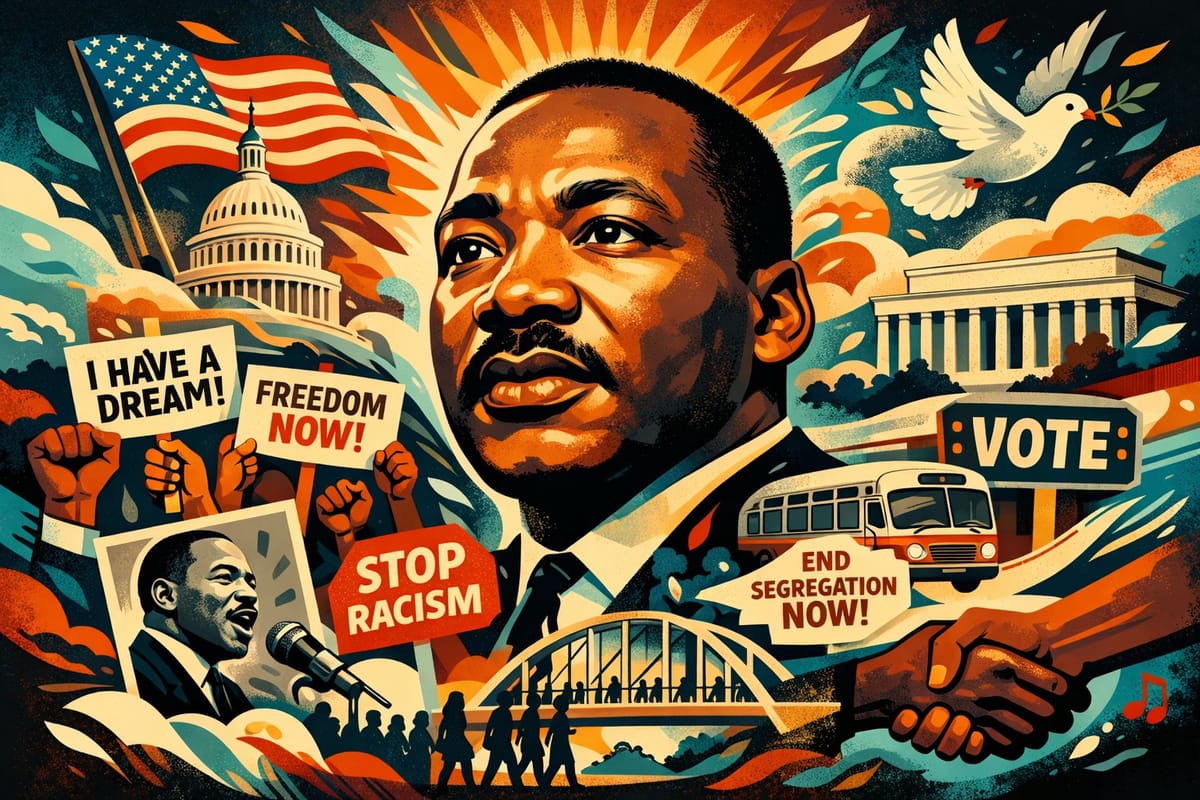
Martin Luther King Jr.’s vision for America transcended the immediate struggles of the civil rights movement to encompass a fundamental reimagining of democratic society itself. His philosophical framework represented not merely a call for racial integration, but a comprehensive blueprint for systemic transformation that addressed the interconnected nature of injustice across economic, social, and political dimensions. King understood that achieving true equality required more than legislative victories; it demanded a revolution in consciousness that would replace systems of exploitation with what he termed the “beloved community”—a society grounded in justice, equal opportunity, and love as a social force.
The foundation of King’s transformative vision rested upon his understanding that America’s democratic promise remained unfulfilled not due to individual moral failings alone, but because of structural arrangements that systematically concentrated power while excluding vast populations from meaningful participation. His analysis recognized that racial oppression, economic exploitation, and militarism formed an interconnected trinity of evils that reinforced each other through institutional mechanisms designed to preserve existing hierarchies. This systemic perspective led King to advocate for fundamental changes in how American society organized itself, moving beyond surface-level reforms toward addressing the root causes of injustice.
Central to King’s philosophy was his conviction that nonviolent resistance represented both a tactical approach and a moral imperative that could transform not only external conditions but the consciousness of all participants in the struggle for justice. He viewed nonviolence as a method for creating what he called “constructive tension”—situations that would force society to confront its contradictions and choose between maintaining systems of oppression or embracing genuine democracy. This approach recognized that lasting change required winning the hearts and minds of opponents rather than simply defeating them, thereby creating the possibility for true reconciliation and shared commitment to justice.
King’s economic vision challenged the assumption that poverty and inequality represented inevitable features of democratic society. Drawing inspiration from both Christian social gospel traditions and democratic socialist principles, he argued that true freedom required not only civil and political rights but economic security and opportunity for all citizens. His later campaigns increasingly focused on what he termed “economic justice,” recognizing that political equality remained hollow without the material foundation necessary for meaningful participation in democratic life. This perspective led him to advocate for guaranteed employment, living wages, and wealth redistribution as essential components of genuine democracy.
The concept of the beloved community served as King’s ultimate goal for American society—a vision that went far beyond simple tolerance or coexistence to envision a society characterized by genuine integration, mutual respect, and shared commitment to the common good. In this framework, diversity became a source of strength rather than division, with different communities contributing their unique gifts toward collective flourishing. King understood that achieving this vision required dismantling not only legal segregation but the deeper psychological and cultural barriers that prevented Americans from recognizing their fundamental interdependence and shared humanity.
King’s understanding of democracy emphasized participation, empowerment, and the cultivation of civic virtue among all citizens rather than mere procedural compliance with electoral processes. He recognized that meaningful democracy required creating conditions where every person could develop their full potential and contribute to society’s well-being. This vision challenged both the limited conception of democracy as majority rule and the assumption that democratic participation should be restricted to those with economic or social privilege. Instead, King advocated for what might be termed “participatory democracy” that actively engaged all citizens in shaping their communities and nation.
The international dimension of King’s vision reflected his understanding that America’s struggle for justice occurred within a global context of decolonization, human rights movements, and emerging consciousness about universal human dignity. He recognized that America’s credibility as a democratic leader depended upon fulfilling its promises to its own citizens, particularly those who had been systematically excluded from full participation. This perspective led him to connect the American civil rights movement with liberation struggles worldwide, arguing that injustice anywhere threatened justice everywhere through the interconnectedness of human communities.
King’s philosophical framework drew upon multiple intellectual traditions to create a synthesis that could address the complexity of modern democratic challenges. His integration of Christian theology, Gandhian nonviolence, American democratic ideals, and social scientific understanding of institutional dynamics provided a comprehensive approach to social transformation that addressed both individual and systemic dimensions of change. This synthetic approach enabled him to speak to diverse audiences while maintaining consistency in his core message about human dignity, justice, and the possibility of beloved community.
The educational implications of King’s vision emphasized the crucial role of critical consciousness in maintaining democratic society. He understood that sustaining meaningful democracy required citizens capable of independent thought, moral reasoning, and commitment to justice rather than mere compliance with authority. This perspective led him to advocate for educational approaches that would develop students’ capacity for ethical reflection, social analysis, and civic engagement rather than simply preparing them for economic productivity within existing systems.
King’s approach to institutional change recognized that transforming society required working simultaneously on multiple levels—changing laws and policies, shifting cultural attitudes and practices, and developing alternative institutional arrangements that could embody democratic values more fully. He understood that sustainable change required creating new institutional forms that could maintain justice over time rather than relying solely on the good intentions of individuals within unchanged systems. This perspective led him to support various experiments in cooperative economics, community organizing, and alternative educational approaches.
The spiritual dimension of King’s vision provided both motivation and guidance for the difficult work of social transformation. His understanding of love as a social force—what he termed “agape”—offered a framework for maintaining hope and commitment to justice even in the face of seemingly insurmountable obstacles. This spiritual foundation enabled him to envision possibilities beyond existing realities while providing practical guidance for how to work toward transformation through methods consistent with desired outcomes.
King’s analysis of power relationships in American society revealed his sophisticated understanding of how concentrated wealth and privilege functioned to maintain systemic inequalities. He recognized that achieving genuine democracy required redistributing not only economic resources but political power itself, creating mechanisms for authentic participation by those who had been systematically excluded from decision-making processes. This analysis led him to support various forms of community organizing and grassroots political engagement as essential components of democratic renewal.
The role of moral leadership in King’s vision emphasized the importance of individuals and institutions willing to articulate and embody higher possibilities for human community. He understood that social transformation required leaders capable of inspiring others to transcend narrow self-interest in favor of broader commitments to justice and human flourishing. This conception of leadership emphasized service, sacrifice, and moral courage rather than mere political effectiveness or personal advancement.
King’s understanding of American history revealed both the democratic potential inherent in founding ideals and the systematic ways those ideals had been betrayed through the exclusion and exploitation of various groups. His approach sought to claim America’s best traditions while honestly confronting the gap between ideals and reality. This historical perspective enabled him to appeal to shared values while demanding fundamental changes in how those values were implemented in practice.
The economic dimensions of King’s later thinking increasingly emphasized the connections between racial justice and broader patterns of economic inequality that affected all working people. His analysis recognized that achieving racial equality required addressing the systemic features of American capitalism that concentrated wealth and power while creating artificial scarcity for the majority of citizens. This perspective led him to advocate for policies like guaranteed income, full employment, and democratic control over economic decisions as essential components of genuine freedom.
King’s vision for international relations reflected his understanding that true security required justice rather than military dominance, and that America’s global leadership depended upon demonstrating commitment to human rights and democratic values in practice. His opposition to the Vietnam War emerged from this framework, recognizing that America could not credibly promote democracy abroad while denying it to citizens at home, nor could it build genuine security through violence and domination of other peoples.
The prophetic dimension of King’s leadership involved his willingness to speak uncomfortable truths about American society while maintaining hope for transformation. He understood that genuine love sometimes required challenging beloved institutions and individuals to live up to their highest possibilities rather than accepting current limitations as inevitable. This prophetic stance enabled him to maintain credibility with both those seeking radical change and those committed to existing institutions by appealing to shared values while demanding their fuller implementation.
King’s approach to coalition building recognized that achieving fundamental change required bringing together diverse groups around shared commitments to justice rather than attempting to maintain unity by avoiding difficult questions. His later efforts to build alliances between civil rights organizations, labor unions, religious communities, and anti-war activists reflected his understanding that the forces maintaining injustice were sufficiently powerful that only broad-based movements could challenge them effectively.
The psychological dimensions of King’s vision addressed the ways that systems of oppression damaged both oppressed and oppressor communities by preventing the full development of human potential and authentic relationship. His analysis recognized that achieving beloved community required healing the psychological wounds created by centuries of injustice while creating new patterns of relationship based on mutual respect and shared commitment to justice. This therapeutic dimension of his vision provided frameworks for addressing the emotional and spiritual work necessary for genuine reconciliation.
King’s understanding of the relationship between means and ends emphasized that the methods used to achieve social change must be consistent with the goals sought, since means and ends were interconnected parts of the same moral reality. This principle led him to reject approaches that might achieve short-term gains through violence or deception, arguing that such methods would ultimately corrupt the movement and prevent achievement of genuine transformation. His commitment to nonviolence reflected not merely tactical considerations but fundamental conviction about the nature of justice and human dignity.
The technological implications of King’s vision, while not extensively developed in his own writings, suggest important questions about how democratic values should guide the development and deployment of new technologies. His emphasis on human dignity, participatory decision-making, and equitable distribution of resources provides frameworks for evaluating whether technological developments serve to enhance human flourishing or to concentrate power and deepen inequalities.
King’s vision for American democracy required what he termed a “revolution of values” that would prioritize human dignity over profit, cooperation over competition, and justice over order. This transformation involved not only changing policies and institutions but fundamentally reordering social priorities to reflect commitment to the common good rather than narrow self-interest. He understood that achieving this reorientation required sustained education, organization, and spiritual development among citizens committed to democratic transformation.
The environmental implications of King’s thinking, while not explicitly developed during his lifetime, emerge naturally from his emphasis on interdependence, stewardship, and responsibility for future generations. His understanding that injustice anywhere threatens justice everywhere provides a framework for recognizing that environmental degradation represents a form of injustice that particularly affects those with least political and economic power to protect themselves.
King’s analysis of media and communication recognized the crucial role that information systems play in either supporting or undermining democratic participation. He understood that achieving genuine democracy required media institutions capable of providing citizens with accurate information and diverse perspectives rather than serving primarily as mechanisms for maintaining existing power arrangements. This analysis anticipated contemporary concerns about media concentration and the challenges of maintaining informed citizenry in complex societies.
The urban implications of King’s vision addressed the particular challenges facing American cities as sites of both tremendous diversity and concentrated inequality. His work in Chicago and other northern cities revealed his understanding that achieving integration required addressing not only legal barriers but the economic and social arrangements that maintained residential segregation and unequal access to opportunity. His approach emphasized community development, economic empowerment, and political participation as essential components of urban transformation.
King’s understanding of generational responsibility emphasized the obligation to create conditions that would enable future generations to continue the work of building beloved community rather than simply achieving immediate victories. This long-term perspective shaped his approach to institution building, education, and leadership development, recognizing that sustainable change required creating mechanisms for ongoing renewal and adaptation rather than relying on charismatic leadership alone.
The global implications of King’s vision reflected his understanding that the struggle for justice in America was part of a worldwide movement toward greater human freedom and dignity. His connections with liberation movements in Africa, Asia, and Latin America revealed his recognition that injustice represented a global phenomenon requiring international cooperation and solidarity among those committed to human rights and democratic values.
King’s approach to religious diversity within democratic society emphasized the potential for different faith traditions to contribute to common commitments to justice and human dignity rather than viewing religious differences as inevitable sources of conflict. His ability to work with leaders from various religious backgrounds while maintaining his own Christian identity provided a model for how religious conviction could enhance rather than undermine democratic participation.
The philosophical sophistication of King’s vision enabled him to address complex questions about the relationship between individual rights and collective responsibility, the balance between stability and change, and the possibility of achieving justice through democratic processes. His synthesis of liberal democratic theory, Christian social ethics, and revolutionary analysis provided frameworks for thinking about social transformation that avoided both naive optimism and cynical despair.
King’s legacy for contemporary America lies not merely in the specific victories achieved by the civil rights movement but in his demonstration that ordinary citizens committed to justice can challenge and transform seemingly immutable systems of oppression. His vision continues to provide guidance for addressing contemporary challenges by emphasizing the interconnectedness of justice issues, the importance of moral leadership, and the possibility of creating beloved community through sustained commitment to nonviolent transformation.
The continuing relevance of King’s vision emerges from his recognition that democracy represents an ongoing aspiration rather than a completed achievement, requiring constant vigilance, renewal, and expansion to include those who remain excluded from full participation. His framework provides tools for analyzing contemporary threats to democratic institutions while maintaining hope for their transformation through organized citizen action guided by moral vision and committed to human dignity.
This comprehensive analysis examines Martin Luther King Jr.’s transformative vision for American society, exploring how his philosophical framework addressed the interconnected nature of racial, economic, and political injustices while offering a blueprint for systemic change through nonviolent resistance and the creation of beloved community grounded in justice, participation, and human dignity.