
The Final Command
How George Orwell's Warning About Truth Manipulation Lives in Contemporary American Democracy

How George Orwell's Warning About Truth Manipulation Lives in Contemporary American Democracy
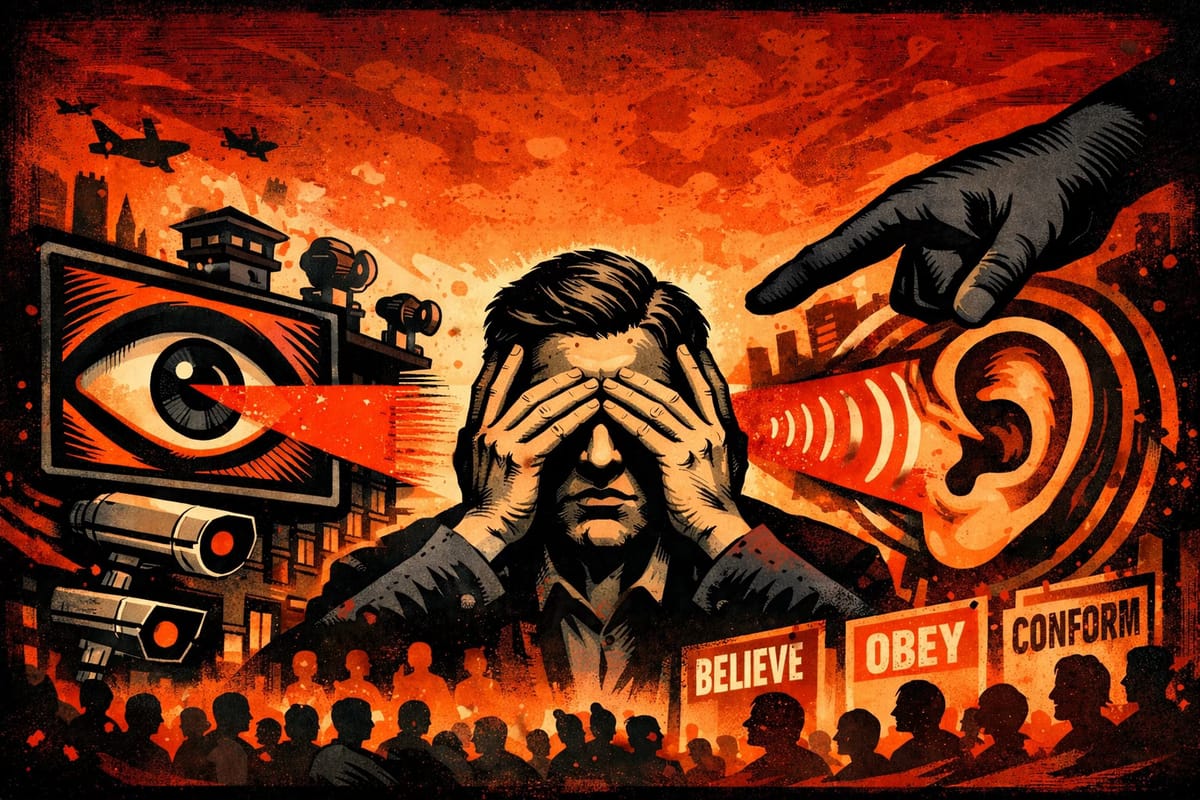
The chilling prophesy embedded within George Orwell’s dystopian masterpiece 1984 has found disturbing resonance in contemporary American political discourse. When Orwell wrote that “The Party told you to reject the evidence of your eyes and ears. It was their final, most essential command,” he articulated what he understood to be the ultimate mechanism of totalitarian control: the systematic destruction of citizens’ capacity to distinguish truth from falsehood. This warning, issued in 1949 from the ashes of World War II and the emergence of Cold War authoritarianism, has acquired urgent relevance as American democratic institutions face unprecedented assaults on the very concept of shared truth.
The connection between Orwell’s fictional warning and contemporary American reality became crystalline on July 24, 2018, when then-President Donald Trump addressed the Veterans of Foreign Wars national convention in Kansas City. Defending his tariff policies against mounting evidence of their economic damage, Trump issued his own version of Orwell’s final command: “Just remember, what you’re seeing and what you’re reading is not what’s happening.” The parallels were so striking that political observers immediately invoked Orwell’s prescient analysis, recognizing in Trump’s words the same fundamental assault on empirical reality that characterized the totalitarian regimes Orwell had studied and feared.
This convergence between Orwellian prophecy and American political reality represents more than mere literary coincidence. It signals a systematic campaign to undermine the epistemological foundations of democratic governance—the shared understanding of factual reality that enables citizens to make informed decisions about their government. The Trump administration’s approach to truth distortion employed tactics that democracy scholars recognize as characteristic of competitive authoritarianism: the gradual erosion of democratic norms through legal and semi-legal means rather than dramatic coups or violent seizures of power.
Orwell’s concept of “doublethink”—the capacity to hold two contradictory beliefs simultaneously while accepting both as truth—provides a critical framework for understanding contemporary information manipulation tactics. In 1984, doublethink served as the Party’s primary mechanism for reality control, enabling citizens to accept obvious contradictions without experiencing cognitive dissonance. Orwell described this process with chilling precision: “To know and not to know, to be conscious of complete truthfulness while telling carefully constructed lies, to hold simultaneously two opinions which cancelled out, knowing them to be contradictory and believing in both of them.”
The Trump administration’s information strategy demonstrated a sophisticated understanding of doublethink’s practical applications. Rather than simply denying inconvenient facts, the administration created parallel information ecosystems where contradictory versions of reality could coexist without apparent conflict. This approach enabled supporters to simultaneously acknowledge factual evidence while accepting narratives that directly contradicted that evidence, precisely the psychological mechanism Orwell had identified as central to totalitarian control.
Academic research has documented the effectiveness of this approach in fragmenting Americans’ shared understanding of basic facts. Studies conducted during and after the Trump administration revealed that exposure to Trump’s messaging increased believers’ willingness to accept contradictory information, particularly when that information was presented by Trump himself. Research published in the American Journal of Sociology found that voters explicitly provided moral justification for politicians’ false statements, suggesting that Trump supporters often recognized the factual inaccuracy of his claims while simultaneously defending those claims as expressing deeper political “truths.”
This phenomenon extends beyond simple partisan loyalty into the realm of cognitive manipulation. The systematic nature of false claims—what The Washington Post documented as over 30,000 false or misleading statements during Trump’s presidency—created what researcher Peter Pomerantsev termed “the fog of unknowability.” By overwhelming citizens with a constant stream of contradictory information, this approach induced the psychological state Orwell had described: the erosion of citizens’ confidence in their own capacity to distinguish truth from falsehood.
The strategic deployment of information overload serves multiple authoritarian objectives simultaneously. First, it exhausts citizens’ cognitive resources for fact-checking and verification, making them more susceptible to simplified narratives that promise clarity amid chaos. Second, it undermines confidence in traditional information intermediaries like journalism and academic institutions, creating space for alternative authority structures centered on political leaders. Third, it normalizes contradiction itself, making citizens more accepting of obvious falsehoods as long as those falsehoods serve broader emotional or political needs.
The Trump administration’s approach to truth distortion represented a qualitative departure from traditional political rhetoric. While politicians throughout American history have engaged in selective presentation of facts, hyperbole, and strategic omissions, the systematic denial of observable reality marked a fundamental shift in the relationship between democratic governance and factual truth. This shift becomes visible when examining specific instances where the administration directly contradicted empirical evidence that citizens could verify through their own observation.
The pattern began immediately with the administration’s claims about inauguration crowd sizes, despite photographic evidence clearly documenting smaller attendance than claimed. White House Press Secretary Sean Spicer’s insistence on obviously false attendance figures established a template for subsequent information manipulation: the direct contradiction of observable reality accompanied by aggressive attacks on anyone questioning the official narrative. When challenged on these demonstrably false claims, senior advisor Kellyanne Conway introduced the concept of “alternative facts,” providing a linguistic framework for legitimizing contradictory versions of verifiable events.
This initial assault on observable reality served as a test case for more consequential truth distortions. The administration’s response to the COVID-19 pandemic demonstrated how reality denial could produce material harm to citizens’ health and safety. Despite mounting evidence of the virus’s severity and transmissibility, the administration consistently promoted narratives that contradicted scientific consensus and observable reality. These included claims that the virus would “disappear like a miracle,” that warm weather would eliminate transmission, that hydroxychloroquine provided effective treatment despite clinical evidence to the contrary, and that increasing case numbers reflected expanded testing rather than actual disease spread.
The systematic nature of these reality distortions became particularly apparent during the 2020 election and its aftermath. Despite extensive evidence from multiple sources confirming the election’s integrity—including Republican state officials, federal judges appointed by Trump himself, and the administration’s own Department of Homeland Security—Trump promoted what he characterized as the “Stop the Steal” narrative. This campaign represented perhaps the most comprehensive assault on empirical reality in American political history, culminating in the January 6, 2021 attack on the Capitol building.
Research from Harvard University’s Berkman Klein Center documented how the “Stop the Steal” narrative functioned as what scholars term a “common knowledge attack” on democracy. By systematically promoting false claims about election fraud across multiple platforms and information channels, the campaign created an alternative information ecosystem where Trump’s electoral defeat could be reinterpreted as evidence of systemic corruption rather than legitimate democratic outcomes. This approach demonstrated the practical application of Orwell’s insight about reality control: by controlling information flow, authoritarian movements can reshape citizens’ understanding of fundamental political realities.
The effectiveness of these reality distortion campaigns depended heavily on the systematic discrediting of competing information sources. The Trump administration’s attacks on what it characterized as “fake news” media served multiple strategic objectives: delegitimizing sources of independent verification, creating justification for citizens to ignore contradictory evidence, and establishing the administration itself as the primary authority for determining truth. This approach directly paralleled Orwell’s description of how the Party maintained control over truth by eliminating external reference points for reality verification.
The success of systematic truth distortion in American democracy reflects deeper institutional vulnerabilities that democracy scholars have identified as characteristic of competitive authoritarianism. Harvard political scientists Steven Levitsky and Daniel Ziblatt argue in their seminal work How Democracies Die that modern democratic breakdown typically occurs through legal and semi-legal means rather than dramatic military coups. This process involves what they term the “gradual erosion of long-standing political norms” combined with the “slow, steady weakening of critical institutions, such as the judiciary and the press.”
The Trump administration’s approach to truth manipulation succeeded partly because it exploited institutional arrangements that were designed for a different information environment. Democratic institutions developed during the twentieth century assumed the existence of relatively centralized, professional information intermediaries—newspapers, television networks, and academic institutions—that could serve as arbiters of factual accuracy. The fragmentation of information ecosystems through digital technology created opportunities for political actors to bypass these traditional gatekeeping mechanisms and communicate directly with supporters through unmediated channels.
This institutional bypass enabled what Levitsky and Ziblatt identify as one of the key warning signs of authoritarian behavior: the systematic delegitimization of democratic institutions and processes. By characterizing traditional media as “enemies of the people,” attacking the independence of federal law enforcement agencies, and questioning the integrity of electoral institutions themselves, the Trump administration followed what scholars recognize as a standard authoritarian playbook for undermining democratic accountability.
The complicity of broader institutional actors proved crucial for legitimizing reality distortion campaigns. Research documented how many Republican elected officials privately acknowledged the falsity of claims about election fraud while publicly supporting or remaining silent about those claims. This pattern reflected what Orwell had identified as a key mechanism of totalitarian control: the requirement that institutional actors participate in obvious falsehoods as a demonstration of loyalty rather than conviction.
Social media platforms initially attempted to moderate false information through content labeling and fact-checking initiatives, but these efforts proved inadequate for addressing systematic disinformation campaigns. Research published in the Harvard Kennedy School Misinformation Review found that Twitter’s “disputed” tags actually increased belief in false claims among Trump supporters with high political knowledge, suggesting that traditional fact-checking approaches were insufficient for addressing politically motivated reality distortion.
The inadequacy of institutional responses to systematic truth distortion reflected what democracy scholars term the “democracy versus democracy” problem: institutions designed to protect democratic values through democratic means may be insufficient for addressing threats that exploit democratic processes themselves. When political actors systematically abuse democratic institutions while maintaining popular support, traditional checks and balances may actually legitimize rather than constrain authoritarian behavior.
The Trump administration’s truth distortion campaigns did not occur in isolation but as part of a broader global trend toward competitive authoritarianism and democratic backsliding. International democracy monitoring organizations documented significant erosion in American democratic institutions during this period, with Freedom House downgrading the United States’ democracy score and placing it in the same category as newer, less stable democracies like Croatia and Mongolia.
This international context reveals how systematic truth distortion serves broader authoritarian objectives beyond domestic political control. Research from the European Parliament documented how Trump’s promotion of false claims about election fraud aligned with and amplified propaganda narratives promoted by foreign authoritarian regimes, particularly Russia and China. Russian state media eagerly amplified Trump’s claims about election fraud while Chinese media portrayed American electoral chaos as evidence of democratic system failure.
The convergence between domestic truth distortion and foreign propaganda reflects what scholars term “authoritarian learning”—the process by which authoritarian movements study and adapt successful techniques for undermining democratic institutions across different national contexts. Trump’s systematic attacks on electoral integrity followed patterns previously documented in Hungary under Viktor Orbán, Poland under Andrzej Duda, and Venezuela under Hugo Chávez, suggesting the emergence of a globalized authoritarian toolkit for democratic subversion.
International research on competitive authoritarianism reveals how truth distortion campaigns typically escalate over time, moving from attacks on media and civil society to more direct assaults on electoral and judicial institutions. The trajectory observed in the United States—beginning with attacks on press credibility, progressing through systematic promotion of false information, and culminating in direct challenges to electoral outcomes—parallels patterns documented in other democracies that experienced significant backsliding.
The global nature of truth distortion campaigns also reflects technological changes that have fundamentally altered information environments worldwide. Digital platforms enable rapid propagation of false information across national boundaries while making traditional regulatory approaches increasingly ineffective. Authoritarian movements have proven particularly adept at exploiting these technological changes to create transnational networks for reality distortion that operate largely outside conventional institutional constraints.
This international dimension reveals the stakes involved in addressing domestic truth distortion campaigns. When the United States—historically viewed as a model for democratic governance—experiences systematic assaults on factual truth, it provides legitimacy for similar campaigns in other countries while undermining global norms supporting press freedom and electoral integrity. Research documented how international observers of American politics explicitly cited Trump’s “fake news” rhetoric to justify their own attacks on independent media and civil society organizations.
The effectiveness of systematic truth distortion campaigns depends heavily on psychological mechanisms that researchers have identified as central to human information processing. Rather than functioning as neutral evaluators of evidence, humans typically engage in “motivated reasoning”—interpreting information in ways that confirm pre-existing beliefs and identity commitments rather than updating beliefs based on new evidence.
Research conducted during the Trump administration revealed how motivated reasoning operates in highly polarized political environments. Studies found that partisan identity often functioned as a stronger predictor of belief in false claims than education level, cognitive sophistication, or exposure to corrective information. This suggests that truth distortion campaigns succeed not by convincing citizens that false information is factually accurate, but by providing psychological justification for accepting false information as legitimate.
The concept of “motivated reasoning” helps explain how citizens can simultaneously acknowledge factual evidence while supporting narratives that contradict that evidence. Research published in Political Psychology documented how Trump supporters often recognized the factual inaccuracy of specific claims while defending those claims as expressing deeper political truths or serving legitimate strategic objectives. This pattern closely parallels Orwell’s description of doublethink as the capacity to hold contradictory beliefs without experiencing psychological discomfort.
Social psychology research reveals how group identity commitment can override individual cognitive assessment of evidence. When false information comes from trusted group leaders and serves group solidarity objectives, individuals may experience accepting that information as an expression of loyalty rather than gullibility. This dynamic enables truth distortion campaigns to exploit social cohesion mechanisms for political manipulation, turning citizens’ natural desire for community belonging into a vector for reality distortion.
The systematic nature of false claims creates additional psychological pressures for acceptance through what researchers term “illusory truth effects” and “repetition bias.” When false information is repeated frequently through multiple channels, citizens may begin to experience that information as familiar and therefore credible, regardless of its factual accuracy. This mechanism enables systematic lying to gradually reshape citizens’ baseline assumptions about reality through simple exposure rather than persuasion.
Cognitive science research also documents how information overload can impair citizens’ capacity for critical evaluation of competing claims. When faced with overwhelming amounts of contradictory information, many individuals resort to simplified heuristics for determining credibility—such as source authority or emotional resonance—rather than engaging in detailed fact-checking. Truth distortion campaigns deliberately exploit this cognitive limitation by creating information environments too complex and chaotic for most citizens to navigate independently.
The contemporary landscape for truth distortion differs fundamentally from the information environment Orwell envisioned in 1984. Rather than centralized state control over information, modern truth distortion operates through what scholars term “information pollution”—the systematic injection of false information into decentralized communication networks that overwhelm citizens’ capacity for verification and fact-checking.
Digital advertising infrastructure provides the economic foundation for large-scale disinformation campaigns. Research from the Center for Countering Digital Hate documented how false information websites generate substantial revenue through programmatic advertising, creating financial incentives for producing and distributing misleading content. This economic model enables disinformation producers to operate sustainably while remaining largely outside traditional regulatory frameworks.
Social media algorithms designed to maximize user engagement tend to amplify emotionally provocative content, regardless of factual accuracy. Research from MIT documented how false information spreads approximately six times faster than accurate information on platforms like Twitter, partly because false stories tend to be more novel and emotionally engaging than factual reporting. This algorithmic bias creates systematic advantages for false information in competitive information environments.
The emergence of artificial intelligence technologies for content generation has further complicated efforts to maintain truth-based information ecosystems. “Deepfake” technology enables the creation of convincing audio and video content showing public figures saying or doing things that never occurred. While this technology remained relatively limited during the Trump administration, its rapid development suggests that future truth distortion campaigns will have access to unprecedented tools for manufacturing false evidence.
The economic infrastructure supporting truth distortion also includes what researchers term “astroturfing”—the creation of artificial grassroots movements through paid social media campaigns. Research documented how political actors can create the appearance of organic citizen support for particular narratives through coordinated networks of fake accounts and automated content generation. This approach enables relatively small groups to create the appearance of widespread popular support for false claims about political events.
The technological infrastructure for truth distortion has also benefited from the broader erosion of traditional media economics. As local newspapers and other independent information sources face financial pressure, many communities lack accessible sources for local fact-checking and verification. This information vacuum creates opportunities for political actors to fill information gaps with partisan narratives rather than independent journalism.
Understanding these economic and technological dynamics reveals why traditional approaches to combating false information—such as fact-checking and content moderation—have proven insufficient for addressing systematic truth distortion campaigns. When false information enjoys structural advantages in digital information environments and generates substantial economic returns, addressing the problem requires systemic rather than content-specific interventions.
Traditional media institutions faced unprecedented challenges in responding to systematic government truth distortion during the Trump administration. Professional journalism norms emphasizing objectivity and balance proved inadequate for addressing situations where one party to political disputes systematically promoted false information. This created what scholars term the “false equivalency” problem: treating obviously false claims as deserving equal consideration with factual evidence in the name of journalistic balance.
Many news organizations attempted to address this challenge through expanded fact-checking initiatives and more direct characterization of false statements as “lies” rather than “misstatements” or “inaccuracies.” However, research suggests these approaches may have inadvertently amplified false information by repeating false claims in the process of debunking them. Studies documented how fact-checking articles often increased public awareness of false claims without proportionally increasing belief in accurate information.
The economic structure of commercial media created additional complications for addressing systematic truth distortion. News organizations depend on audience engagement for advertising revenue, and false or provocative claims often generate higher engagement than routine factual reporting. This created perverse incentives for covering false claims extensively while providing less coverage for complex but important policy issues that generate less audience interest.
Cable news networks faced particular challenges due to their dependence on live programming formats that required immediate response to emerging claims. The real-time nature of this coverage often prevented thorough fact-checking and verification, while the competitive pressure to provide instant analysis sometimes led to amplification of false claims before their accuracy could be established.
Social media platforms initially attempted to address false information through content labeling and fact-checking partnerships, but these efforts proved inadequate for systematic disinformation campaigns. Research found that content warnings and fact-check labels had minimal effect on belief in false information among strongly partisan audiences, while sometimes triggering “reactance” effects that actually increased belief in false claims.
The inadequacy of corporate media responses reflected deeper structural limitations in information markets. When significant portions of the audience actively seek information that confirms pre-existing beliefs rather than challenging those beliefs, market incentives may favor confirmation bias over accuracy. This creates what economists term “market failure” in information markets, where consumer preferences do not align with broader social needs for accurate information.
These limitations revealed the need for systemic approaches to supporting factual information ecosystems that go beyond content-specific interventions. Rather than simply fact-checking individual false claims, democracy advocates argue for broader institutional changes that would restructure incentives in information markets to favor accuracy over engagement.
Despite the systematic nature of truth distortion campaigns during the Trump administration, American democratic institutions demonstrated significant resilience in key moments. The 2020 election provided a critical test case for institutional resistance to reality distortion, as state and local officials from both parties upheld electoral processes despite unprecedented pressure to alter or misrepresent election results.
State election officials in contested swing states played particularly crucial roles in maintaining electoral integrity. Republican officials like Georgia Secretary of State Brad Raffensperger and Arizona Governor Doug Ducey faced enormous political pressure to validate false claims about election fraud but ultimately certified accurate election results. This institutional resistance demonstrated how democratic norms can persist even when challenged by systematic disinformation campaigns.
Federal courts provided another crucial check on reality distortion campaigns. Despite Trump’s appointment of numerous federal judges, the judiciary rejected virtually all legal challenges to election results that were based on false claims rather than legitimate evidence. Federal judges appointed by both Republican and Democratic presidents consistently ruled that vague allegations of fraud without supporting evidence did not justify overturning election results.
Civil society organizations played essential roles in documenting and countering systematic false information campaigns. Groups like the Brennan Center for Justice, Common Cause, and the Election Protection Coalition provided independent verification of electoral processes while monitoring attempts at vote suppression or electoral manipulation. These organizations helped create alternative information sources that citizens could access independently of partisan political messaging.
Academic researchers and fact-checking organizations also provided crucial infrastructure for maintaining evidence-based information ecosystems. Universities and research institutions documented patterns of false information while providing accessible resources for citizens seeking independent verification of political claims. Professional fact-checking organizations expanded their operations significantly during this period, though their effectiveness remained limited in highly polarized information environments.
The resilience of these institutions suggests that democratic societies possess significant capacity for resisting truth distortion campaigns when institutional actors commit to maintaining professional standards rather than partisan loyalty. However, this resilience depends on the continued independence and credibility of these institutions, which face ongoing pressure from political actors seeking to discredit sources of independent information.
The experience also revealed the importance of pre-existing social trust in democratic institutions. Research suggests that societies with higher baseline levels of institutional trust and civic engagement demonstrate greater resilience against truth distortion campaigns, while societies with weaker social cohesion and lower institutional trust prove more vulnerable to reality manipulation.
The systematic truth distortion campaigns of the Trump administration created lasting damage to American democratic culture that extends beyond the immediate political consequences of specific false claims. Research suggests that exposure to systematic false information can produce enduring changes in citizens’ cognitive approaches to evaluating political information, making them more susceptible to future manipulation campaigns.
Surveys conducted after the 2020 election revealed that substantial portions of Republican voters continued to believe false claims about election fraud despite extensive evidence to the contrary. This persistent false belief creates ongoing legitimacy problems for democratic governance, as significant numbers of citizens view election results as products of fraud rather than legitimate expressions of popular will.
The normalization of systematic lying in political discourse has broader implications for democratic accountability mechanisms. When citizens become accustomed to obvious falsehoods from political leaders, they may become less responsive to evidence of genuine corruption or policy failures that require democratic correction. This erosion of accountability mechanisms enables broader forms of institutional capture and policy manipulation.
The international reputation consequences of systematic truth distortion campaigns also create lasting strategic vulnerabilities for American foreign policy and global leadership. When the United States models reality distortion and electoral delegitimization, it provides legitimacy for authoritarian movements worldwide while undermining America’s capacity to promote democratic values internationally.
Research on democratic backsliding suggests that truth distortion campaigns can create self-reinforcing cycles of institutional degradation. As citizens lose trust in traditional information sources and democratic processes, they become more reliant on partisan sources that may prioritize political loyalty over factual accuracy. This dynamic gradually erodes the shared factual foundation that enables democratic deliberation and compromise.
The psychological consequences of systematic truth distortion may prove particularly enduring. Research suggests that prolonged exposure to contradictory information and reality distortion can produce lasting changes in cognitive processing that make individuals more susceptible to conspiracy theories and less capable of evaluating evidence independently. These cognitive changes may persist long after specific political actors leave office.
However, research also suggests that democratic societies can recover from truth distortion campaigns through sustained institutional reform and civic education initiatives. Countries that have experienced democratic backsliding and subsequently restored democratic governance—such as Spain after Franco or Eastern European nations after communist rule—demonstrate that institutional recovery is possible with sustained civic commitment and appropriate structural reforms.
The response to systematic truth distortion has increasingly focused on technological interventions designed to limit the spread of false information through digital platforms. Social media companies have implemented various content moderation policies, algorithm modifications, and fact-checking partnerships aimed at reducing exposure to misleading content. However, research suggests these technological approaches face fundamental limitations that prevent them from addressing the root causes of truth distortion campaigns.
Content moderation faces what scholars term the “scale problem”—the sheer volume of content posted to major social media platforms makes comprehensive fact-checking impossible with current technological capabilities. Platforms process billions of posts daily, while even the most sophisticated automated detection systems struggle to identify false information that is presented in subtle or coded ways. This creates opportunities for systematic disinformation campaigns to evade detection through strategic adaptation of messaging strategies.
Algorithm modifications designed to reduce false information face the challenge of balancing accuracy promotion with user engagement. Since platform revenue depends on user attention, algorithms that successfully reduce exposure to false information may also reduce overall platform usage, creating economic disincentives for aggressive content moderation. This tension between business models and information quality creates structural limitations on platforms’ capacity to address systematic disinformation.
Fact-checking partnerships between platforms and professional verification organizations have expanded significantly, but research suggests their effectiveness remains limited in highly polarized information environments. Studies find that fact-check labels may actually increase belief in false information among partisan audiences through “reactance” effects, where fact-checking is interpreted as evidence of bias rather than accuracy verification.
The emergence of artificial intelligence technologies for content generation creates additional challenges for technological approaches to truth verification. “Deepfake” audio and video technology enables the creation of convincing false evidence that may be difficult for automated systems to detect. As these technologies become more accessible and sophisticated, the technological arms race between truth distortion and verification may increasingly favor disinformation producers.
Censorship concerns also limit the effectiveness of technological interventions, particularly in democratic societies that value free speech principles. Aggressive content moderation policies risk suppressing legitimate political discourse while potentially missing subtle forms of disinformation that comply with platform policies. This creates tension between maintaining open information environments and preventing systematic reality manipulation.
The global nature of digital platforms creates additional complications for content moderation approaches. Standards for truth verification may vary significantly across different national and cultural contexts, making universal content policies difficult to implement fairly. Platform policies developed for American political contexts may prove inappropriate for other democratic societies with different constitutional traditions and information norms.
Addressing systematic truth distortion requires institutional reforms that go beyond content-specific interventions to address the structural conditions that enable reality manipulation in democratic societies. Democracy scholars have proposed various institutional changes aimed at strengthening the foundations for factual discourse while preserving fundamental democratic values like free speech and open debate.
Campaign finance reforms represent one potential avenue for reducing incentives for systematic disinformation. By limiting the influence of concentrated wealth in political campaigns, campaign finance restrictions could reduce the resources available for large-scale disinformation campaigns while making candidates more accountable to broader public concerns rather than narrow donor interests.
Electoral system reforms such as ranked-choice voting and redistricting reform could reduce political incentives for reality distortion by making candidates more responsive to moderate voters rather than partisan extremes. When politicians must appeal to broader coalitions rather than narrow partisan bases, they face greater political costs for promoting obviously false information that alienates moderate supporters.
Media regulatory reforms could address the economic incentives that currently favor sensationalistic content over factual accuracy. Proposals include advertising regulation that reduces revenue for false information websites, antitrust enforcement that breaks up platform monopolies, and public media funding that creates alternatives to commercial information sources.
Civic education reforms could strengthen citizens’ capacity for evaluating political information independently by teaching critical thinking skills, media literacy, and basic statistical reasoning. Research suggests that educational interventions can improve citizens’ ability to identify false information and resist manipulation, though these effects require sustained reinforcement over time.
Professional journalism institutions could be strengthened through targeted public funding, tax incentives for local news operations, and regulatory changes that support independent media ownership. When communities have access to professional journalism that prioritizes accuracy over partisan loyalty, citizens gain important resources for independent verification of political claims.
Transparency requirements for political advertising could make systematic disinformation campaigns more difficult to conduct covertly. By requiring disclosure of funding sources and content sponsors for digital political advertising, these regulations could help citizens evaluate the credibility and motivations behind information sources.
However, institutional reforms face significant political obstacles in polarized environments where one party benefits from current information distortions. Successful reform may require broad bipartisan coalitions that prioritize democratic governance over short-term political advantages, which can be difficult to achieve in highly polarized political environments.
The global nature of contemporary truth distortion campaigns requires international cooperation among democratic societies to address systematic disinformation effectively. Individual nations acting alone face significant limitations in addressing disinformation campaigns that operate across national boundaries and exploit differences in regulatory approaches between countries.
The European Union has developed more aggressive approaches to regulating digital platforms and addressing false information through legislation like the Digital Services Act and the Code of Practice on Disinformation. These regulatory frameworks provide potential models for other democratic societies seeking to address systematic disinformation while preserving fundamental rights and democratic values.
International information sharing about disinformation campaigns could help democratic societies identify and respond to coordinated manipulation efforts more quickly. When authoritarian regimes or other actors conduct similar disinformation campaigns across multiple countries, international cooperation enables more effective detection and response than individual national efforts.
NATO and other security alliances have begun to address disinformation as a national security issue, developing frameworks for collective response to information warfare campaigns. This approach recognizes that systematic truth distortion can threaten democratic governance and social stability in ways that parallel traditional security threats.
Academic and civil society cooperation across national boundaries could strengthen international capacity for independent information verification and disinformation detection. International networks of researchers, fact-checkers, and democracy advocates can provide resources that exceed the capacity of individual national organizations.
Trade policy and economic cooperation can also address the financial infrastructure that supports international disinformation campaigns. By coordinating economic sanctions and regulatory enforcement, democratic societies can make systematic disinformation more costly and difficult to conduct profitably.
However, international cooperation faces challenges from sovereignty concerns and differences in constitutional traditions around free speech and content regulation. What constitutes appropriate content moderation may vary significantly between democratic societies with different legal and cultural traditions.
The success or failure of efforts to address systematic truth distortion in American democracy carries implications that extend far beyond domestic political concerns. As the world’s oldest large-scale democracy and a global model for democratic governance, the United States’ response to truth distortion campaigns influences democratic developments worldwide.
When American political leaders systematically promote false information without facing political consequences, it provides legitimacy for similar campaigns in other countries while undermining international norms supporting press freedom and electoral integrity. Research documented how international observers explicitly cited Trump’s “fake news” rhetoric to justify attacks on independent media in their own countries.
The global stakes become particularly apparent when considering the international competition between democratic and authoritarian governance models. Authoritarian regimes invest substantial resources in promoting the narrative that democratic systems are inherently chaotic and unreliable compared to authoritarian alternatives. Systematic truth distortion in American politics provides evidence for these authoritarian narratives while undermining democracy’s comparative advantages.
The technological dimensions of truth distortion also carry global implications as digital platforms and artificial intelligence technologies spread worldwide. The techniques developed for manipulating American political discourse can be rapidly adapted for use in other countries, while successful responses to disinformation in the United States could provide models for democratic societies facing similar challenges.
Economic considerations also shape the global stakes involved in addressing truth distortion campaigns. The information economy increasingly determines competitive advantage in global markets, while systematic false information can distort economic decision-making and undermine market efficiency. Countries that maintain higher information quality may gain competitive advantages over those where systematic disinformation degrades decision-making capacity.
The intergenerational implications of current truth distortion campaigns may prove particularly significant for long-term democratic sustainability. Young citizens who come of age during periods of systematic reality manipulation may develop different expectations about political discourse and institutional credibility than previous generations, potentially creating lasting changes in democratic culture.
Historical analysis reveals that the relationship between truth and democratic governance has never been straightforward, but contemporary truth distortion campaigns represent a qualitatively different challenge than previous periods of American political conflict. While American democracy has survived previous episodes of systematic lying—from the propaganda campaigns of the Civil War era to the McCarthyism of the 1950s—the scale and technological sophistication of contemporary disinformation campaigns create unprecedented challenges for democratic institutions.
The historical comparison that proves most instructive may be the interwar period in Europe, when democratic societies faced systematic challenges from anti-democratic movements that used modern mass communication techniques to undermine shared factual foundations. The success of fascist movements in Germany and Italy demonstrated how systematic reality distortion could destabilize democratic governance even in societies with strong institutional traditions.
Contemporary scholars like Timothy Snyder have drawn explicit parallels between Nazi propaganda techniques and contemporary disinformation campaigns, noting how both rely on creating confusion about factual reality rather than simply promoting alternative policies within shared factual frameworks. The Nazi concept of “Lügenpresse” (lying press) bears striking similarities to contemporary “fake news” rhetoric, while both campaigns systematically delegitimized independent information sources to establish political movements as sole arbiters of truth.
However, historical analysis also reveals the resilience of democratic societies when institutional actors commit to defending democratic norms rather than pursuing short-term political advantages. The survival of democratic governance in countries like Britain and France during the 1930s demonstrates that democratic institutions can resist systematic truth distortion when supported by committed civil society and political leadership.
The American experience during World War II also provides instructive parallels for contemporary challenges. Franklin Roosevelt’s administration engaged in extensive propaganda and information management during the war period, but generally maintained distinctions between wartime information strategy and systematic reality distortion aimed at undermining domestic democratic processes.
The Cold War period demonstrates both the possibilities and dangers of systematic information campaigns in democratic societies. While American propaganda efforts against Soviet communism served legitimate strategic objectives, domestic anti-communist campaigns sometimes employed truth distortion techniques that damaged democratic institutions and civil liberties.
These historical parallels suggest that democratic societies possess significant capacity for resisting truth distortion campaigns, but this resistance requires sustained institutional commitment and civic engagement rather than relying on automatic democratic self-correction mechanisms.
Research on societies recovering from systematic disinformation campaigns suggests that the psychological and social effects of truth distortion may persist long after specific political actors leave office. Citizens who experience prolonged exposure to reality manipulation may develop lasting changes in cognitive processing that affect their capacity for evaluating information independently.
Studies of post-communist societies in Eastern Europe reveal how populations can maintain skepticism about official information sources long after democratic transitions, creating challenges for legitimate democratic governance. This suggests that recovering from systematic truth distortion requires sustained efforts to rebuild institutional credibility rather than simply replacing discredited political leadership.
Social psychology research indicates that truth distortion campaigns can damage social trust more broadly, affecting relationships between citizens as well as between citizens and institutions. When people lose confidence in their ability to distinguish true from false information, they may become more suspicious of neighbors and community members who express different political views.
However, research also documents successful examples of social recovery from systematic disinformation. Countries like Spain after Franco or South Korea after military rule demonstrate that societies can rebuild shared commitment to factual discourse through sustained civic education and institutional reform.
The role of civil society institutions proves particularly crucial for psychological and social recovery from truth distortion. Libraries, schools, religious organizations, and community groups can provide alternative spaces for factual discourse that operate independently of political campaigns and partisan media.
Therapeutic approaches developed for addressing trauma and cult indoctrination may also provide relevant insights for helping individuals recover from systematic reality manipulation. These approaches emphasize gradual reconnection with independent information sources and social support networks rather than confrontational debunking of false beliefs.
The recovery process may require acknowledging the legitimate grievances that make citizens susceptible to truth distortion campaigns in the first place. When false information provides psychological comfort for people experiencing economic insecurity or social displacement, successful recovery must address underlying material and social needs rather than simply correcting false beliefs.
Creating sustainable resistance to systematic truth distortion requires building information ecosystems that prioritize accuracy over engagement while remaining accessible and relevant to diverse communities. This represents a fundamental design challenge that goes beyond content moderation or fact-checking to address the structural conditions that enable disinformation to flourish.
Successful information ecosystem design must balance multiple objectives: maintaining diversity of perspectives and sources, ensuring accessibility across different educational and technological backgrounds, preserving democratic values like free speech and open debate, providing economic sustainability for independent information producers, and creating resilience against coordinated manipulation campaigns.
Research suggests that effective information ecosystems require multiple layers of verification and cross-checking rather than relying on single authoritative sources. When citizens have access to diverse independent sources that can verify each other’s reporting, they become less vulnerable to systematic manipulation by any single information producer.
Local information sources may prove particularly important for building resilient information ecosystems. When citizens have access to trusted local news sources and community information networks, they develop stronger capacity for independent verification of broader political claims. Local information also creates accountability mechanisms that may be absent for national media sources.
Educational institutions play crucial roles in developing citizens’ capacity for information evaluation. Media literacy education that teaches basic skills for assessing source credibility, identifying manipulation techniques, and cross-referencing information sources can provide lasting protection against disinformation campaigns.
Professional journalism institutions require sustainable economic models that align financial incentives with accuracy and public service rather than audience engagement and advertising revenue. This may require creative approaches including public media funding, nonprofit journalism, and alternative revenue models that reduce dependence on advertising.
Technology design also influences information ecosystem resilience. Platform algorithms that prioritize diverse sources and discourage viral spread of unverified information could reduce advantages currently enjoyed by false and misleading content. However, implementing such changes requires balancing accuracy promotion with user engagement and free speech considerations.
The systematic truth distortion campaigns of recent years have revealed fundamental vulnerabilities in American democratic institutions while also demonstrating the resilience that enables democratic societies to resist authoritarian manipulation. George Orwell’s warning about the Party’s “final, most essential command” to reject empirical evidence has proven prophetic, but not deterministic. Democratic societies possess resources for defending factual discourse that were unavailable to the citizens of Orwell’s dystopian Oceania.
The Trump administration’s assault on truth represented a systematic test of American democratic institutions’ capacity to maintain shared factual foundations for democratic deliberation. While this assault caused significant damage to democratic culture and institutional credibility, it also triggered important defensive responses from civil society, academic institutions, journalism, and democratic political leadership.
The experience revealed that preserving factual discourse in democratic societies requires active commitment rather than passive institutional protection. When political actors systematically promote false information while facing minimal political consequences, democratic institutions may prove insufficient for maintaining truth-based governance without sustained civic engagement and institutional reform.
The international dimensions of contemporary truth distortion campaigns highlight the global stakes involved in American responses to systematic disinformation. As authoritarian movements worldwide study and adapt successful techniques for undermining democratic institutions, the American experience with truth distortion campaigns influences democratic developments far beyond national borders.
The technological revolution in information production and distribution has fundamentally altered the landscape for democratic discourse, creating new opportunities for both democratic engagement and authoritarian manipulation. Successfully navigating this changed environment requires institutional innovations that preserve democratic values while addressing new vulnerabilities created by digital communication technologies.
The psychological and social dimensions of truth distortion may prove as significant as the immediate political consequences. When substantial portions of democratic societies lose confidence in their capacity to distinguish truth from falsehood, the foundations for democratic deliberation and compromise become seriously compromised. Addressing these deeper psychological and social effects requires sustained attention to civic education, institutional credibility, and social cohesion.
The economic infrastructure supporting systematic disinformation creates ongoing challenges that require structural rather than content-specific responses. When false information enjoys systematic advantages in digital information markets, addressing the problem requires changing economic incentives rather than simply fact-checking individual false claims.
However, the experience also demonstrates that democratic societies possess significant capacity for resistance when institutional actors commit to defending democratic norms rather than pursuing short-term political advantages. State election officials, federal judges, career civil servants, and civil society organizations provided crucial checks on reality distortion campaigns during critical moments.
The path forward requires sustained commitment to institutional reforms that strengthen democratic culture while addressing the structural conditions that enable systematic truth distortion. This includes electoral reforms that reduce political incentives for reality manipulation, media regulation that supports independent journalism, civic education that develops citizens’ capacity for information evaluation, and international cooperation that addresses the global dimensions of contemporary disinformation campaigns.
Ultimately, Orwell’s warning about the rejection of empirical evidence serves as both prophecy and call to action. The capacity of democratic societies to maintain truth-based governance depends on citizens’ willingness to defend factual discourse against systematic manipulation. This defense requires understanding both the techniques employed by truth distortion campaigns and the institutional reforms necessary for building resilient democratic information ecosystems.
The stakes involved extend beyond immediate political conflicts to encompass the fundamental question of whether democratic societies can maintain the shared factual foundations necessary for collective self-governance in an era of digital communication and global information warfare. The American response to systematic truth distortion will influence not only domestic democratic development but also global competition between democratic and authoritarian governance models.
The test continues, and its outcome remains undetermined. Democratic societies possess the resources necessary for defending factual discourse, but employing those resources effectively requires sustained civic commitment and institutional innovation. The final command to reject empirical evidence need not be final if democratic citizens choose to defend their capacity for independent reasoning and factual verification.
This analysis examines the systematic assault on empirical truth in contemporary American democracy through the lens of George Orwell’s warnings about totalitarian reality control. Drawing on current research in democracy studies, political psychology, and information warfare, the analysis explores how truth distortion campaigns exploit institutional vulnerabilities while identifying potential responses for strengthening democratic information ecosystems.