
The Crisis of American Democracy
How Corporate Money Has Undermined Political Representation

How Corporate Money Has Undermined Political Representation
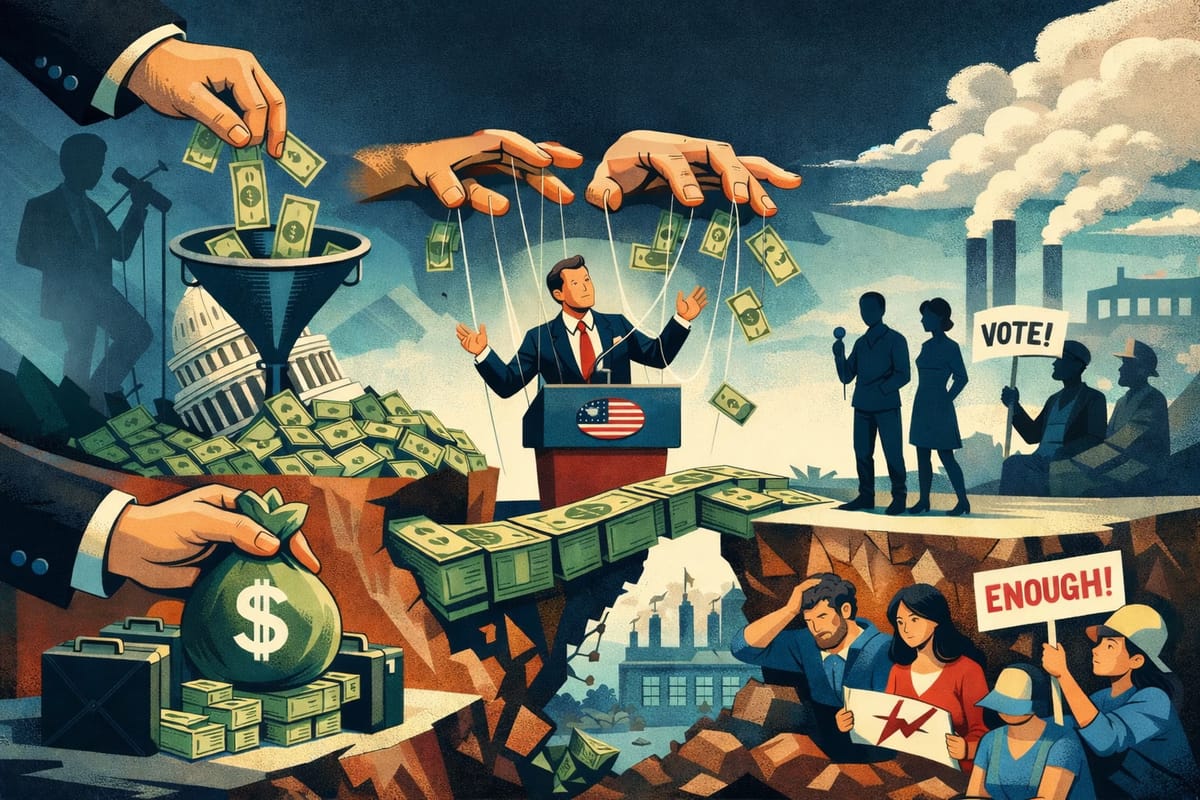
American democracy faces a fundamental crisis of representation. While politicians claim to serve “we the people,” the reality is that a vast chasm has opened between what citizens want and what their elected officials actually do. This disconnect isn’t accidental—it’s the direct result of a political system increasingly dominated by corporate money and wealthy interests that has systematically marginalized the voices of ordinary Americans.
The numbers tell a stark story of how money has overwhelmed democratic participation. In 2024, lobbying spending reached a record-breaking $4.4 billion, representing a massive increase in corporate attempts to influence government policy. In 2023, the pharmaceuticals and health products industry spent the most on lobbying efforts, totaling about $379 million, while the top lobbying spender was the U.S. Chamber of Commerce, with spending of $69.58 million.
These figures represent just the tip of the iceberg. Federal lobbying spending exceeded $1.2 billion in the first quarter of 2024 alone, putting the year on track for another nominal record and demonstrating how corporate interests maintain constant pressure on the political process. The oil and gas industry alone provides a telling example: oil and gas companies spent nearly $60 million lobbying Republican Party members in the 2024 election cycle.
The 2010 Supreme Court decision in Citizens United v. Federal Election Commission fundamentally transformed American democracy by unleashing unlimited corporate spending on elections. The decision further tilted political influence toward wealthy donors and corporations, creating what experts now recognize as a turning point in American political history.
The consequences have been dramatic and measurable. Just 100 billionaire donors poured a record $2.6 billion into the 2024 elections, making up nearly 20 percent of total spending, while over 80 percent of the total amount spent by billionaires during the 2024 election cycle was spent through channels that were prohibited prior to Citizens United.
The decision created new mechanisms for wealthy influence that fundamentally altered the balance of power in American politics. The ruling ushered in massive increases in political spending from outside groups, dramatically expanding the already outsized political influence of ultra-wealthy donors, corporations, and special interest groups. These “Super PACs” can now raise and spend unlimited amounts while maintaining only the fiction of independence from candidates.
Politicians accept money from billion-dollar corporations not primarily due to personal corruption, but because the current system creates structural dependencies that make corporate funding essential for political survival. Several interconnected factors drive this phenomenon:
Modern campaigns require enormous sums of money for television advertising, digital marketing, staff salaries, and voter outreach. Members of Congress spend a large part of their time looking for campaign contributions, and lobbyists offer a prime target. Without corporate funding, candidates simply cannot compete in today’s expensive electoral environment.
Corporations don’t just provide money—they provide access to information, expertise, and networks that politicians need to understand complex policy issues. This creates a dependency where elected officials rely on corporate lobbyists for technical knowledge about industries they regulate.
The promise of lucrative private sector positions after leaving office creates powerful incentives for politicians to maintain good relationships with corporate interests. This “revolving door” between government and industry ensures ongoing cooperation.
In states that threw out independent expenditure laws after the Citizens United ruling, lawmakers cut corporate tax rates by 4 to 8 percent and passed business-friendly tort laws, while unrelated policies (for example, gun control) saw no change. This demonstrates how corporate money directly translates into favorable policy outcomes.
The result is a political system that systematically fails to represent the interests and preferences of ordinary Americans. Research consistently shows that elected officials are far more responsive to wealthy donors than to their constituents’ actual views.
Eighty-seven percent of Americans polled soon after Citizens United believed that members of Congress are influenced more by donors than by constituents’ views. This isn’t just a perception problem—it reflects the reality of how policy gets made. According to a recent poll by Pew Research Center, 80 percent of Americans believe donors have too much sway in Congress, while 70 percent say constituents have too little.
The representation gap extends beyond mere influence to fundamental policy outcomes. In the 2014 federal midterm elections, just 1.75 percent of Americans contributed to a congressional campaign, and of those contributors, 0.2 percent gave as much as 66 percent of the total contributions. When such a small fraction of the population provides the majority of campaign funding, it’s inevitable that their preferences will receive disproportionate attention.
The concentration of political influence among the wealthy undermines the fundamental democratic principle of political equality—the idea that all citizens should have an equal voice in shaping the policies that govern their lives. All citizens may be created equal in relation to each other, but not necessarily in relation to corporations or in relation to how corporations may empower some individuals relative to others.
This inequality manifests in multiple ways:
Wealthy interests can afford to hire teams of lobbyists to constantly push their priorities, while ordinary citizens must rely on occasional voting and limited civic engagement opportunities.
Corporate interests can fund research, think tanks, and media campaigns to shape public understanding of issues, giving them tremendous advantages in framing political debates.
The complexity of modern governance creates opportunities for corporate interests to position themselves as indispensable sources of technical knowledge, making it difficult for politicians to develop independent policy positions.
Poor representation has cascading effects throughout the political system. When politicians depend on corporate funding, several predictable patterns emerge:
Industries effectively capture regulatory agencies and legislative committees, turning government oversight into industry self-regulation.
As the median member of the public has become poorer, redistributive policies have remained weak, because wealthy donors oppose policies that would reduce their advantages.
American democracy is showing clear signs of strain as citizens lose faith in institutions that consistently fail to address their concerns.
When both parties depend on corporate funding but compete for different sets of wealthy donors, it can increase political polarization while narrowing the range of acceptable policy options.
Defenders of the current system often frame unlimited corporate spending as a free speech issue, arguing that restrictions on money in politics violate First Amendment protections. However, this framing obscures the fundamental difference between individual speech and corporate power.
Speech is the act of expressing thoughts, feelings, or perceptions by the articulation of words. It is a vocalized form of human communication. Money, by contrast, is a medium of exchange that can be accumulated in unlimited quantities and used to amplify some voices while drowning out others.
More money is not more democracy. When corporations can outspend entire communities, they effectively silence opposing viewpoints not through censorship, but through sheer volume. This creates what scholars call “market failure” in the marketplace of ideas—where the best-funded ideas, not necessarily the best ideas, dominate political discourse.
Despite the dominance of corporate money in politics, public support for reform remains strong across party lines. Three-quarters of respondents to a CBS News poll said the wealthy have more influence over elections than other Americans.
However, translating public support into actual reform faces enormous structural obstacles. The same corporate interests that benefit from the current system naturally resist changes that would reduce their influence. This creates a feedback loop where corporate power protects and extends itself through the political process.
The American experience with corporate political influence is not inevitable or natural—it represents specific policy choices that have created uniquely extreme inequality in political voice. The prediction that democracy will function as a brake on economic inequality assumes that elected representatives will adopt policies responsive to the preferences of the median member of the public. But democracy in America does not seem to be working that way.
Other advanced democracies have implemented stronger campaign finance regulations, public funding of elections, and restrictions on lobbying that have maintained more balanced political representation. The American system represents an extreme case of what happens when corporate political influence is allowed to operate with minimal constraints.
Addressing the crisis of representation requires understanding that corporate political influence operates as a system, not just isolated instances of corruption. Citizens United created new avenues through which economic power can be converted into political power. Mitigating its negative effects on democracy requires addressing both economic and political inequality.
Meaningful reform must target multiple points of leverage simultaneously:
Public funding of elections, small-donor matching programs, and limits on corporate political spending can reduce politician dependence on wealthy interests.
Stronger disclosure requirements, limits on revolving door employment, and expanded definition of lobbying activities can reduce corporate access advantages.
A wealth tax would reduce the outsized influence of top donors on election and policy outcomes, while guaranteeing voting rights and banning gerrymandering would give those at the other end of the wealth distribution more of a say.
Strengthening labor unions, expanding voting access, and creating new mechanisms for citizen participation can amplify the political voice of ordinary Americans.
The crisis of representation threatens the fundamental legitimacy of American democracy. As ultra-wealthy interests gain power, public trust in government has cratered. Public satisfaction with the way democracy is working in the US has reached record lows, while experts now classify the US as a “flawed” rather than “full” democracy.
This degradation isn’t just about policy outcomes—it’s about whether democratic self-governance can survive in an era of extreme economic inequality. Voters say “we don’t have a representative government anymore” and believe that “the nexus of money and power, greased by special interest lobbyists and large campaign donations” means that “the game is rigged” and “the wealthy and big industries get policies that reinforce their advantage.”
The challenge facing American democracy is clear: can a political system dominated by corporate money and wealthy interests be reformed from within, or will the concentration of political power continue to accelerate until democratic institutions become mere facades for oligarchic rule? The answer will determine not just what policies America adopts, but whether the promise of democratic self-governance remains viable in the 21st century.
The time for incremental tinkering has passed. American democracy needs fundamental reform that restores the principle that government should serve all citizens, not just those who can afford to purchase political influence. Only by addressing the structural sources of corporate political dominance can the United States hope to rebuild a truly representative democracy worthy of its founding ideals.
This crisis demands urgent action from citizens, activists, and leaders who still believe in the democratic promise. The stakes couldn’t be higher: the future of American democracy itself hangs in the balance. The question isn’t whether change is needed—it’s whether Americans have the will to demand it and the courage to fight for it.
This article examines the systemic challenges facing American democratic representation in the age of unlimited corporate political spending. The evidence demonstrates a clear pattern: when money dominates politics, ordinary citizens lose their voice in governance.