
The Contradiction at the Heart of Trump's America First Agenda
When "Making America Great Again" Meets Foreign Talent Dependence

When "Making America Great Again" Meets Foreign Talent Dependence
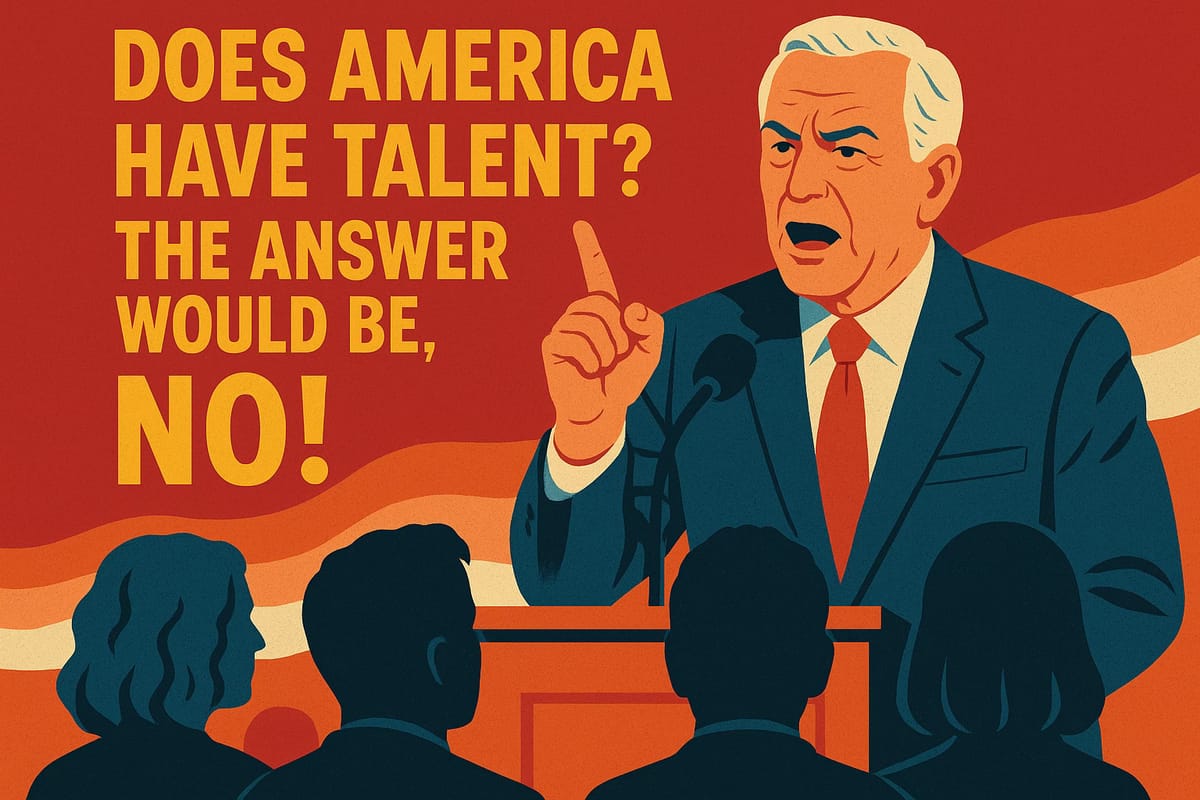
In a striking moment that has exposed deep fractures within the MAGA movement, President Donald Trump recently told Fox News host Laura Ingraham that America lacks workers with “certain talents” needed to fill critical domestic jobs, defending the controversial H-1B skilled worker visa program. The comments, made during a November interview at the White House, have ignited a firestorm of criticism from his own political base and raised fundamental questions about the consistency of his “America First” philosophy.
During the contentious exchange with Laura Ingraham, Trump was pressed on whether his administration would reduce H-1B visas over concerns they depress wages for American workers. When Ingraham responded, “We have plenty of talented people here,” Trump replied, “No, you don’t, no you don’t … you don’t have certain talents, and people have to learn. You can’t take people off an unemployment line and say, ‘I’m going to put you into a factory where we’re going to make missiles.’”
The president went further, citing a specific example to justify his position. He pointed to the September ICE raid of a Georgia Hyundai facility, which saw authorities arrest and deport hundreds of South Korean contractors, as evidence of the country’s need for skilled foreign workers. “In Georgia, they raided because they wanted illegal immigrants out — they had people from South Korea that made batteries all their life,” Trump said. “You know, making batteries is very complicated. It’s not an easy thing. Very dangerous, a lot of explosions, a lot of problems.”
This defense of foreign expertise represents a remarkable departure from the populist nationalism that defined Trump’s initial rise to power and his 2024 campaign messaging.
The reaction from Trump’s core supporters was swift and unforgiving. Rep. Marjorie Taylor Greene, once among Trump’s most loyal allies, promptly spoke out against the statements, declaring herself “America First and America Only.” In a pointed social media post, she wrote: “I believe you are good, talented, creative, intelligent, hardworking, and want to achieve. I am solidly against you being replaced by foreign labor, like with H1Bs.”
Greene’s criticism didn’t stop there. She announced plans to introduce legislation to “END the mass replacement of American workers by aggressively phasing out the H1B program,” stating that “Big Tech, AI giants, hospitals, and industries across the board have abused the H-1B system to cut out our own people. Americans are the most talented people in the world.”
The Georgia congresswoman’s defiance prompted Trump to publicly dismiss her concerns. When asked about Greene’s criticism, Trump told reporters: “I don’t know what happened to Marjorie. Nice woman, but she’s lost her way. I have to view the presidency as a worldwide situation, not locally.”
Trump’s defense of H-1B visas reveals the complex economic pressures facing modern American industry. The H-1B visa is a work visa that’s valid for three years and can be renewed for another three years. Economists have argued the program allows US companies to maintain competitiveness and grow their business, creating more jobs in the US.
The numbers tell a compelling story about America’s reliance on foreign talent. In 2024, approximately 400,000 H-1B visas were approved, with the majority as renewals rather than new hires. The program is particularly crucial for technology companies, with Amazon, Google and Microsoft securing at least 61,000 H-1B visas combined between 2022 and December 2024, even while laying off tens of thousands of American workers during the same period.
However, Trump has attempted to address concerns about abuse of the system. Trump signed an executive action in September to impose a $100,000 application fee for H-1B visas, marking the latest in a series of efforts to crack down on immigration and place sharp new limits on the types of foreigners allowed into the country.
The contradiction between Trump’s populist messaging and his practical governing approach reflects a deeper tension in American economic policy. Throughout his political career, Trump has built his brand on the premise that American workers have been betrayed by globalist elites who prioritize cheap foreign labor over domestic talent. His signature slogan “Make America Great Again” explicitly suggests that America’s greatness lies in its people and their capabilities.
Yet his recent comments suggest a fundamentally different worldview—one that acknowledges America’s limitations in certain technical fields and accepts the necessity of importing talent to maintain competitiveness. When Ingraham pressed further by asking “How did we ever do it before?” during their exchange about specialized manufacturing, Trump’s response revealed his belief that modern technological demands exceed traditional American capabilities.
The president’s shift on H-1B visas may reflect the growing influence of technology leaders in his administration. SpaceX and Tesla CEO Elon Musk, who originally is from South Africa and used an H-1B visa to remain in the U.S., said in December he would “go to war” on the issue. “The reason I’m in America along with so many critical people who built SpaceX, Tesla, and hundreds of other companies that made America strong is because of H1B,” Musk posted on X.
This alliance with Silicon Valley moguls represents a dramatic evolution from Trump’s 2016 campaign, when he positioned himself as the champion of forgotten American workers against coastal elites. The transformation suggests that the realities of governing in a globalized economy have forced pragmatic compromises with the very establishment he once opposed.
Trump’s comments, while politically damaging, point to legitimate concerns about America’s preparedness for advanced manufacturing and technology sectors. The president specifically referenced battery manufacturing, a critical component of the electric vehicle revolution and energy storage infrastructure. “Making batteries is very complicated. It’s not an easy thing. Very dangerous, a lot of explosions, a lot of problems,” Trump explained, defending the need for experienced foreign workers to train Americans in these specialized skills.
However, critics argue that this perspective reflects a failure of American education and training systems rather than an inherent lack of American capability. Conservative commentator Matt Walsh pushed back on Trump, noting “America is for Americans” and arguing that “Even if it were true that we don’t have enough talented people in this country, which it isn’t, that would be all the more reason to stop importing foreigners. We need to train up our own people.”
The debate touches on fundamental questions about American exceptionalism and national character. Throughout American history, the country has balanced between celebrating homegrown talent and recognizing the contributions of immigrants and foreign expertise. The space race, Manhattan Project, and early computer industry all benefited significantly from foreign-born scientists and engineers.
However, Trump’s political movement was explicitly built on rejecting this cosmopolitan approach in favor of nationalist economic policies. His 2016 campaign promised to end what he characterized as the exploitation of American workers through unfair trade deals and immigration policies that suppressed wages.
The H-1B controversy reveals the challenging political calculations facing Trump as he attempts to balance competing constituencies. On one side are his populist base supporters who view any defense of foreign workers as a betrayal of core promises. On the other are business leaders and technology executives whose support he needs for economic growth and campaign fundraising.
Critics within the MAGA movement worry about electoral consequences. “This is insane—we’re going to lose the mid-terms so badly,” said Anthony Sabatini, a Republican county commissioner in Florida, in response to Trump’s comments. The concern reflects awareness that young voters, who played a crucial role in Trump’s 2024 victory, may be particularly alienated by suggestions that American talent is inadequate.
The White House has attempted to manage the political fallout while defending the president’s position. “The Trump administration is protecting American workers by restoring accountability in the H1-B process, ensuring that it is used to bring in only the highest-skilled foreign workers in specialty occupations and not low wage workers that will displace Americans,” White House spokeswoman Taylor Rogers said in a statement.
This response attempts to thread the needle between acknowledging the need for foreign talent while emphasizing protections for American workers. The administration points to enforcement measures and higher fees as evidence of their commitment to preventing abuse of the system.
The H-1B debate represents more than a single policy disagreement; it reflects broader tensions within the conservative movement about globalization, economic nationalism, and America’s role in the world economy. Trump’s comments suggest an acceptance of global interdependence that conflicts with the self-sufficient nationalism many of his supporters expect.
The controversy has exposed what some observers call “real schisms within the movement,” as traditional economic conservatives who support business-friendly immigration policies clash with populist nationalists who prioritize American worker protection above all other considerations.
Trump’s assertion that Americans lack certain technical skills raises important questions about education and workforce development policies. If the president is correct that Americans cannot simply be retrained for advanced manufacturing jobs, it suggests systemic failures in educational institutions and vocational training programs.
However, this perspective may underestimate American adaptability and learning capacity. Throughout history, American workers have successfully transitioned to new technologies and industries, from agriculture to manufacturing to services. The question becomes whether current educational and training systems are adequate to meet 21st-century challenges.
The tension between international competitiveness and domestic worker protection represents one of the central challenges of economic policy in a globalized world. Trump’s defenders argue that restricting access to global talent would handicap American companies in competition with international rivals who face no such limitations.
Critics contend that this argument accepts a race to the bottom in wages and working conditions, undermining the middle-class prosperity that made America an economic powerhouse. They argue for policies that invest in American human capital rather than relying on foreign substitutes.
Critics of the H-1B program point to systematic abuses that undermine both American workers and the foreign workers themselves. Many testimonials exist of American workers being forced to train their own H-1B replacements before being laid off. The visa system creates power imbalances where employers hold significant leverage over foreign workers, often leading to below-market wages and poor working conditions.
Government records show that the vast majority of H-1B approvals are for entry and junior level jobs at wage levels significantly below market salaries. This contradicts the narrative that these visas are reserved for the “best and brightest” filling roles that truly cannot be filled by American workers.
An entire economy of foreign middlemen, particularly in India, has emerged around providing “talent” through kickback schemes and job-selling operations. These practices suggest that the program has evolved far from its original intent of addressing genuine skill shortages.
Trump’s defense of foreign talent extended beyond H-1B visas to include Chinese students in American universities. During the same interview, he defended allowing 600,000 Chinese students to study in the U.S., arguing that “you would have half the colleges in the United States go out of business” without their tuition payments.
This position has drawn criticism from national security experts who point out that China is an authoritarian state with clear incentives to use student visas as cover for intelligence gathering operations. When universities become financially dependent on a single foreign country for survival, it creates vulnerabilities that can be exploited.
Trump’s comments about battery manufacturing highlight a broader challenge facing his promised manufacturing renaissance. Modern advanced manufacturing requires specialized knowledge that cannot be easily transferred or quickly learned. This creates a genuine dilemma between the desire for domestic production and the reality of current American capabilities in emerging technologies.
The battery example is particularly relevant as the United States seeks to compete with China in electric vehicle production and energy storage. Chinese companies have developed deep expertise in battery chemistry and manufacturing processes over decades of focused investment. Replicating this knowledge base in America would require substantial time and resources.
The H-1B controversy reveals different perspectives between various regions and demographic groups within the Republican coalition. Technology-heavy regions with significant foreign-born populations may be more accepting of skilled immigration, while working-class communities that have experienced job losses may be more skeptical.
Young college-educated Republicans who work in technology fields may have different views than older, blue-collar Trump supporters who feel left behind by economic changes. This generational and educational divide complicates efforts to maintain a unified political message.
The debate over H-1B visas reflects broader disagreements about immigration policy approaches. Some argue for better enforcement and higher standards to prevent abuse while maintaining the program for legitimate needs. Others contend that the program is fundamentally flawed and should be eliminated entirely.
Trump’s approach of imposing high fees and stricter oversight represents a middle ground, but it satisfies neither those who want complete elimination nor those who oppose any restrictions on business hiring decisions. This compromise position may be politically unsustainable in the long term.
The reality of global competition for skilled workers cannot be ignored in policy discussions. Countries like Canada, Australia, and the United Kingdom actively compete to attract the same talent that American companies seek through H-1B visas. If America makes it significantly more difficult to hire foreign workers, these individuals may simply go elsewhere, potentially taking valuable innovations and business developments with them.
However, this argument assumes that talent attraction is a zero-sum game and that American workers cannot be developed to fill these roles. Critics argue that this defeatist attitude becomes self-fulfilling by discouraging investment in domestic human capital development.
The H-1B controversy illustrates the difficulty of maintaining populist political messaging while governing in a complex global economy. Trump’s comments suggest recognition that certain campaign promises may be incompatible with economic realities, but this acknowledgment comes at significant political cost.
The challenge for the Trump administration will be finding policies that address legitimate business needs for skilled workers while maintaining credibility with a political base that expects “America First” to mean Americans first in employment opportunities. This may require significant investments in education, training, and workforce development—investments that could take years to show results.
Potential solutions could include:
Massive public and private investment in vocational training and technical education specifically designed for emerging industries like battery manufacturing, semiconductor production, and advanced materials.
European-style apprenticeship programs that combine work experience with formal education to develop specialized skills in American workers.
Mandating that companies using H-1B visas invest equivalent amounts in training American workers for similar roles.
Developing long-term plans to transition from foreign worker dependence to domestic capability in critical industries.
Reforming educational systems to better prepare American students for technical careers in advanced manufacturing and technology.
President Trump’s admission that America lacks the talent needed to fill certain jobs represents a moment of truth for the “Make America Great Again” movement. While his comments may reflect legitimate concerns about skills gaps in advanced manufacturing and technology sectors, they directly contradict the nationalist messaging that brought him to power.
The fierce backlash from supporters like Marjorie Taylor Greene demonstrates that significant portions of Trump’s base remain committed to the original vision of American self-sufficiency and worker protection. The president’s apparent evolution toward accepting global labor interdependence may be economically rational, but it threatens the political coalition that enabled his return to power.
As this controversy continues to unfold, it will test whether Trump can maintain his populist political brand while making the pragmatic compromises that governing in a global economy requires. The answer may determine not only the success of his administration but the future direction of American conservative politics.
The H-1B debate ultimately forces a fundamental question: Can “Make America Great Again” coexist with the acknowledgment that America needs foreign talent to compete in key industries? Trump’s recent comments suggest he believes the answer is yes, but his own political base appears far from convinced.
This schism within the MAGA movement reflects broader tensions in American society about globalization, national identity, and economic competitiveness. How these tensions are resolved will have profound implications for American politics, policy, and prosperity in the years ahead.
The controversy also highlights the challenge of translating campaign slogans into governing realities. “America First” sounds straightforward as a political message, but implementing it in a interconnected global economy requires complex tradeoffs that may not align with voter expectations.
Whether Trump can navigate these contradictions while maintaining political support remains to be seen. What is clear is that the simple narratives of the campaign trail have collided with the complex realities of governing in the 21st century, forcing difficult choices between ideological purity and practical governance.
This analysis reflects the ongoing debate over American immigration policy, economic competitiveness, and political messaging in the Trump era. The ultimate resolution of these issues will significantly impact America’s economic future and political landscape.