
The American Decline
A Multi-Dimensional Crisis

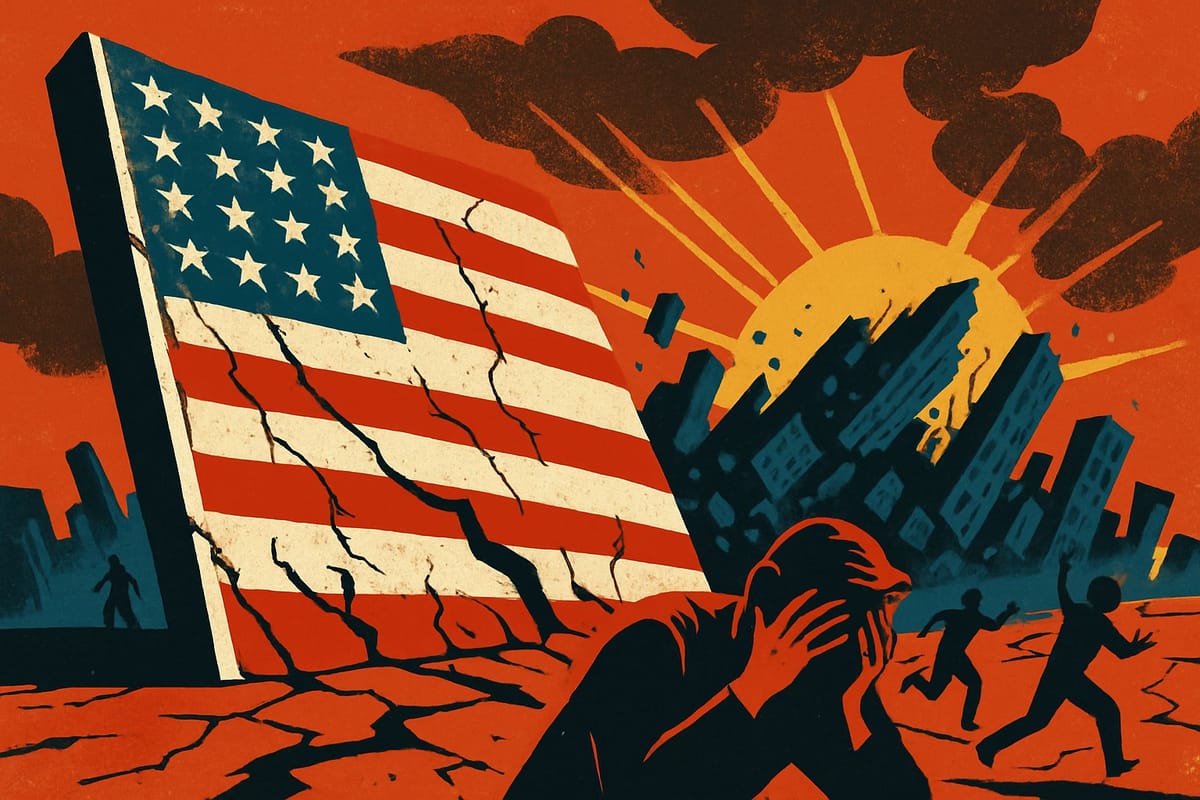
America in 2025 presents a paradox that would be almost comedic if it weren't so consequential. The world's most powerful nation, with unprecedented technological capabilities and wealth, simultaneously exhibits symptoms of systemic dysfunction that historians typically associate with civilizational decline. This isn't merely about political polarization or economic inequality—though both are symptomatic—but rather a comprehensive breakdown spanning infrastructure, institutions, social cohesion, and perhaps most critically, the psychological fabric that binds a society together.
The signs are everywhere, hiding in plain sight like a slow-motion catastrophe unfolding across multiple dimensions simultaneously. Understanding this decline requires examining not just the obvious metrics of national health, but the deeper currents of human behavior, social trust, and collective meaning-making that determine whether a civilization thrives or merely survives.
America's physical infrastructure tells the story of a nation that has forgotten how to maintain itself. The American Society of Civil Engineers consistently grades U.S. infrastructure somewhere between C- and D+, a report card that would trigger panic in any functional society. Bridges collapse not from natural disasters but from decades of deferred maintenance. Water systems deliver poison to entire cities, as Flint, Michigan discovered to its horror. The electrical grid, a marvel of 20th-century engineering, now struggles with 21st-century demands while remaining vulnerable to both cyber attacks and severe weather.
This isn't merely about funding shortfalls or political gridlock, though both play roles. It reflects a deeper cultural shift away from long-term thinking toward short-term optimization. Previous generations built infrastructure with 100-year lifespans; contemporary America struggles to maintain what was inherited, much less plan for future needs.
The digital realm mirrors this physical decay. Despite pioneering the internet, America now ranks behind numerous smaller nations in broadband speed and accessibility. Rural areas remain digital deserts while urban centers grapple with aging fiber networks. Social media platforms—America's primary contribution to global digital infrastructure—have become vectors for misinformation, psychological manipulation, and social fragmentation rather than tools for connection and knowledge sharing.
The statistics on wealth inequality have become so extreme they border on the absurd. The top 1% of Americans now control roughly 32% of total wealth, while the bottom 50% hold just 2%. This isn't simply inequality—it's oligarchy with democratic window dressing.
More telling than raw numbers is how this concentration manifests in daily life. Entire industries have been financialized into extraction mechanisms rather than value-creation engines. Private equity firms buy up housing stock, healthcare systems, and local newspapers, optimizing them for profit extraction rather than community service. The result is a economy that generates tremendous wealth while simultaneously making life less affordable and community-oriented for ordinary citizens.
Perhaps no trend better captures America's economic dysfunction than the financialization of basic human needs. Healthcare costs have increased 300% faster than wages over the past four decades, not because medical care has become proportionally more complex, but because a web of insurance companies, pharmaceutical giants, and hospital corporations have turned illness into profit opportunities.
Housing follows the same pattern. In many metropolitan areas, owning a home—once considered a basic middle-class achievement—now requires either inherited wealth, exceptional income, or financial leverage that would have been considered reckless in previous generations. When basic shelter becomes a speculative investment vehicle, society has prioritized capital returns over human needs.
American institutions face a crisis of legitimacy that extends far beyond partisan political disagreement. Trust in government, media, educational institutions, and even scientific establishments has eroded to levels that would have been unthinkable in previous eras. This isn't simply about "fake news" or political polarization—it's about the systematic failure of institutions to serve their stated purposes.
Consider the spectacle of American elections: billions spent on campaigns, months of coverage, sophisticated polling and analysis, yet outcomes that often feel disconnected from policy preferences or even basic governance competence. The 2020 election, regardless of one's political alignment, revealed a system where significant portions of the population fundamentally distrust the basic mechanics of democratic participation.
The relationship between government and corporations has evolved into something resembling feudalism more than free-market capitalism. Regulatory agencies are routinely staffed by former industry executives who return to those same industries after their government service. The result is regulation written by and for the regulated, creating the appearance of oversight while enabling systemic extraction.
This dynamic plays out across sectors: pharmaceutical companies influence drug approval processes, financial institutions shape banking regulations, and technology platforms help write their own privacy rules. The revolving door between public service and private profit has created a governance system that serves capital rather than citizens.
America faces a loneliness crisis that the Surgeon General has declared a public health emergency equivalent to smoking 15 cigarettes daily. This isn't hyperbole—social isolation has measurable impacts on mortality, mental health, and cognitive function that rival major diseases.
The statistics paint a grim picture: Americans have fewer close friends than previous generations, spend less time in community activities, and report feeling increasingly isolated despite unprecedented technological connectivity. Bowling leagues, community organizations, religious congregations, and even informal neighborhood connections have withered as Americans retreat into private spaces and digital interactions.
Sociologist Ray Oldenburg's concept of "third places"—spaces that are neither home nor work where community naturally develops—illuminates a crucial aspect of American decline. Cafes, parks, libraries, community centers, and local gathering spots have been systematically eliminated or commercialized out of existence.
Suburban development patterns, designed around automobile dependency and single-family isolation, have created physical environments that make community formation structurally difficult. Shopping malls, once vibrant community spaces despite their commercial nature, now sit empty while online commerce eliminates even casual social interactions around consumption.
Behind the economic and political symptoms lies what psychologists and philosophers term a "meaning crisis"—a collective sense that traditional sources of purpose, identity, and belonging have been eroded without adequate replacements. Work, for many Americans, has become disconnected from any sense of contribution or craftsmanship. Communities have fragmented. Religious and philosophical frameworks that once provided coherent worldviews have lost their binding power.
This crisis manifests in rising rates of anxiety, depression, and what researchers term "deaths of despair"—suicides and overdoses that have actually decreased American life expectancy in recent years. When the wealthiest society in human history sees declining lifespans, something profound has broken in the relationship between material prosperity and human flourishing.
The human brain, evolved for small-group social interaction and focused attention, now operates in an environment of constant digital stimulation designed to maximize engagement (and advertising revenue) rather than wellbeing or productivity. Social media platforms use psychological techniques developed in casinos to create addictive engagement patterns, while news media adopts the same engagement-optimization strategies, resulting in information consumption patterns that prioritize emotional activation over understanding.
The result is a population with shortened attention spans, increased anxiety, and decision-making processes shaped more by algorithmic manipulation than rational deliberation. Democracy requires informed citizens capable of sustained thought about complex issues; American culture increasingly produces citizens optimized for rapid consumption of emotionally engaging content.
While America maintains the forms of democratic governance, practical power has concentrated in ways that would be familiar to students of historical oligarchies. A relatively small number of individuals and families control vast portions of economic activity, media influence, and political access.
This isn't conspiracy but structural evolution. When wealth concentrates, political influence naturally follows. Campaign finance laws that allow unlimited spending through various vehicles mean that policy preferences of the ultra-wealthy carry disproportionate weight compared to popular opinion. Studies consistently show stronger correlations between policy outcomes and elite preferences than between outcomes and public polling.
Digital technology, rather than democratizing information and opportunity as early internet enthusiasts predicted, has instead created new forms of concentrated power. A handful of technology companies control the primary platforms through which Americans receive information, connect socially, and increasingly, conduct economic activity.
These platforms have evolved into what some researchers term "digital feudalism"—systems where users provide labor (content creation, data generation, network effects) while platforms extract value and maintain control over the rules of engagement. The result is unprecedented surveillance capabilities and behavioral influence concentrated in private hands with minimal democratic oversight.
American young adults report anxiety and depression rates that would have been considered epidemic in previous generations but have become normalized as the baseline experience of growing up in contemporary America. This isn't simply about increased awareness or reduced stigma—multiple indicators suggest genuine increases in psychological distress.
The causes are multifaceted: economic uncertainty that makes traditional life milestones (homeownership, family formation, career stability) increasingly difficult to achieve; social media environments that create constant social comparison and FOMO; educational systems that emphasize competition over collaboration; and broader cultural messages that individual success is both paramount and entirely dependent on personal effort, creating shame around structural difficulties.
Marriage rates have declined precipitously, birth rates have fallen below replacement level, and Americans report having fewer close friends than previous generations. These aren't simply lifestyle preferences but symptoms of broader social dysfunction that makes relationship formation and maintenance more difficult.
Economic instability makes long-term commitments risky; geographic mobility for employment disrupts community formation; digital interaction partially substitutes for but doesn't fully replace in-person relationship building. The result is a society of increasingly isolated individuals who lack the social support networks that historically provided resilience during difficult periods.
Perhaps nothing captures the absurdity of American decline quite like the spectacle of a nation that maintains military bases in dozens of countries while its own citizens lack basic healthcare, affordable education, and safe infrastructure. America spends more on defense than the next ten countries combined while American life expectancy declines and infant mortality rates exceed those of other developed nations.
This isn't an argument against national defense but rather an observation about priorities that would seem incomprehensible to outside observers. A nation that can project power globally but cannot provide basic services to its citizens has confused means with ends, maintaining the symbols of strength while allowing the foundations to crumble.
America continues to lecture other nations about democracy, human rights, and good governance while exhibiting symptoms of institutional failure that undermine the credibility of such lectures. Elections contested by losing candidates, political violence, widespread distrust in democratic institutions, and governance paralysis make American democracy promotion efforts appear hypocritical to international audiences.
The soft power that once allowed America to shape global norms through attraction rather than coercion has been severely undermined by the visible dysfunction of American society and governance.
From a systems perspective, American society exhibits characteristics that complexity theorists associate with impending phase transitions or "collapses." High degrees of internal complexity, tight coupling between subsystems, and optimization for efficiency rather than resilience create conditions where small disruptions can cascade into system-wide failures.
The 2008 financial crisis, the COVID-19 pandemic, and various infrastructure failures demonstrate how interconnected systems can amplify rather than contain disruptions. American society has been optimized for growth and efficiency in ways that have eliminated the redundancy and slack that provide resilience during stress.
Historical analysis of civilizational decline reveals common patterns that contemporary America exhibits: extreme wealth concentration, institutional sclerosis, loss of social cohesion, and what historian Arnold Toynbee termed "creative minority" failure—the inability of elites to respond effectively to new challenges.
Previous American crises (the Civil War, the Great Depression, World War II) were resolved through massive mobilization of collective resources and social solidarity. Contemporary America's atomization and institutional weakness make such mobilization increasingly difficult to imagine, much less execute.
Beyond social and political factors, America faces environmental constraints that previous generations didn't encounter. Climate change will require massive infrastructure adaptation and economic transformation at precisely the moment when American political and institutional capacity for large-scale collective action appears most limited.
Resource depletion, environmental degradation, and climate instability create external pressures that functioning societies can address through collective action and long-term planning. Societies in decline typically respond to such pressures through denial, blame, and magical thinking rather than adaptive action.
Paradoxically, honestly confronting decline can be liberating. Much American anxiety stems from the cognitive dissonance between official narratives of continued progress and lived experiences of deterioration. Acknowledging decline eliminates the psychological energy spent maintaining comforting illusions and allows focus on adaptation rather than denial.
This honesty also creates space for dark humor, which historically has been a crucial psychological resource for populations navigating difficult periods. The absurdities of American decline—billionaires launching vanity space projects while infrastructure crumbles, politicians debating bathroom access while cities lack clean water—become sources of shared understanding rather than sources of despair when approached with appropriate perspective.
While system-level collapse may be inevitable or at least highly probable, human-scale resilience remains possible and necessary. Community formation, skill development, and local self-reliance can provide buffers against broader systemic instability.
This isn't about survivalist individualism but rather about rebuilding the social connections and practical capabilities that have been eroded by decades of specialization and institutional dependence. Learning to grow food, repair things, provide mutual aid, and maintain community connections creates resilience regardless of what happens at larger scales.
Historical perspective suggests that civilizational decline, while painful for those experiencing it, is also natural and potentially generative. The fall of Rome led to the eventual emergence of new forms of organization; the collapse of feudalism enabled modern democracy; the breakdown of agricultural societies created industrial ones.
American decline may be creating conditions for new forms of social organization more adapted to contemporary challenges like climate change, technological transformation, and global interconnection. The question isn't whether change will occur—it's already occurring—but whether Americans can participate consciously in shaping what emerges rather than simply being victims of forces they refuse to acknowledge.
American decline is not a future possibility but a present reality. The infrastructure is crumbling, institutions are failing, communities are fragmenting, and individuals are struggling with unprecedented levels of psychological distress. These are not temporary problems that can be solved through better policies or different political leadership—they are symptoms of systemic transformation that requires fundamentally different ways of thinking about society, economy, and human relationships.
The choice isn't between decline and continued growth, but between conscious adaptation to new realities or unconscious victimization by forces that remain unacknowledged. Honest assessment, community building, skill development, and psychological resilience provide pathways forward that don't depend on reversing macro-level trends but rather on creating human-scale alternatives that can thrive regardless of what happens to larger systems.
Perhaps most importantly, this moment requires abandoning the American exceptionalism that insists this society is immune to the historical forces that have shaped all previous civilizations. America is not special in ways that exempt it from the cycles of rise and decline that characterize complex societies. Accepting this reality, while initially disturbing, ultimately provides the foundation for realistic responses rather than magical thinking.
The empire is in decay, but humans remain capable of community, creativity, and mutual care. The question isn't whether American society as currently configured will survive—it won't—but what will emerge from its transformation and how individuals and communities can participate consciously in shaping that emergence rather than simply enduring it.
In the end, civilizational decline is a human-scale experience requiring human-scale responses. The macro-level trends may be beyond individual control, but the micro-level responses—how we treat each other, what skills we develop, what communities we build—remain matters of choice. And perhaps that's enough.