
Shaping Democracy
The Ramifications of Political Redistricting

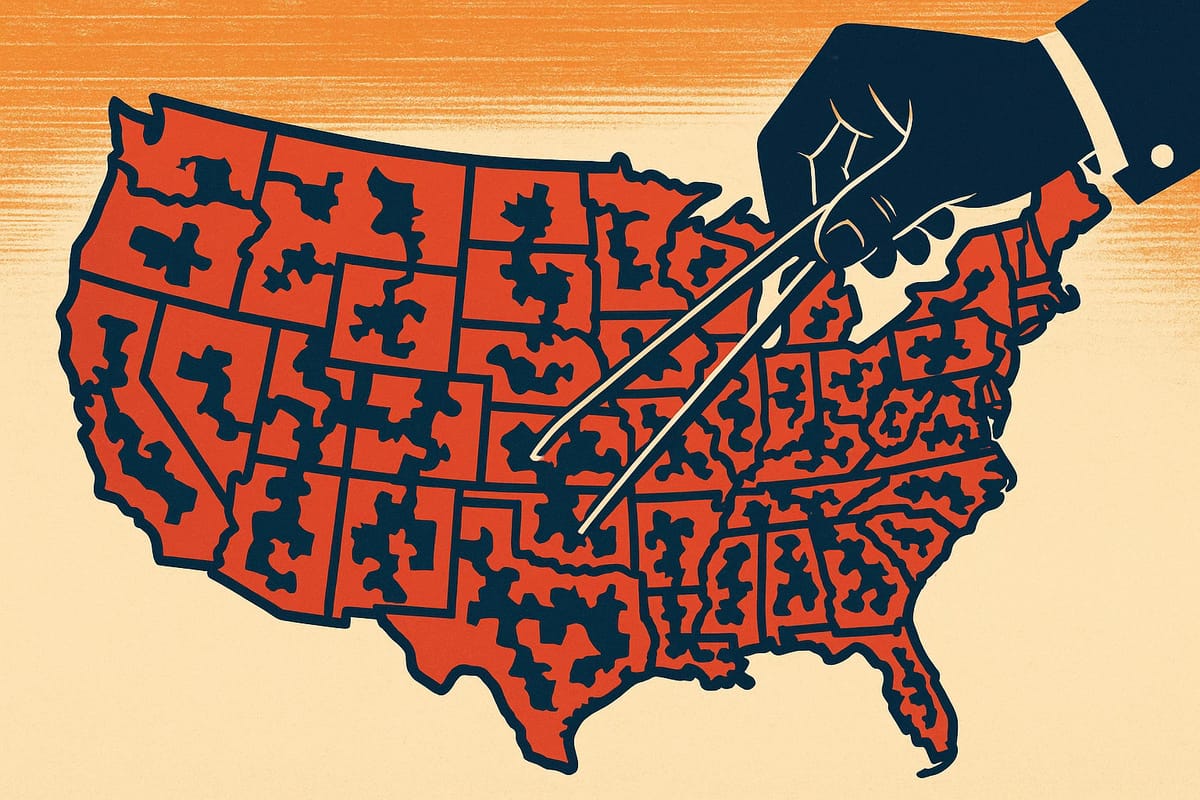
Political redistricting—the process of redrawing electoral district boundaries—stands as one of the most consequential yet underappreciated aspects of democratic governance. Every ten years following the U.S. census, states redraw their congressional and legislative districts to account for population shifts, a process that profoundly influences political representation, electoral competition, and policy outcomes for the following decade.
Redistricting ostensibly serves a straightforward purpose: ensuring equal representation by adjusting district boundaries to reflect population changes. The principle of "one person, one vote," established through landmark Supreme Court cases in the 1960s, requires districts to contain roughly equal populations. However, the actual process of drawing these lines involves far more than simple arithmetic.
State legislatures typically control redistricting for both congressional and state legislative districts, though some states have established independent or bipartisan commissions to manage the process. The party controlling the redistricting process gains enormous power to influence electoral outcomes, leading to the practice of gerrymandering—manipulating district boundaries for partisan advantage. Modern redistricting employs sophisticated software and detailed voter data to create districts with surgical precision, maximizing partisan advantage while maintaining the appearance of compliance with legal requirements.
The political ramifications of redistricting extend far beyond individual elections. Gerrymandered districts can effectively predetermine electoral outcomes, creating "safe" seats where the real competition occurs in primaries rather than general elections. This dynamic pushes politicians toward ideological extremes to satisfy their base voters, contributing to political polarization and legislative gridlock.
Electoral competitiveness suffers dramatically under aggressive gerrymandering. In many states, the vast majority of legislative and congressional seats become predetermined, with margins of victory exceeding 20 or 30 percentage points. This lack of competition reduces voter engagement and accountability, as politicians in safe districts face little pressure to respond to diverse constituent views or work across party lines.
Partisan gerrymandering can also create scenarios where the party winning a minority of statewide votes nonetheless captures a majority of seats—a fundamental challenge to democratic principles. Several states have experienced such outcomes, where the distribution of seats bears little resemblance to the overall partisan preferences of voters. This disconnect between voter intent and electoral outcomes undermines public faith in democratic institutions and can lead to governance that fails to reflect the will of the majority.
Beyond partisan politics, redistricting profoundly affects how communities are represented. The practice of "cracking" divides cohesive communities across multiple districts, diluting their political influence, while "packing" concentrates certain populations into single districts to limit their broader impact. These tactics particularly affect racial and ethnic minorities, urban communities, and other demographically distinct groups.
The Voting Rights Act historically provided crucial protections against racial gerrymandering, requiring certain jurisdictions to obtain federal approval before implementing redistricting plans. However, the 2013 Supreme Court decision in Shelby County v. Holder weakened these protections, leading to concerns about renewed discrimination in redistricting. Communities of color continue to challenge district maps that dilute their voting power, though legal remedies have become more difficult to obtain.
Rural and urban communities also experience distinct impacts from redistricting. Urban areas often see their political influence diluted through creative district drawing that combines city neighborhoods with distant rural areas, creating districts where urban concerns become secondary. Meanwhile, rural communities may find themselves divided among multiple districts, reducing their collective voice on issues like agricultural policy or rural healthcare.
The courts have become increasingly central to redistricting battles, though judicial intervention remains limited and inconsistent. While the Supreme Court has ruled that racial gerrymandering violates the Constitution, it declared in the 2019 Rucho v. Common Cause decision that federal courts cannot adjudicate partisan gerrymandering claims, calling such issues "political questions" beyond judicial reach. This decision shifted the battleground to state courts and reform initiatives.
State courts have emerged as crucial arbiters, with several striking down gerrymandered maps under state constitutional provisions. Pennsylvania, North Carolina, and other states have seen their maps redrawn following state court interventions, though the standards and willingness to intervene vary significantly across jurisdictions.
Reform movements have gained momentum in response to gerrymandering concerns. Citizen initiatives have established independent redistricting commissions in states like Michigan, Colorado, and Virginia, removing the process from direct legislative control. These commissions typically include members from different political parties and independents, with requirements for transparency and public input. Early evidence suggests these commissions produce more competitive districts and better preserve community boundaries, though partisan tensions persist even within supposedly neutral processes.
The future of redistricting will be shaped by advancing technology, changing demographics, and evolving legal standards. Artificial intelligence and machine learning now enable the creation of thousands of potential maps optimized for various criteria, raising questions about how to balance competing priorities like competitiveness, compactness, and community representation.
Demographic shifts, including increasing racial and ethnic diversity and continued urbanization, will complicate future redistricting efforts. Growing numbers of voters who identify as independents or split their tickets challenge the assumptions underlying partisan gerrymandering, potentially reducing its effectiveness over time.
The ramifications of redistricting extend to the very foundation of representative democracy. How we draw district lines determines whose voices are heard, which communities have political power, and whether electoral outcomes reflect popular will. As technology advances and political polarization intensifies, the stakes of redistricting continue to rise. The ongoing struggle over redistricting ultimately reflects deeper questions about fairness, representation, and the meaning of democracy itself. Whether through judicial intervention, legislative reform, or citizen initiatives, addressing the challenges of redistricting remains essential for maintaining public faith in democratic institutions and ensuring that government truly represents the governed.
The choices made in redistricting reverberate through every level of government and every aspect of policy-making. From healthcare and education to infrastructure and environmental protection, the politicians elected from gerrymandered or fairly drawn districts shape the laws and policies affecting millions of lives. Understanding and engaging with the redistricting process, therefore, becomes not just a matter of political interest but a civic necessity for anyone concerned with the health and future of democratic governance.