
How The Ruling Class Ruined America
The Disappearance of America

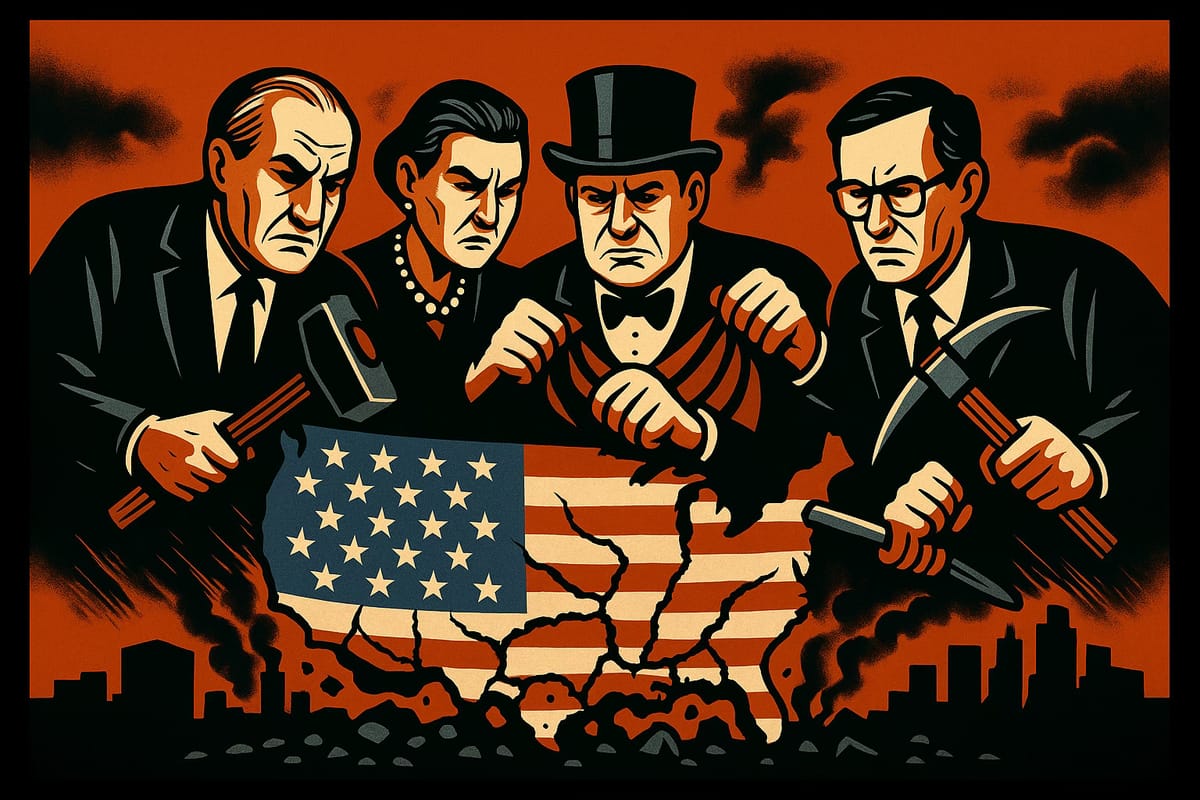
For decades, American politicians and pundits have pointed fingers at China, Mexico, and other foreign competitors to explain the disappearance of manufacturing jobs from the American heartland. But this narrative, while politically convenient, obscures a more uncomfortable truth that economist Thomas Sowell and Alibaba founder Jack Ma have both illuminated: America's job losses stem primarily from deliberate strategic decisions made in corporate boardrooms and policy circles, not from external theft by foreign adversaries.
The popular narrative suggests that China and other developing nations "stole" American jobs through unfair trade practices, currency manipulation, or exploitation of cheap labor. This framing portrays American workers and companies as passive victims of foreign predators. However, this perspective fundamentally misunderstands the nature of economic transformation and deflects attention from the domestic policy choices that facilitated the hollowing out of America's industrial base.
Jobs don't simply vanish into thin air, nor are they stolen like physical objects. Economic activity migrates in response to incentives, policies, and strategic decisions. When Jack Ma observed that America's problems stem from "your strategy," he wasn't being dismissive—he was identifying the core issue that most American leaders prefer to avoid confronting.
The real story of American job displacement begins with a fundamental shift in corporate strategy that gained momentum in the 1980s and accelerated through subsequent decades. American companies increasingly embraced financialization—the process of prioritizing financial engineering and short-term profit maximization over long-term industrial investment and production.
This strategic pivot manifested in several key ways. Companies discovered they could boost quarterly earnings more quickly by cutting labor costs, outsourcing production, and engaging in financial speculation rather than investing in domestic manufacturing capacity, worker training, and technological innovation. The stock market rewarded this approach handsomely, as share prices often rose following announcements of layoffs and plant closures.
Private equity firms epitomized this approach, purchasing profitable companies, loading them with debt, extracting dividends, and then either selling them or allowing them to collapse. This process generated enormous wealth for a small class of financial engineers while destroying productive capacity and eliminating good-paying jobs for working-class Americans.
These corporate strategies didn't emerge in a vacuum—they were enabled and encouraged by specific policy choices. Trade policies like NAFTA weren't forced upon America by foreign nations; they were crafted and implemented by American negotiators pursuing a specific vision of economic integration that prioritized capital mobility over worker security.
Tax policies further reinforced these incentives. The tax code was restructured to favor financial returns over productive investment, making it more profitable to engage in financial engineering than to build factories or train workers. Meanwhile, labor protections were weakened, unions were marginalized, and worker bargaining power was systematically eroded.
Monetary policy also played a crucial role. Low interest rates and quantitative easing programs inflated asset bubbles that made financial speculation extraordinarily lucrative while making productive investment relatively less attractive. The Federal Reserve's policies effectively subsidized Wall Street's financialization strategies while providing little direct benefit to manufacturing communities.
The consequences of these strategic decisions are visible across America's industrial heartland. Cities like Detroit, Cleveland, and Pittsburgh—once thriving centers of American manufacturing—experienced devastating population losses and economic collapse. Smaller manufacturing towns throughout Ohio, Pennsylvania, West Virginia, and other states became what some observers called "sacrifice zones"—communities written off as acceptable casualties of America's new economic strategy.
The social costs extended far beyond unemployment statistics. Family structures deteriorated as good-paying manufacturing jobs that could support middle-class lifestyles disappeared. Educational opportunities declined as tax bases eroded. Healthcare systems strained under the weight of economic despair. The opioid crisis that devastated these communities wasn't coincidental—it was a predictable consequence of the economic hopelessness that followed industrial decline.
Meanwhile, the benefits of financialization accrued heavily to a narrow segment of the population. Wall Street bonuses reached astronomical levels even as manufacturing wages stagnated. Wealth inequality soared to levels not seen since the 1920s. The geographic concentration of financial wealth in cities like New York and San Francisco created a stark divide between thriving financial centers and struggling industrial regions.
Blaming China for American job losses serves multiple political purposes while obscuring the role of domestic policy choices. For politicians, it provides a convenient external enemy that deflects criticism from their own policy decisions. For corporate leaders, it shifts attention away from their strategic choices to prioritize short-term financial gains over long-term industrial investment.
The reality is more complex. China certainly pursued aggressive industrial policies designed to build its manufacturing capacity. Chinese companies did engage in technology transfer, intellectual property acquisition, and other practices that American companies and policymakers found objectionable. However, these Chinese strategies were largely defensive responses to American economic dominance, not aggressive attacks on American workers.
More importantly, China's rise was only possible because American companies actively participated in the process. American corporations weren't passive victims of Chinese industrial policy—they were willing partners who saw opportunities to reduce costs and increase profits by moving production overseas. The decision to hollow out American manufacturing capacity was made in American boardrooms, not imposed by Chinese factories.
The trajectory of American industrial decline wasn't inevitable. Other developed nations faced similar competitive pressures from low-wage countries but maintained stronger industrial bases through different strategic choices. Germany, for example, pursued policies that preserved manufacturing employment while upgrading technological capabilities. Japanese and South Korean companies invested heavily in long-term research and development while maintaining strong domestic production capabilities.
These countries made deliberate choices to prioritize industrial policy, worker training, and technological innovation over short-term financial engineering. They structured their tax systems, labor relations, and financial regulations to encourage productive investment rather than financial speculation. The results speak for themselves—these nations maintained stronger middle classes and more resilient economies even as they competed in global markets.
America could have pursued similar strategies. Instead of prioritizing financial deregulation and short-term profit maximization, American policymakers could have invested in infrastructure, education, and research and development. They could have structured trade agreements to include strong labor protections and environmental standards. They could have reformed tax policies to encourage domestic investment over financial speculation.
Recognizing that America's industrial decline resulted from strategic choices rather than foreign theft is essential for developing effective responses. Continuing to blame China, Mexico, or other trading partners distracts from the domestic policy reforms necessary to rebuild American manufacturing capacity and restore economic opportunity to struggling communities.
Real solutions require confronting the financialization strategies that prioritized short-term profits over long-term industrial investment. This means reforming tax policies to encourage productive investment, strengthening labor protections, and restructuring financial regulations to reduce the incentives for speculative financial engineering.
It also means developing comprehensive industrial policies that support domestic manufacturing, invest in worker training, and promote technological innovation. Countries that have successfully maintained industrial competitiveness have done so through active government involvement in economic development, not through passive reliance on market forces alone.
The transformation of America's economy over the past several decades represents the culmination of deliberate strategic choices, not the inevitable result of foreign competition or technological change. While these choices generated enormous wealth for a small segment of the population, they also hollowed out the industrial base that once provided economic opportunity for millions of working-class Americans.
Jack Ma's observation that America's problems stem from strategic decisions rather than external theft contains an important insight: strategies can be changed. The policies that enabled financialization and industrial decline can be reformed. The tax incentives that reward financial speculation over productive investment can be restructured. The trade agreements that prioritize capital mobility over worker security can be renegotiated.
However, meaningful change requires acknowledging the role of domestic policy choices in creating current problems. As long as American leaders continue to blame foreign competitors for problems that stem from domestic strategic decisions, they will be unable to develop effective solutions. The jobs didn't disappear—they migrated in response to the incentives created by American policies and corporate strategies. Reversing this migration requires different incentives and different strategies, not more blame directed at foreign competitors.
The choice facing America is clear: continue the failed strategy of financialization while blaming foreigners for the predictable consequences, or acknowledge the role of domestic policy choices and pursue the comprehensive reforms necessary to rebuild American industrial capacity and restore economic opportunity to struggling communities. The former path leads to continued decline and social dysfunction. The latter offers hope for renewal and shared prosperity.
The question is whether American leaders have the courage to confront uncomfortable truths about their own strategic choices rather than continuing to seek convenient scapegoats abroad. The future of American manufacturing—and the communities that depend on it—hangs in the balance.