
Democracy Under Siege
How Journalism Layoffs and Billionaire Media Capture Threaten the Republic's Foundation

How Journalism Layoffs and Billionaire Media Capture Threaten the Republic's Foundation
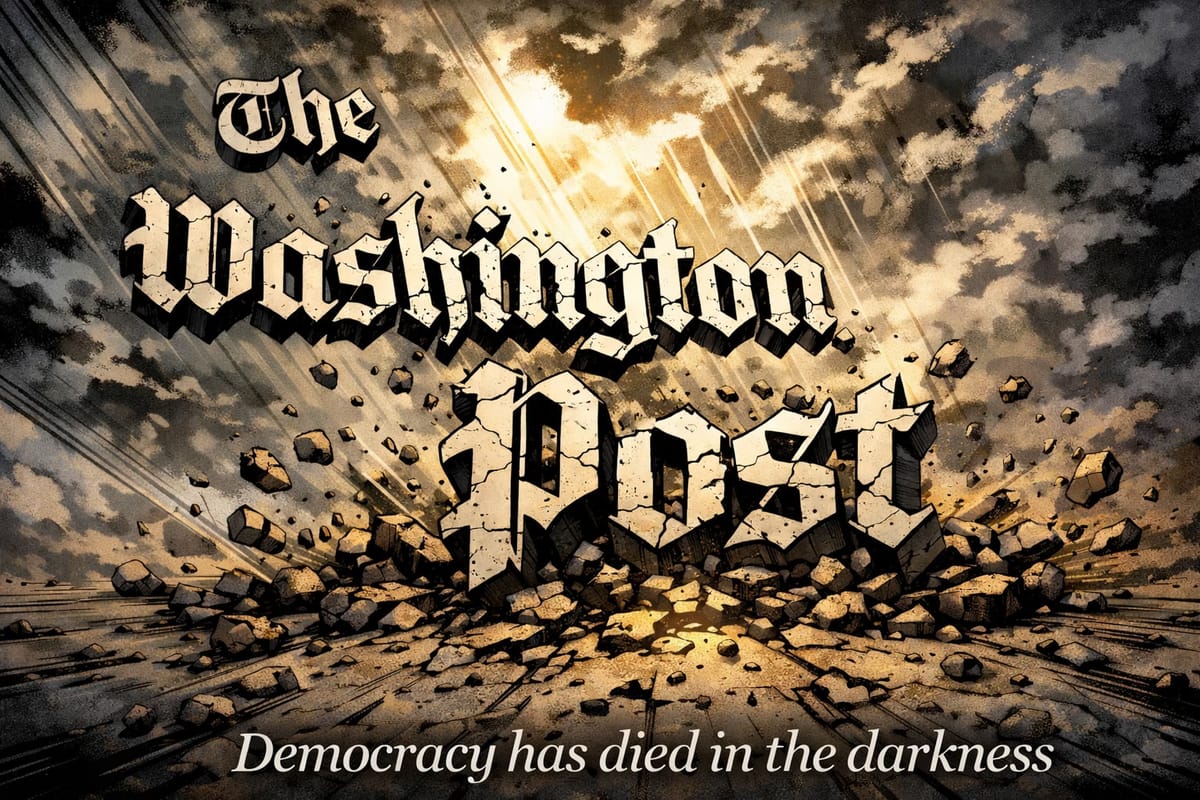
The dismantling of The Washington Post’s newsroom on February 4, 2026, represents far more than corporate restructuring or economic optimization. When Jeff Bezos authorized the elimination of one-third of the newspaper’s workforce—over 300 journalists from a newsroom of 800—he severed critical neural pathways in American democracy’s information nervous system. The Post’s decision to shutter entire departments, from sports to international coverage, while gutting its books section and suspending flagship podcasts, exemplifies a broader crisis that threatens to leave American democracy functionally blind to the corruption, incompetence, and authoritarian drift that journalism has historically exposed and constrained.
This massive reduction in journalistic capacity occurs precisely when democratic institutions face unprecedented stress from authoritarian movements, corporate capture, and systematic disinformation campaigns. The timing reveals the profound disconnect between billionaire media owners’ business calculations and democracy’s informational requirements. While Bezos—worth an estimated $261 billion—could operate The Washington Post at a loss indefinitely as a democratic public service, his decision to prioritize profitability over accountability journalism demonstrates how concentrated wealth systematically undermines the civic functions that independent media must serve in a healthy republic.
The Post layoffs illuminate a fundamental contradiction in contemporary American media: the institutions most essential to democratic governance have become subordinated to the financial interests and political calculations of the ultra-wealthy. This represents not merely a business model failure but a form of institutional capture that threatens democracy’s basic operations. When billionaires control the primary channels through which citizens learn about their government’s actions, the potential for manipulation, suppression, and distortion becomes structurally embedded in the information ecosystem that democratic accountability requires.
The Washington Post’s cuts represent the latest milestone in an accelerating destruction of American journalism infrastructure that has reached crisis proportions. In 2024 alone, nearly 15,000 media jobs were eliminated across television, film, broadcast, news, and streaming platforms. The journalism sector specifically lost over 2,000 positions, continuing a pattern that has seen more than 10,000 journalists laid off in the past three years—representing more than one in ten editors and reporters employed in the industry.
This systematic reduction in journalistic capacity creates what researchers call “news deserts”—communities with no professional source of local news. More than 1,800 American communities now exist in this condition, with many more served only by skeletal weekly publications operated by profit-maximizing corporate chains or hedge funds that prioritize extracting value rather than serving civic functions. The Medill School of Journalism documented that since 2005, the newspaper industry has lost nearly two-thirds of its journalists and nearly one-third of its newspapers, representing perhaps the most dramatic contraction of civic infrastructure in modern American history.
The breadth of recent cuts demonstrates this is not isolated economic pressure but systematic institutional degradation. The Los Angeles Times reduced its newsroom by 20 percent in January 2025. Time magazine cut 15 percent of its staff. Business Insider eliminated 8 percent of its workforce. Sports Illustrated laid off most of its staff after failing to pay licensing fees. The Messenger, a news startup, shuttered entirely after less than a year in operation, leaving more than 300 employees without work. CNN, NBC News, and MSNBC conducted significant layoffs as part of broader corporate restructuring efforts that prioritize shareholder returns over journalistic capacity.
These cuts follow a pattern that extends beyond cyclical economic pressures to reflect structural changes in how news organizations are owned, operated, and valued. Corporate consolidation has placed most American media outlets under the control of profit-maximizing entities that view journalism as a cost center rather than a democratic service. Hedge funds and private equity firms have purchased struggling newspapers specifically to extract real estate value, selling downtown office buildings and printing facilities while leaving skeletal news operations to wither. This “vulture capitalism” approach treats journalism’s civic functions as externalities—costs to be minimized rather than benefits to be maximized.
The human cost of this contraction extends far beyond employment statistics. When experienced journalists lose their positions, institutional knowledge disappears. Beat reporters who understood complex policy areas, maintained source networks, and knew how to navigate government bureaucracies are replaced by entry-level workers or simply not replaced at all. The Kentucky Center for Investigative Reporting found that newsroom diversity has been particularly devastated, with journalists of color representing 42 percent of those laid off despite constituting only 17 percent of the industry workforce. This compounds the profession’s existing representation problems while eliminating perspectives essential to covering increasingly diverse American communities.
The concentration of media ownership in the hands of ultra-wealthy individuals creates structural conditions for democratic manipulation that extend far beyond traditional market failures. Jeff Bezos’s stewardship of The Washington Post exemplifies how billionaire ownership, even when initially appearing benevolent, ultimately serves elite interests at democracy’s expense. Despite early investments in newsroom technology and apparent editorial independence, Bezos’s recent decisions—blocking the Kamala Harris endorsement, purchasing Melania Trump’s documentary for Amazon, attending Trump’s inauguration, and now conducting massive layoffs—reveal the underlying dynamics of billionaire media control.
Academic research demonstrates that billionaire media ownership functions as political investment rather than philanthropic endeavor. Studies examining Sheldon Adelson’s acquisition and operation of Israel Hayom show how ultra-wealthy individuals can shape electoral outcomes by controlling media outlets that propagate their political interests. The newspaper, distributed for free, became Israel’s most widely read publication and exerted significant electoral influence primarily benefiting Netanyahu and the Likud party. This pattern reflects what researchers call “media capture”—the systematic instrumentalization of journalism by extra-journalistic actors who curtail editorial autonomy to advance their own goals.
The political economy of billionaire media ownership reveals why such arrangements inevitably compromise journalistic independence. Wealthy media owners possess extensive business interests that intersect with government policy across multiple domains. Bezos controls Amazon, which maintains billions of dollars in government contracts and faces ongoing antitrust scrutiny. His space company Blue Origin competes for lucrative NASA and Defense Department contracts. These interests create countless potential conflicts where editorial independence conflicts with business calculations, regulatory positioning, or political relationship management.
Research published in the Journal of Politics demonstrates that wealth concentration increases the probability of media capture because large shareholders disproportionately benefit from policy outcomes and therefore exhibit stronger incentives to manipulate public opinion. The model developed by economists studying this phenomenon predicts that higher ownership concentration makes captured media more likely, since wealthy patrons have more to gain from untruthful reporting and can pay more to secure it. This creates what researchers term “systematic bias toward elite interests” that operates regardless of individual owners’ stated intentions or initial commitments to editorial independence.
The Roosevelt Institute’s analysis of American media political economy documents how market supremacy has made media institutions “dangerously vulnerable to commercial pressure and political capture.” Billionaires can decide which news organizations live or die “for mere pennies on the dollar of their fortunes.” Peter Thiel’s financial backing of lawsuits against Gawker Media, which forced the company into bankruptcy despite its journalistic accomplishments, demonstrates how ultra-wealthy individuals can eliminate media outlets through legal warfare even when they cannot control them directly.
The timing of major billionaire media decisions reveals their political calculation. Bezos’s blocking of The Washington Post’s Harris endorsement occurred eleven days before the 2024 presidential election, causing hundreds of thousands of subscription cancellations that exacerbated the financial problems now used to justify massive layoffs. His subsequent appearance at Trump’s inauguration, Amazon’s purchase of Melania Trump’s documentary for $40 million, and the dramatic alteration of the Post’s opinion section to exclude left-of-center perspectives demonstrate how ownership concentration enables rapid ideological realignment when political winds shift.
Current patterns of media concentration and manipulation echo historical periods when wealthy media owners prioritized profit and political influence over democratic service. The late 19th century “yellow journalism” era, dominated by William Randolph Hearst and Joseph Pulitzer’s circulation war, demonstrates how competitive sensationalism and elite control can distort public discourse in ways that undermine democratic decision-making.
Hearst’s media empire, which at its peak controlled nearly 30 major newspapers across American cities, pioneered techniques of political manipulation through selective coverage, sensationalized reporting, and the deliberate manufacturing of public opinion. His approach to the Spanish-American War—famously telling illustrator Frederic Remington “You furnish the pictures and I’ll furnish the war”—exemplifies how media owners can shape public policy through information control. The systematic campaign of jingoistic coverage conducted by both the Journal and the World between 1895 and 1898 demonstrates how concentrated media ownership enables the creation of political consent through propaganda techniques disguised as journalism.
The yellow journalism period reveals important parallels to contemporary media capture. Like today’s billionaire owners, Hearst possessed extensive business interests that intersected with government policy. His mining investments, real estate holdings, and political ambitions created numerous conflicts between journalistic objectivity and personal financial gain. His newspapers’ coverage consistently favored policies that benefited his business empire while attacking politicians who threatened his interests. This pattern of using media ownership to advance broader political and economic agendas demonstrates the structural incentives that make billionaire journalism ultimately incompatible with democratic accountability.
The historical resolution of yellow journalism’s excesses required both market corrections and professional reforms that established stronger boundaries between editorial and business functions. The success of The New York Times’s “highly conservative” approach, which proved profitable while maintaining credibility, created competitive pressure that forced sensationalist publications to adopt more responsible practices. Professional journalism organizations developed ethical standards that limited publisher interference in editorial decisions. The emergence of journalism schools and professional training programs created institutional barriers to direct owner manipulation.
Contemporary billionaire media capture operates in a fundamentally different structural context that makes historical corrective mechanisms less effective. The collapse of advertising revenue and subscription models has eliminated the market incentives that once rewarded credible journalism. The consolidation of ownership has reduced competitive pressure from independent alternatives. The weakening of professional journalism organizations and the elimination of editorial autonomy protections have removed institutional barriers to owner interference. Most significantly, the emergence of social media platforms as primary information sources has created alternative channels for political manipulation that operate outside traditional journalistic ethical frameworks.
The yellow journalism period also demonstrates how media capture enables broader democratic backsliding. Hearst’s support for fascist regimes in the 1930s, including positive coverage of Nazi Germany and personal meetings with Adolf Hitler, shows how concentrated media ownership can facilitate authoritarian influence. His newspapers ran columns by Nazi leaders Hermann Göring, Alfred Rosenberg, and Hitler himself without rebuttal, while dismissing or minimizing reports of Nazi atrocities. This pattern reveals how billionaire media owners’ pursuit of political influence can compromise democratic institutions’ ability to identify and resist authoritarian threats.
The systematic reduction in journalistic capacity eliminates specific civic functions that no other institutions can adequately perform in a democratic system. Independent journalism serves as democracy’s immune system, identifying and exposing threats before they can metastasize into systemic failures. When newsrooms are gutted and beat reporters eliminated, this early warning system breaks down in ways that create cascading vulnerabilities throughout democratic institutions.
Academic research has established clear causal relationships between journalism presence and democratic accountability. Studies tracking federal regulatory violations found that after local newspaper closures, facilities increase violations by 1.1 percent and penalties by 15.2 percent, indicating reduced press monitoring leads directly to increased institutional misconduct. Research examining political corruption found that when elected leaders are under investigation, intensive media coverage significantly increases the likelihood they will resign from office. Citizens are more likely to vote out incumbent officials when media outlets highlight their ties to corruption, demonstrating journalism’s role in enabling electoral accountability.
The watchdog function of journalism operates through several mechanisms that other institutions cannot replicate. Professional journalists maintain specialized knowledge of government operations, legal frameworks, and institutional procedures that enables them to identify irregularities and misconduct that would escape public notice. They possess legal protections and professional resources that allow them to investigate powerful actors despite potential retaliation. They maintain source networks within government institutions that provide access to information unavailable through official channels. They operate under professional ethical standards that prioritize public interest over political or commercial considerations.
Local journalism serves particularly crucial functions in maintaining democratic governance at the community level. Research demonstrates that local newspaper closures lead to increased political polarization as citizens rely more heavily on national partisan media for political information. Split-ticket voting decreases significantly in communities that lose local newspapers, suggesting that local coverage helps citizens evaluate candidates based on individual qualifications rather than partisan affiliation. Local reporting also enables citizen participation in government processes by providing information about municipal meetings, school board decisions, zoning proposals, and other civic matters that directly affect daily life.
The investigative journalism function provides particularly high returns on investment in terms of democratic accountability. James Hamilton’s research in “Democracy’s Detectives: The Economics of Investigative Journalism” quantifies the economic impact of watchdog reporting, finding that investigative stories generate far more social value than they cost to produce. A single investigation exposing government waste or corruption can save taxpayers millions of dollars while preventing ongoing institutional failures. Investigative reporting on corporate misconduct protects consumers and workers while deterring future violations through the threat of exposure.
Professional journalism also serves crucial agenda-setting functions that help democratic institutions prioritize public problems appropriately. Beat reporters covering specific policy areas develop expertise that enables them to identify emerging issues before they become crises. Environmental reporting alerts communities to pollution and public health threats. Education coverage highlights problems in school systems that require citizen attention. Healthcare reporting exposes insurance fraud and medical malpractice that threaten patient safety. When these specialized beats are eliminated through layoffs, communities lose early warning systems for problems that may require collective action.
The gatekeeping function of professional journalism helps maintain shared factual foundations necessary for democratic deliberation. Professional editorial standards require verification of claims, attribution of sources, and correction of errors in ways that social media and partisan outlets do not. While professional journalism is not immune to bias or error, its institutional structures create accountability mechanisms that help maintain baseline credibility. When professional journalism’s market share declines relative to unregulated information sources, the shared factual foundation necessary for democratic discourse deteriorates.
The concentration of media ownership within a small group of ultra-wealthy individuals represents a form of institutional capture that systematically undermines democratic governance. Institutional capture occurs when powerful private actors impose their interests in the formation and implementation of public policy, effectively controlling institutions that should serve broader public interests. Media capture represents perhaps the most dangerous form of institutional capture because it compromises the information systems that enable citizens to identify and respond to other forms of institutional failure.
Research published in the Journal of Economics demonstrates that media capture operates through multiple mechanisms beyond direct editorial interference. Ownership concentration affects the quality of issue coverage, tone of news reporting, and amount of game-frame coverage that focuses on political strategy rather than policy substance. Media owners significantly influence political coverage and bias in news coverage through hiring decisions, budget allocations, and strategic priorities that shape newsroom culture even when direct editorial orders are not issued. Corporate owners with political goals create systematic pressures that alter journalistic output in ways that serve elite interests rather than democratic accountability.
The Roosevelt Institute’s analysis identifies how “oligarchic media ownership” combines with “the collapse of local journalism” and “state threats to media companies” to create systemic vulnerabilities in democratic information infrastructure. These multiple simultaneous pressures reflect what researchers term “structural pathologies that have long been in the making” rather than temporary market corrections. Decades of neoliberal policies treating media as commercial commodities rather than democratic infrastructure have created conditions where billionaire capture becomes the dominant form of media organization.
The political implications of media capture extend beyond biased coverage to fundamental questions about democratic legitimacy. When citizens cannot access reliable information about government actions, policy alternatives, or candidate qualifications, the democratic feedback mechanisms that enable popular sovereignty break down. Research examining European democracies found that media ownership concentration correlates with reduced government responsiveness to public concerns about income inequality, suggesting that captured media actively prevent democratic systems from addressing systemic problems that threaten elite interests.
Media capture also enables what scholars term “truth decay”—the declining role of facts in public discourse and the increasing challenge of distinguishing between opinion and fact. When billionaire-owned media outlets present partisan propaganda as objective journalism, they contribute to public confusion about reliable information sources. This creates opportunities for demagogic politicians to dismiss unfavorable coverage as “fake news” while promoting alternative information sources that serve their political interests. The systematic erosion of trust in professional journalism creates fertile ground for authoritarian movements that depend on controlling information flows to maintain power.
The technological dimensions of contemporary media capture extend beyond traditional journalism to encompass social media platforms and search algorithms that shape information access. Tech billionaires like Elon Musk’s control over Twitter/X and Mark Zuckerberg’s control over Facebook create opportunities for information manipulation that operate at unprecedented scale and speed. These platforms’ algorithmic systems can amplify or suppress information in ways that shape public opinion without explicit editorial decisions, creating what researchers term “algorithmic capture” that operates below the threshold of public awareness.
The international dimensions of billionaire media capture reveal how concentrated wealth can undermine democratic institutions across national boundaries. Russian oligarchs’ ownership of media outlets in European democracies, Saudi Arabian investments in American media companies, and Chinese corporate control over entertainment platforms create opportunities for foreign influence that operate through apparently legitimate business relationships. When billionaire media owners maintain business interests in authoritarian countries, their editorial decisions may reflect foreign policy considerations rather than American democratic interests.
The simultaneous closure of newsrooms across multiple communities creates network effects that amplify democracy’s information crisis beyond the sum of individual closures. When local newspapers shut down, national news organizations lose important sources of local information that inform broader coverage patterns. State capitol bureaus depend on local reporters to identify stories that deserve wider attention. Investigative journalists rely on local sources to develop national stories about policy implementation and regulatory enforcement. The systematic elimination of these local nodes degrades the entire information network in ways that compromise accountability at all levels of government.
Research demonstrates that local newspaper closures lead to measurable increases in government bond borrowing costs as financial markets recognize reduced oversight creates higher risks of municipal corruption and mismanagement. Communities without local newspapers experience decreased citizen participation in local government meetings, reduced voting in municipal elections, and less competitive races for local office. These changes reflect the breakdown of civic engagement mechanisms that require reliable local information to function effectively.
The geographic distribution of newspaper closures exacerbates existing inequalities in democratic representation. Rural communities are disproportionately affected by local news closures, creating “news deserts” that leave large populations without professional journalism coverage. Low-income communities and communities of color are more likely to lose local news sources, compounding existing barriers to political participation and representation. This pattern creates what researchers term “information inequality” that maps onto existing social and economic inequalities in ways that reinforce democratic exclusion.
The economic multiplier effects of journalism layoffs extend beyond media companies to affect broader community economic health. Local newspapers employ not only journalists but also advertising sales staff, circulation managers, printing workers, and administrative personnel whose jobs depend on newsroom viability. When newspapers close, they eliminate local advertising venues that small businesses depend on for marketing, reducing economic activity and employment in communities already facing economic stress. The social capital generated by local newspapers—shared community knowledge, civic engagement, local business promotion—disappears in ways that are difficult to measure but crucial for community resilience.
The national security implications of degraded local journalism create vulnerabilities that extend beyond domestic democratic concerns. Foreign disinformation operations specifically target communities with weakened local news environments because they lack institutional mechanisms for verifying claims and debunking false narratives. Communities without strong local journalism are more susceptible to conspiracy theories, extremist recruitment, and political manipulation by both domestic and foreign actors seeking to undermine democratic institutions.
Addressing journalism’s crisis requires structural reforms that treat media as democratic infrastructure rather than commercial commodity. Public funding models successfully implemented in other democracies provide templates for ensuring journalism independence while maintaining financial viability. The BBC’s public service model, NPR’s hybrid public-private structure, and Canada’s CBC demonstrate how government funding can support journalism without compromising editorial independence when appropriate institutional safeguards are implemented.
Antitrust enforcement represents another crucial structural intervention. The concentration of media ownership in the hands of a few billionaires reflects broader patterns of monopolization across the American economy that require systematic anticompetitive enforcement. Breaking up large media conglomerates, preventing further consolidation, and establishing ownership limits could restore competitive pressure that rewards quality journalism while preventing excessive concentration of information control.
Professional journalism organizations must reassert independence from corporate ownership through stronger collective bargaining, professional ethical standards, and legal protections for editorial autonomy. The Guild movement in journalism provides a model for ensuring that journalistic professionals maintain control over editorial decisions regardless of ownership changes or corporate pressure. Shield laws protecting journalists from retaliation, source confidentiality protections, and professional licensing requirements could create institutional barriers to owner interference in editorial functions.
Nonprofit journalism models offer promising alternatives to both billionaire ownership and failing commercial models. Organizations like ProPublica, The Marshall Project, and local nonprofit newsrooms demonstrate how philanthropic funding can support high-quality journalism when properly structured. However, these models require broader philanthropic support and public funding to achieve the scale necessary to replace commercial journalism infrastructure. Tax policy changes that incentivize journalism donations and provide public funding for local news could accelerate the transition to sustainable nonprofit models.
Community-supported journalism represents another emerging model that creates direct financial relationships between newsrooms and the communities they serve. Subscription cooperatives, membership models, and community ownership structures enable citizen participation in journalism funding while maintaining editorial independence from both corporate and government influence. These models work particularly well at the local level where community identity and shared interests create strong incentives for supporting local journalism.
Technological solutions must address the platform monopolies that have disrupted journalism’s traditional revenue models. Proposals requiring tech platforms to pay news organizations for content use, similar to Australia’s News Media Bargaining Code, could redirect some of the advertising revenue that has migrated to Google and Facebook back to journalism organizations. Platform regulation that limits algorithmic manipulation and requires transparency in content promotion could reduce tech companies’ ability to control information flows in ways that damage journalism viability.
Educational initiatives promoting media literacy and critical thinking skills can help citizens navigate degraded information environments while creating demand for quality journalism. When citizens understand how to evaluate source credibility, identify misinformation, and recognize bias, they become more effective consumers of journalism and more likely to support quality news organizations financially. Media literacy education in schools, public libraries, and community organizations creates long-term demand for the accountability journalism that democracy requires.
The systematic destruction of American journalism infrastructure occurs at a moment when democratic institutions face unprecedented threats from authoritarian movements, foreign interference, and domestic extremist violence. The coincidence of journalism’s collapse with democracy’s crisis reflects not random timing but structural relationships between information control and political power. Authoritarian movements specifically target independent journalism because they understand that democratic accountability requires citizens’ ability to access reliable information about government actions.
The pattern of billionaire media capture that exemplified by Bezos’s Washington Post decisions reflects broader elite strategies for managing democratic consent while pursuing policies that serve concentrated wealth rather than popular interests. When billionaire media owners prioritize access to political power over journalistic independence, they signal to other elites that institutional capture represents acceptable strategy for political influence. The normalization of media capture creates precedents that encourage similar institutional capture in regulatory agencies, educational institutions, and other democratic infrastructure.
International experience demonstrates that media capture typically precedes broader democratic backsliding. Countries experiencing democratic erosion consistently show patterns of increasing media concentration, billionaire ownership of news outlets, and declining press freedom that enable authoritarian consolidation. Hungary’s Viktor Orbán systematically captured media outlets to control information flows before implementing broader authoritarian policies. Russia’s Vladimir Putin used oligarch media ownership to eliminate independent journalism before consolidating autocratic control. The American pattern of increasing billionaire media ownership while journalism capacity declines suggests similar vulnerabilities are developing.
The economic dimensions of journalism’s crisis intersect with broader patterns of inequality and democratic exclusion that threaten institutional legitimacy. When news coverage serves billionaire interests rather than citizen needs, it contributes to political systems’ inability to address problems like healthcare access, climate change, and economic inequality that require collective democratic action. Media capture thus becomes both symptom and cause of democratic dysfunction, creating feedback loops that accelerate institutional deterioration.
The urgency of journalism’s crisis demands recognition that democratic institutions cannot survive without independent information infrastructure. The window for implementing structural reforms may be narrowing as billionaire capture accelerates and alternative information systems continue developing. Citizens, policymakers, and democratic institutions must treat journalism’s preservation as an existential issue for democratic survival rather than a minor economic adjustment to changing market conditions.
The Washington Post layoffs represent a critical threshold in American journalism’s collapse that demands immediate and comprehensive response. Jeff Bezos’s decision to prioritize profit over democratic accountability while possessing the resources to maintain journalism independence demonstrates how concentrated wealth operates as an anti-democratic force regardless of individual owners’ stated intentions. The broader pattern of journalism destruction reflects systematic institutional capture that requires structural intervention rather than market-based solutions.
Democracy’s survival depends on citizens’ ability to access reliable information about government actions, policy alternatives, and political candidates. When billionaire media owners control this information access, they effectively control democratic outcomes in ways that serve elite interests rather than popular sovereignty. The preservation of independent journalism therefore represents not simply a professional concern but a fundamental requirement for democratic governance. Without structural reforms that prioritize journalism’s civic functions over billionaire owners’ political calculations, American democracy faces an information crisis that may prove incompatible with democratic survival.
The choice facing American society is stark: either restore journalism’s independence through comprehensive structural reforms, or accept that democratic accountability will remain subordinated to billionaire political priorities. The Washington Post layoffs demonstrate that hoping for benevolent billionaire stewardship represents a failed strategy that leaves democracy vulnerable to elite capture. Only systematic intervention that treats journalism as democratic infrastructure can preserve the information foundations that make democratic governance possible. The stakes could not be higher, and the time for action is rapidly running out.
Comprehensive analytical examination of journalism layoffs and billionaire media ownership patterns, documenting systematic threats to democratic accountability and information infrastructure. Analysis draws from current employment data, academic research on media concentration, and historical patterns of elite media control to assess implications for democratic governance and institutional survival.