
Captured Opposition
Why Democratic Leaders Won't Fight When America Demands Action

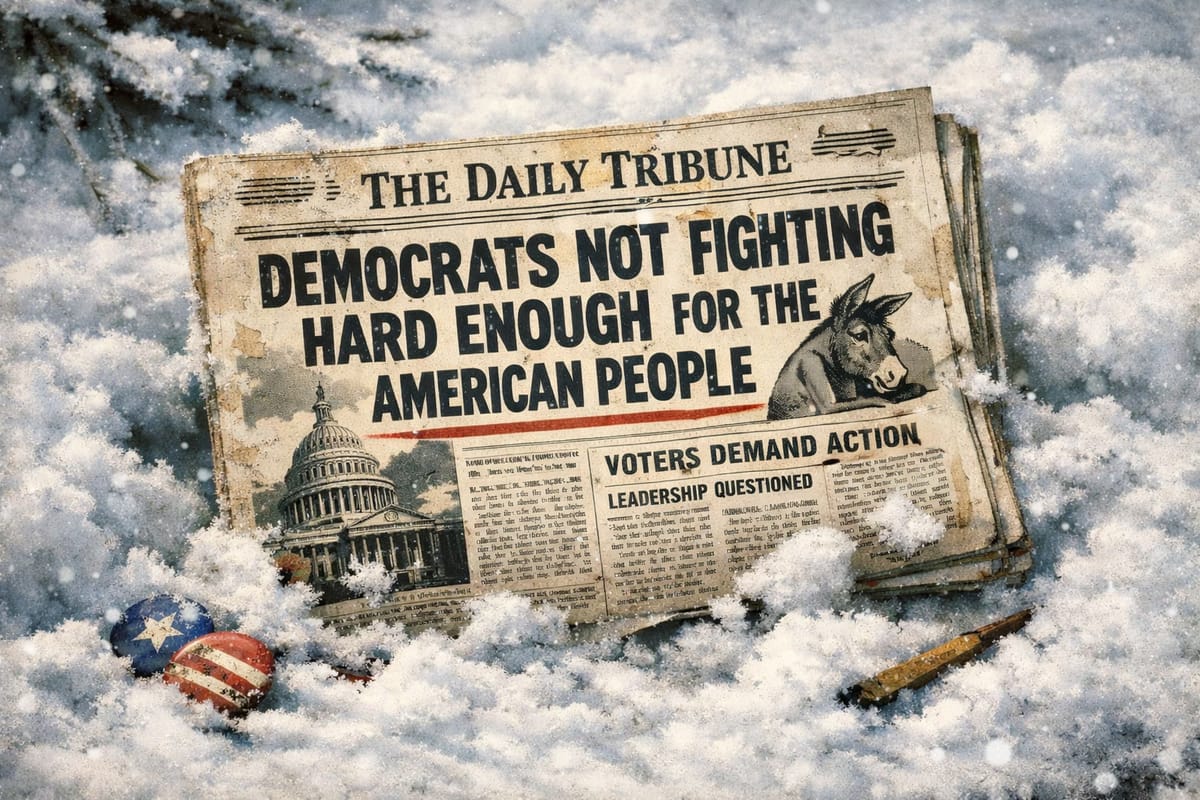
The current political moment presents a striking paradox that illuminates fundamental tensions within American democratic institutions. While polling consistently shows President Trump’s approval ratings hovering in the low-to-mid 30s range, with widespread public concern about authoritarian governance practices, the Democratic Party leadership continues to operate within traditional institutional frameworks that critics argue are inadequate to the moment. This disconnect between public sentiment and institutional response reveals deeper structural problems within American political opposition mechanisms.
The most immediate manifestation of this paradox emerged during the recent congressional battles over Department of Homeland Security funding. Despite widespread public outcry following ICE operations in Minneapolis that resulted in the deaths of two U.S. citizens within three weeks—Renee Good and Alex Pretti—House Democrats ultimately provided the votes necessary to fund ICE operations at $10 billion annually. Only seven Democrats broke party ranks to oppose the funding, while Minority Leader Hakeem Jeffries and other top Democrats voted against the measure but declined to aggressively whip votes or use procedural tools to block funding.
The killing of Alex Pretti on January 25, 2025, particularly crystallized the disconnect between public outrage and Democratic institutional response. Pretti, a 37-year-old ICU nurse at a Minneapolis VA hospital with no criminal record, was shot multiple times by Border Patrol agents while documenting ICE operations with his phone. Video evidence from multiple angles contradicts administration claims that Pretti “attacked” officers or “brandished” his weapon, instead showing him being pepper-sprayed and overwhelmed by multiple agents before being shot ten times in five seconds. The incident prompted bipartisan calls for investigation, with even Republican senators like Bill Cassidy and Thom Tillis demanding accountability. Yet Democratic leadership’s response remained confined to issuing statements and calling for investigations rather than using their institutional power to defund the operations that enabled these killings.
This pattern reflects what polling data suggests is a broader phenomenon of institutional capture within the Democratic establishment. A recent Pew Research Center survey found that 41% of frustrated Democratic voters cite the party’s failure to push back hard enough against Trump administration policies as their primary concern with party leadership. This sentiment has contributed to the Democratic Party achieving historically low favorability ratings, with a recent Quinnipiac poll showing only 30% of Americans viewing the party favorably—the lowest rating since the poll began tracking this metric in 2008.
Current polling reveals significant public support for more aggressive opposition strategies than Democratic leadership has been willing to pursue. A YouGov/Economist poll conducted immediately following the Minneapolis ICE operations found that 46% of Americans now support abolishing ICE entirely—a higher level of support than when the slogan first gained prominence during Trump’s first term, when support peaked around 32%. This represents a remarkable shift in public opinion, with the change driven not only by independents (from 25% to 42% support) but particularly among Democrats, where support has jumped from 40% to 69%.
The killings of Renee Good and Alex Pretti have intensified this shift in public sentiment. Both victims were 37-year-old U.S. citizens with no criminal records, making their deaths particularly difficult for the Trump administration to justify. Pretti’s background as an ICU nurse serving veterans has resonated powerfully across political lines, with even Republican lawmakers like Representative Thomas Massie defending his constitutional right to carry a firearm and criticizing federal officials who suggested that “carrying a firearm is not a death sentence, it’s a Constitutionally protected God-given right.” The National Rifle Association also criticized the administration’s handling of the incident, further complicating typical partisan responses.
The polling data becomes even more significant when viewed alongside Trump’s declining approval ratings. Multiple surveys show the president’s job approval in negative territory, with Gallup reporting 36% approval and 63% disapproval as of late 2025. A separate Economist/YouGov poll found similar results, with 39% approval and 57% disapproval. These numbers represent some of the lowest approval ratings of Trump’s second term, suggesting significant public openness to more assertive opposition strategies.
Perhaps most tellingly, Americans consistently rank threats to democracy among their top political concerns. In Emerson College polling, 61% of voters cite threats to democracy as very important to their voting decisions, ranking it second only to economic concerns at 75%. This suggests a public increasingly concerned about authoritarian governance practices, yet Democratic leadership has largely refrained from using the institutional tools available to them to address these concerns.
The gap between public sentiment and Democratic leadership response has generated increasingly vocal criticism from progressive commentators, activists, and online influencers who command significant audiences. The phrase “Democrats brought a lectern to a social media war” has become emblematic of progressive frustration with party leadership’s communication strategy and institutional approach.
The killings of Good and Pretti have intensified this criticism exponentially. Progressive commentators have highlighted the grim irony of Democratic leaders funding the very agencies that killed these U.S. citizens, even as video evidence contradicted official narratives about both incidents. The Pretti family’s statement, calling out “the sickening lies told about our son by the administration,” while showing video of him clearly holding only his phone with his left hand raised, has been widely shared by influencers as evidence of systematic government dishonesty that Democrats are failing to confront.
Digital creators and influencers have become particularly critical of what they characterize as Democratic “fecklessness.” Despite Democratic leadership’s efforts to engage with content creators—including meetings between Senate Democrats and progressive online personalities with millions of followers—the results have often backfired, drawing mockery from both liberal allies and Republican opponents. These efforts highlight the fundamental disconnect between traditional political communication strategies and the direct, confrontational approach that many progressive voices argue the moment requires.
The critique extends beyond communication strategy to substantive policy positions. Progressive commentators have noted the contradiction between Democratic rhetoric about Trump’s authoritarian tendencies and their willingness to fund the very agencies implementing what critics characterize as authoritarian policies. As one analysis in The New Republic pointed out after the killings, “No rational, functioning opposition party would step in to fund the primary enforcement mechanism of the authoritarian takeover they ostensibly oppose,” especially when that mechanism is now killing American citizens on American soil.
Democratic leadership’s approach reflects a complex calculation involving institutional constraints, electoral considerations, and strategic assumptions about effective opposition. Party leaders cite polling showing Republicans maintain advantages on immigration and crime issues, with 44% of Americans trusting Republicans more on immigration compared to 35% for Democrats. This polling environment has led many Democratic strategists to counsel caution on issues where the party has struggled to earn voters’ trust.
However, the Pretti killing has complicated these strategic calculations by generating bipartisan concern that threatens to outflank Democratic leadership from the right. When Republican senators like Bill Cassidy and Thom Tillis are calling for “full joint federal and state investigations” while Democratic leaders limit themselves to standard oversight procedures, it creates the politically awkward dynamic of Republicans appearing more committed to accountability than Democrats. Representative Thomas Massie’s defense of Pretti’s constitutional right to carry firearms and the National Rifle Association’s criticism of federal agents have forced Democratic leaders into the uncomfortable position of appearing less committed to constitutional protections than prominent conservative voices.
The institutional framework within which Democrats operate also creates structural incentives for cooperation rather than confrontation. The congressional appropriations process requires bipartisan cooperation to avoid government shutdowns, and Democratic leadership has consistently prioritized keeping government functioning over using funding deadlines as leverage points. This approach reflects a traditional view of responsible governance but has drawn criticism from activists who argue that extraordinary times require extraordinary measures—particularly when federal agents are killing U.S. citizens while implementing policies that majorities of Americans oppose.
Additionally, the Democratic Party’s organizational structure emphasizes unity and discipline in ways that can inhibit more aggressive opposition strategies. The pressure to present a unified front, particularly when the party holds limited institutional power, often works against the kind of confrontational tactics that might better match public sentiment about Trump administration policies.
A critical factor in understanding Democratic leadership’s strategic choices involves examining the party’s financial ecosystem and its relationship to major donors. Campaign finance data reveals the extent to which Democratic leaders remain embedded within networks of wealthy donors whose interests may not always align with more confrontational opposition strategies.
Federal Election Commission filings show that Democratic campaigns continue to receive substantial funding from the finance, insurance, and real estate sectors, with securities and investment industry contributions representing one of the largest sources of campaign funding. The Biden campaign received $44.5 million from FIRE sector donors as of mid-2024, representing the largest single industry contribution source. Communications and electronics sectors contributed an additional $21.1 million, reflecting the party’s deep ties to entertainment and media industries.
This donor dependency creates potential conflicts between grassroots Democratic sentiment and elite donor preferences. Many major Democratic donors come from industries that benefit from stable regulatory environments and predictable institutional processes. The kind of confrontational opposition strategies favored by progressive activists could potentially disrupt the economic and political stability that many Democratic donors prefer.
Senator Elizabeth Warren highlighted this tension in a recent National Press Club speech, arguing that “if Democrats want to win elections, they need to read the room—or I should say, they need to read literally any room anywhere in America that isn’t filled with big donors.” Warren specifically criticized attempts by major Democratic donors like LinkedIn co-founder Reid Hoffman to steer party conversation away from wealth inequality issues toward more business-friendly “abundance” frameworks.
The influence of donor networks became particularly visible during the 2024 campaign when wealthy Democratic donors organized what amounted to a funding strike to pressure President Biden to withdraw from the race. This episode demonstrated the significant leverage that major donors maintain over party decision-making processes, potentially explaining leadership reluctance to pursue strategies that might alienate financial supporters.
The Democratic Party’s approach to opposition reflects deeper philosophical assumptions about American political institutions and the appropriate mechanisms for democratic accountability. Party leadership continues to operate under what might be called an institutionalist framework that prioritizes working within existing systems rather than challenging their fundamental legitimacy or effectiveness.
This institutionalist approach manifests in several ways. Democratic leaders consistently frame their opposition in terms of defending democratic norms and institutions rather than questioning whether those institutions are adequate to address contemporary challenges. They emphasize the importance of maintaining institutional credibility and bipartisan cooperation, even when Republicans show little interest in reciprocating such cooperation.
The party’s legal and procedural approach to opposition also reflects institutionalist thinking. Democratic responses to Trump administration actions typically involve filing lawsuits, conducting oversight hearings, and issuing strongly worded statements rather than using the kinds of confrontational tactics that might actually disrupt harmful policies. While these approaches may serve important functions in documenting abuses and preserving legal precedents, they often fail to provide immediate protection for vulnerable communities.
This institutionalist framework may be particularly problematic when dealing with actors who explicitly reject institutional constraints. Critics argue that responding to authoritarian tactics with traditional institutional processes is fundamentally mismatched to the threat level, creating a dynamic where Democratic responses consistently lag behind the pace and intensity of Republican actions.
The Democratic Party’s strategic positioning also reflects complex class and economic dynamics that may influence leadership calculations about opposition strategies. While the party’s base increasingly includes working-class voters of color and young voters facing economic precarity, its leadership and donor networks remain concentrated among more affluent professionals and business interests.
This class composition creates tension around opposition strategies that might disrupt economic stability or challenge business-friendly policies. More aggressive opposition tactics—such as government shutdowns, mass civil disobedience, or direct challenges to corporate power—could potentially harm the economic interests of party donors and professional-class supporters even while appealing to working-class base voters.
The party’s geographic concentration in affluent urban and suburban areas also shapes strategic thinking. Democratic leaders representing wealthy districts may face different pressures than those representing working-class communities directly affected by Trump administration policies. This geographic and economic stratification within the Democratic coalition can lead to leadership positions that satisfy affluent supporters while failing to address the urgent needs of the party’s most vulnerable constituencies.
Campaign finance data reveals how these dynamics play out in practice. While Democratic candidates do receive significant support from labor unions, they are increasingly dependent on major individual donors and corporate interests. This dependency relationship creates incentives for maintaining stability and avoiding confrontational approaches that might disrupt fundraising relationships.
The pattern of Democratic responses to Trump administration policies reveals what political scientists term “institutional capture”—a situation where political actors become so embedded within existing institutional frameworks that they lose the capacity to challenge those frameworks even when circumstances require fundamental changes.
Democratic leadership’s approach to the ICE funding debate exemplifies this dynamic. Despite clear evidence of agency misconduct that has now escalated to the killing of two U.S. citizens, widespread public opposition to current enforcement practices, and significant political leverage through the appropriations process, party leaders ultimately chose to work within existing frameworks rather than using their institutional power to force meaningful changes. The fact that federal agents can kill American citizens on American soil while implementing policies opposed by plurality majorities, yet still receive billions in continued funding with Democratic support, suggests institutional capture has reached crisis levels.
The Pretti and Good killings represent a qualitative escalation that traditional oversight mechanisms appear incapable of addressing. When institutional processes fail to prevent federal agents from killing citizens, those processes have lost their fundamental legitimacy. Yet Democratic leaders continue to respond as if filing reports and conducting hearings can address systemic breakdowns that have reached lethal levels. This represents not merely policy disagreement but institutional failure at the most basic level—the government’s ability to protect its own citizens from state violence.
This capture manifests in several ways. Democratic leaders consistently prioritize institutional stability over policy outcomes, even when that stability enables harmful policies to continue. They define responsible opposition in terms of following established procedures rather than achieving substantive results. And they treat bipartisan cooperation as an end in itself rather than a means to achieve specific policy goals, even when that cooperation enables the continuation of policies that kill American citizens.
The consequences of institutional capture extend beyond specific policy debates to fundamental questions about democratic accountability. When opposition parties become unwilling or unable to use their institutional power to check executive abuses, the entire system of checks and balances begins to break down. This breakdown becomes particularly dangerous when dealing with actors who explicitly seek to undermine democratic institutions and are now employing lethal force against U.S. citizens.
The current moment offers several alternative models for more effective opposition strategies that could better align Democratic leadership approaches with public sentiment and the urgency of contemporary challenges. Historical examples of successful political opposition provide templates for more assertive strategies that work within democratic frameworks while refusing to accept institutional limitations as fixed constraints.
The civil rights movement demonstrated how sustained pressure, strategic disruption, and moral clarity could force institutional changes that traditional political processes had been unable to achieve. Labor movements have shown how collective action and economic pressure can create leverage points that purely electoral strategies cannot match. International examples of democratic resistance to authoritarian governance provide additional models for sustained, principled opposition.
More immediately, Democratic leaders could pursue strategies that use their existing institutional power more aggressively. The appropriations process provides significant leverage for conditioning funding on specific policy changes and accountability measures. Congressional oversight powers, when used consistently and strategically, can create political costs for administrative misconduct. And coordination with state and local officials can create implementation challenges for harmful federal policies.
The key insight from these alternative models is that effective opposition requires clarity about goals, willingness to accept short-term costs for long-term gains, and recognition that institutional power must be actively used rather than simply preserved.
The disconnect between Democratic leadership strategies and public sentiment raises fundamental questions about the health of American democratic institutions and the capacity of existing political parties to respond effectively to contemporary challenges. When opposition parties become unable or unwilling to provide meaningful alternatives to governing party policies that include the killing of U.S. citizens, the entire system of democratic accountability has reached a crisis point.
The killings of Renee Good and Alex Pretti represent a qualitative escalation that tests whether American democratic institutions can function when state violence reaches lethal levels. If Democratic leadership cannot respond meaningfully to federal agents killing American citizens on American soil—citizens who were exercising their constitutional rights to document government actions—then the question becomes whether these institutions serve any protective function at all.
This deterioration becomes particularly concerning when combined with broader trends toward political polarization, institutional mistrust, and economic inequality. If Democratic institutions cannot produce responsive opposition when federal agents are killing citizens, public faith in democratic processes themselves may continue to erode at an accelerated pace.
The current moment also highlights tensions between different models of democratic representation. Should Democratic leaders prioritize the preferences of their donor networks, the strategic calculations of political professionals, or the clearly expressed preferences of their electoral base when those preferences include not funding agencies that kill American citizens? The answer to this question will significantly shape both the party’s electoral prospects and its capacity to serve as an effective check on executive power.
Perhaps most importantly, the current situation demonstrates the limitations of purely electoral approaches to political change. While elections remain crucial mechanisms for democratic accountability, the pace of contemporary political change—including the escalation to lethal state violence—often requires more immediate responses than electoral cycles can provide. When federal agents can kill two American citizens within three weeks and still receive continued funding from both parties, it suggests the need for sustained political engagement and organization that extends far beyond traditional campaign and election activities.
The ultimate test of American democratic institutions may be whether they can evolve to meet contemporary challenges while preserving their fundamental democratic character. The Democratic Party’s response to Trump administration policies, particularly its continued funding of agencies that kill American citizens, provides an important case study in whether existing political formations can adapt to new circumstances or whether more fundamental changes in American political organization may be necessary. The stakes of this test have now escalated beyond policy disagreements to questions of life and death for American citizens.
This analysis examines the complex institutional, economic, and political factors that shape contemporary Democratic Party opposition strategies, drawing on polling data, campaign finance information, and political commentary to understand the disconnect between public sentiment and party leadership approaches to Trump administration policies.