
A Force for Justice
The Life and Legacy of Reverend Jesse Jackson

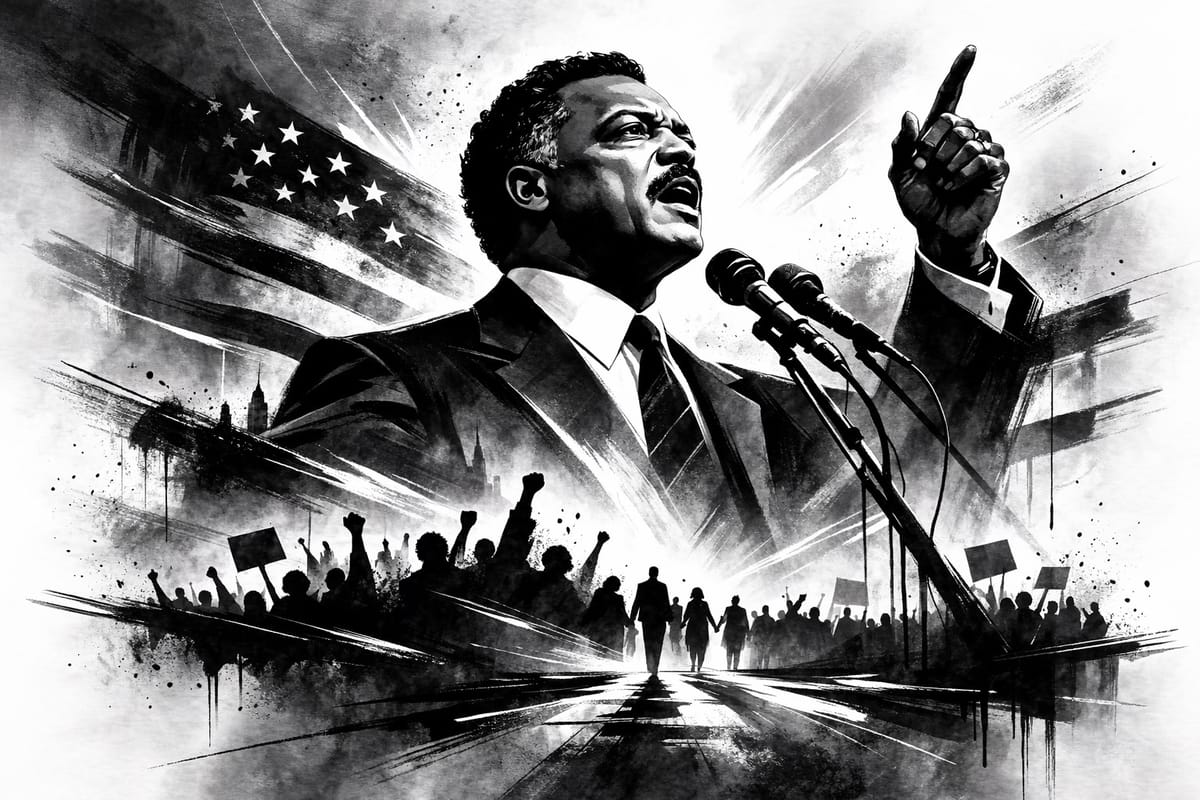
On February 17, 2026, America lost one of its most influential civil rights leaders when Reverend Jesse Louis Jackson died peacefully at his home in Chicago at the age of 84, surrounded by his family. His passing marked the end of an extraordinary six-decade journey that reshaped American politics, expanded economic opportunities for millions, and challenged the nation to live up to its highest ideals of equality and justice. From the streets of segregated Greenville, South Carolina, to the corridors of international diplomacy, from the pulpit to presidential campaigns, Jackson’s life embodied the relentless pursuit of human dignity and the unwavering belief that ordinary people, when organized and inspired, could change the course of history.
Jackson’s family released a statement that captured the essence of his life’s work: “Our father was a servant leader—not only to our family, but to the oppressed, the voiceless, and the overlooked around the world.” Indeed, Jackson spent his entire adult life in service to those he once described as “the desperate, the damned, the disinherited, the disrespected and the despised,” building coalitions across racial, economic, and geographic divides to challenge systems of inequality and create pathways to opportunity where none existed before. His contributions to civil rights, economic justice, international diplomacy, and democratic participation cannot be measured simply in legislative victories or policy changes, but in the fundamental transformation of American political consciousness and the millions of lives touched by his advocacy, organization, and inspiration.
Jesse Louis Jackson was born on October 8, 1941, in Greenville, South Carolina, in the heart of the Jim Crow South, to Helen Burns, a sixteen-year-old high school student, and Noah Louis Robinson, a married man who lived next door and acknowledged paternity but had little contact with his son. This difficult beginning could have defined Jackson’s trajectory, but his mother’s remarriage to Charles Henry Jackson, a post office maintenance worker who adopted young Jesse when he was about fifteen, provided stability and a surname that would become synonymous with civil rights advocacy. Growing up in the segregated South, Jackson experienced firsthand the daily humiliations and structural violence of racial apartheid, from attending underfunded, racially segregated schools to being denied access to public facilities that his tax dollars helped support.
Jackson’s first act of civil disobedience came during the winter break of his freshman year at the University of Illinois, where he had enrolled on a football scholarship. Needing to borrow a book for his studies, he attempted to use the Greenville Public Library, only to be turned away because it was whites-only. On July 16, 1960, Jackson and seven other students held a sit-in at the library and were arrested for protesting, becoming known as the “Greenville Eight.” A judge ultimately ruled that they had the right to use the publicly funded facility, and the library system was integrated later that year. This early victory demonstrated the power of direct action and nonviolent resistance to dismantle segregation, lessons that would guide Jackson’s activism for the rest of his life.
After his experience at Illinois, where he reportedly faced resistance to the idea of a Black quarterback leading the team, Jackson transferred to North Carolina Agricultural and Technical College, a historically Black institution in Greensboro where the modern sit-in movement had begun just months before his arrival. At North Carolina A&T, Jackson thrived academically and organizationally, earning a sociology degree in 1964 while serving as student body president and participating actively in the burgeoning civil rights movement. He and his future wife, Jacqueline Lavinia Brown, whom he married in 1962, participated in sit-ins to integrate public facilities in Greensboro, joining thousands of young people across the South who were willing to face arrest, violence, and economic retaliation to challenge the foundations of racial segregation.
Jackson’s commitment to the movement led him to the Chicago Theological Seminary on a scholarship, but his studies would take a backseat to the moral urgency of the civil rights struggle. In 1965, he joined the historic voting rights march from Selma to Montgomery, Alabama, where he first met Reverend Dr. Martin Luther King Jr. This encounter changed the trajectory of Jackson’s life, as King recognized in the young seminary student a rare combination of organizational talent, charismatic oratory, and unwavering commitment to justice. King invited Jackson to work with the Southern Christian Leadership Conference, and by 1966, Jackson had become the head of the Chicago chapter of Operation Breadbasket, the SCLC’s economic justice program that would become a cornerstone of the civil rights movement’s “Northern Campaign.”
Under Jackson’s leadership, Operation Breadbasket in Chicago pioneered a new approach to civil rights activism that recognized economic power as inseparable from political and social freedom. The program’s simple but powerful premise was that businesses operating in Black communities and profiting from Black consumers had an obligation to hire Black workers, use Black-owned suppliers, and invest in community development. King had articulated this vision when he appointed Jackson to lead the Chicago initiative, understanding that the movement needed to address not just the legal structures of segregation but the economic foundations of racial inequality.
Jackson transformed Operation Breadbasket from a theoretical concept into a formidable economic justice machine. Teams of ministers monitored local businesses to document their hiring practices, then approached companies that employed few or no Black workers with specific demands for hiring qualified candidates within defined timeframes. When negotiations failed, Jackson and his coalition of clergy would call for selective buying campaigns—economic boycotts that leveraged the collective purchasing power of Black communities to force corporate accountability. The strategy proved remarkably effective, combining moral suasion with economic pressure to create tangible results.
The five dairy companies that Operation Breadbasket targeted in its early campaigns illustrated the program’s impact. Three companies complied immediately with demands to hire more Black employees when confronted with documentation of their discriminatory practices and the threat of community boycotts. Two others resisted until actual boycotts demonstrated the economic consequences of excluding Black workers from employment while profiting from Black consumers. Jackson’s Operation Breadbasket then expanded its focus to soft drink bottlers, supermarket chains, and other major employers, using the same combination of negotiation, public pressure, and economic leverage to open up thousands of jobs.
The results were staggering. In its first fifteen months under Jackson’s leadership, Operation Breadbasket in Chicago won two thousand new jobs with fifteen million dollars annually in new income for the Black community. By the time Jackson left the program in 1971, it had secured an estimated 4,500 jobs over six years and dramatically increased business at Black-owned companies and stores. King himself called Operation Breadbasket the SCLC’s “most spectacularly successful program” in Chicago, and Jackson’s success in translating movement energy into concrete economic gains established him as one of the most effective organizers of his generation.
But Operation Breadbasket was more than just a jobs program. Jackson understood that economic empowerment required building institutions and fostering a culture of self-determination. The Saturday morning meetings at Capitol Theater, later at the Tabernacle Baptist Church, became legendary gathering places where Black Chicagoans could hear inspiring messages, participate in direct action planning, and celebrate Black excellence. These meetings combined the emotional power of Black church tradition with pragmatic economic organizing, featuring musical performances, speeches about Black buying power and self-determination, and concrete plans for boycotts and negotiations. The weekly broadcasts reached beyond those physically present, creating a sense of community participation and shared purpose that extended across Chicago and eventually to Operation Breadbasket chapters in other cities.
On April 4, 1968, Jackson was at the Lorraine Motel in Memphis, Tennessee, with King and other SCLC leaders who had gathered to support striking sanitation workers demanding dignity and fair wages. King had delivered his prophetic “I’ve Been to the Mountaintop” speech the night before, speaking of threats against his life but declaring he was not afraid because he had “seen the Promised Land.” The next evening, as King stood on the motel’s balcony preparing for dinner, a single bullet ended his life and plunged the nation into grief and upheaval.
Jackson was one of the last people to be with King in those final moments, and the trauma of witnessing his mentor’s assassination would shape the rest of his life and career. In the immediate aftermath, Jackson appeared on national television wearing the turtleneck he had worn that day, which he said was stained with King’s blood, recounting the assassination and positioning himself as a witness to history and a potential heir to King’s legacy. These actions sparked controversy that would follow Jackson throughout his career, with some SCLC officials disputing his account and suggesting he was opportunistically using King’s death to elevate his own profile. Whether Jackson was simply a traumatized aide overcome with grief or someone consciously positioning himself for leadership succession, or some complex combination of both, the Memphis assassination marked a turning point in his trajectory from promising organizer to national civil rights leader.
The question of who would carry forward King’s vision created tensions within the SCLC. Ralph Abernathy, King’s chosen successor as SCLC president, had neither King’s charisma nor his strategic vision, and the organization struggled to maintain cohesion and momentum in the years following the assassination. Jackson, with his national profile from Operation Breadbasket’s success and his proximity to King’s final moments, increasingly clashed with Abernathy over direction, finances, and leadership. The break became complete in December 1971 when Abernathy suspended Jackson for “administrative improprieties and repeated acts of violation of organizational policy,” including questions about handling of receipts from the Black Expo and forming nonprofit corporations without permission.
Rather than accept subordination, Jackson resigned from Operation Breadbasket, along with his entire staff and thirty of the thirty-five board members, signaling his determination to chart his own course. Al Sharpton, then a youth group leader of the SCLC, left the organization to protest Jackson’s treatment and formed the National Youth Movement, while Jackson and his allies began planning a new organization that would expand the economic justice work of Operation Breadbasket while building political power and addressing broader issues of inequality. This rupture with the SCLC freed Jackson to pursue a more ambitious vision of social change, one that would link economic development, political mobilization, and cultural transformation in ways that extended beyond the SCLC’s traditional focus.
On Christmas Day, 1971, Jackson announced the formation of Operation PUSH—People United to Save Humanity, later changed to People United to Serve Humanity—before an enthusiastic crowd at the Metropolitan Theater on Dr. Martin Luther King Drive in Chicago’s Bronzeville neighborhood. The New York Times reported that “wearing a blue vest and checkered shirt, Mr. Jackson conducted a spirited four-hour meeting at the crowded Metropolitan Theater,” where “people sat in the aisles, lined the walls and made the sidewalk outside impassable.” Jackson told the overflow crowd that the new organization would pursue economic and political empowerment through direct action: “We must picket, boycott, march, vote and, when necessary, engage in civil disobedience.”
Operation PUSH built on the foundation of Operation Breadbasket but expanded its scope significantly. While continuing to negotiate covenants with major corporations for Black hiring and business development, PUSH also launched educational programs, housing initiatives, and political campaigns that addressed the multifaceted nature of inequality in Black communities. The organization’s weekly Saturday morning broadcasts became must-listen programming that provided analysis of critical issues, celebrated Black achievement, and mobilized communities for action. Notable figures ranging from future media mogul Oprah Winfrey to basketball legend Michael Jordan would make appearances at PUSH events, while grassroots leaders, block club organizers, and community activists found a home for their work.
PUSH’s corporate campaigns achieved landmark victories that demonstrated the power of organized economic pressure. In 1981, after months of negotiations and the threat of a nationwide boycott, Coca-Cola signed a groundbreaking agreement committing millions of dollars to hire more Black executives, use more Black-owned suppliers and advertising agencies, and increase deposits in Black-owned banks. Similar covenants followed with Anheuser-Busch, Burger King, and other major corporations, establishing the principle that companies profiting from Black consumers had obligations to Black communities. These agreements created pathways to corporate leadership for thousands of Black professionals, generated hundreds of millions in business for Black-owned firms, and demonstrated that civil rights activism could reshape corporate America’s hiring and investment practices.
Beyond corporate accountability, PUSH launched PUSH Excel, an education initiative that worked to keep inner-city youth in school while assisting them with job placement. The program, which required participating students to pledge in writing to study two hours per night with parental monitoring, attracted support from President Jimmy Carter’s administration, which became a major sponsor. PUSH Excel represented Jackson’s understanding that economic justice required not just opening doors through direct action but ensuring that young people had the preparation and support to walk through those doors. The program provided scholarships, tutoring, job training, and placement assistance, creating comprehensive support systems that addressed the interconnected challenges facing urban youth.
Throughout the 1970s and into the 1980s, Jackson used PUSH to protect Black homeowners from discriminatory lending practices, support Black-owned businesses, and honor prominent Black Americans and international leaders working for justice. The organization combined confrontation and negotiation, using boycotts and prayer vigils when necessary but always seeking to build long-term relationships and sustainable change. Jackson understood that economic power was not just about individual advancement but about building institutions—Black-owned banks, insurance companies, media outlets, and businesses—that could provide stability and opportunity across generations.
While Operation PUSH proved the effectiveness of economic organizing, Jackson recognized that fundamental change required political power. The election of Ronald Reagan in 1980 on a platform of cutting social programs, weakening labor protections, and reducing government’s role in addressing inequality convinced Jackson that the moment had arrived to challenge the Democratic establishment and build a multiracial coalition that could advance progressive policies. In 1983, Jackson became the first African American to launch a nationwide presidential campaign with the organizational capacity and political infrastructure to compete seriously in the Democratic primaries.
Jackson’s 1984 presidential campaign was built on the concept of the “Rainbow Coalition”—a term he borrowed from Chicago Black Panther leader Fred Hampton, who had used it in 1969 to describe alliances between the Black Panthers, Puerto Rican Young Lords, and working-class white organizations. Jackson’s version expanded this vision to include Black voters, Latino and Asian American communities, labor unions, students, farmers, small business owners, peace activists, environmentalists, and anyone else who felt excluded from Reagan’s vision of America. “Our flag is red, white and blue,” Jackson declared at the 1984 Democratic National Convention in San Francisco, “but our nation is a rainbow—red, yellow, brown, black, and white—and we’re all precious in God’s sight.”
The 1984 campaign registered over one million new voters and won 3.5 million votes in the primaries, with Jackson placing third behind Walter Mondale and Gary Hart. For many of those voters, particularly in Black communities, Jackson’s campaign represented their first meaningful participation in presidential politics, proof that someone who looked like them and spoke to their experiences could compete on the national stage. Jackson’s speech at the Democratic convention, later known as his “Our Time Has Come” address, was the first time a speaker at a national political convention mentioned gay and lesbian Americans, demonstrating his commitment to building an inclusive movement that recognized multiple forms of marginalization and oppression.
The campaign faced significant obstacles and controversies. Jackson’s reference to New York City as “Hymietown” in remarks to a reporter, using a derogatory term for Jews, sparked outrage and accusations of antisemitism that Jackson at first denied and then apologized for. His association with Nation of Islam leader Louis Farrakhan, who made inflammatory antisemitic statements while supporting Jackson’s campaign, further damaged his credibility with Jewish voters and liberal Democrats. These controversies would haunt Jackson throughout his political career, raising legitimate questions about his judgment and his ability to build the truly inclusive coalition his rhetoric described.
Despite these setbacks, Jackson’s 1984 campaign fundamentally altered Democratic politics. It demonstrated that a progressive candidate focusing on economic justice, peace, and inclusion could mobilize millions of voters who had been marginalized by the party’s centrist turn. It forced the Democratic Party to take seriously the concerns of its most loyal constituency—Black voters—who had been taken for granted while the party pursued white suburban moderates. And it created the organizational infrastructure and political networks that would support Jackson’s even more successful 1988 campaign.
Jackson’s 1988 presidential campaign built on the foundation of 1984 while expanding outreach to white working-class voters, labor unions, and family farmers facing economic hardship. The campaign’s message of economic populism resonated across racial lines, arguing that Reagan’s policies had enriched the wealthy while devastating working people of all backgrounds. Jackson won seven million votes in the primaries and finished second to Massachusetts Governor Michael Dukakis, winning thirteen contests and briefly taking the delegate lead after a surprise victory in the Michigan caucuses. He came closer to the Democratic nomination than any Black candidate had before Barack Obama’s historic victory two decades later.
Jackson’s frequent criticism of Democratic Party rules for allocating delegates led to significant reforms that would have lasting consequences. Party rules at the time required candidates to receive 20-30 percent of the vote in congressional or legislative districts and statewide to qualify for delegates, which disadvantaged candidates like Jackson whose support was concentrated in particular communities or constituencies. Jackson argued these thresholds were undemocratic and discriminatory, designed to prevent insurgent candidates from accumulating delegates even when they commanded substantial popular support. His advocacy led to changes that allowed delegates to be awarded proportionally to any candidate receiving above a minimal threshold, a reform that would prove crucial to Barack Obama’s narrow delegate victory over Hillary Clinton in 2008.
The emotional high point of Jackson’s 1988 campaign came at the Democratic National Convention in Atlanta, where he delivered a speech that moved many delegates to tears and crystallized his message of hope and perseverance. Standing just miles from where Dr. King was buried, Jackson recounted his own journey from poverty in segregated Greenville to the national political stage, telling the convention: “I was born in the slum, but the slum was not born in me. And it wasn’t born in you. And you can make it. Wherever you are tonight, you can make it.”
The speech’s climax came with Jackson’s now-legendary call to “Keep hope alive,” a phrase that would become synonymous with his political legacy and inspire generations of activists and politicians. “It gets dark sometimes, but the morning comes,” Jackson declared. “Don’t you surrender! Suffering breeds character. Character breeds faith. In the end, faith will not disappoint. You must not surrender. You may or may not get there, but just know that you are qualified, and you hold on and hold out. We must never surrender. America will get better and better. Keep hope alive. Keep hope alive! Keep hope alive!”
Jackson’s 1988 campaign demonstrated the viability of progressive economic populism as an electoral strategy, showing that candidates could build winning coalitions by addressing the material concerns of working people rather than triangulating toward the political center. His advocacy for cutting Pentagon spending while increasing investment in education, housing, and healthcare, his support for Palestinian self-determination and opposition to South African apartheid, and his willingness to challenge corporate power and defend labor unions established a template for progressive politics that would influence figures from Bernie Sanders to Alexandria Ocasio-Cortez.
Yet Jackson’s inability to secure the nomination also revealed the limits of moral leadership divorced from institutional power. Despite his popular support and inspiring message, Democratic Party leaders remained skeptical of his electability in a general election, pointing to polls showing him trailing far behind Republican Vice President George H.W. Bush in hypothetical matchups. The party’s choice of the moderate Dukakis, who went on to lose the general election in a landslide, validated Jackson’s critique of establishment timidity while also suggesting that his particular combination of racial identity, progressive politics, and controversial associations made him unpalatable to a national electorate still resistant to fundamental change.
While Jackson’s presidential campaigns brought him national attention, his work as an unofficial diplomatic envoy demonstrated his influence on the global stage and his unique ability to negotiate with adversaries when official channels had failed. Throughout the 1980s and 1990s, Jackson traveled to hostile nations and conflict zones to secure the release of American hostages and prisoners, often over the objections of U.S. government officials who viewed his interventions as interference with foreign policy. Yet Jackson’s success rate was remarkable, and his willingness to engage directly with leaders others refused to talk to saved lives and sometimes opened doors to dialogue that official diplomacy could not.
In 1984, Jackson traveled to Syria and negotiated with President Hafez al-Assad for the release of U.S. Navy Lieutenant Robert Goodman Jr., whose plane had been shot down over Lebanon and who was being held prisoner by Syrian forces. The Reagan administration had publicly criticized Jackson’s trip as grandstanding, but when Jackson returned with Goodman to a hero’s welcome, even critics had to acknowledge the humanitarian success of his intervention. That same year, Jackson traveled to Cuba and secured the release of forty-eight American and Cuban political prisoners from Fidel Castro’s government, bringing them back to the United States and demonstrating that his approach of direct engagement and moral persuasion could achieve results that official sanctions and isolation could not.
Jackson’s most dramatic hostage negotiation came in 1999, during the Kosovo conflict, when Serbian forces captured three U.S. Army soldiers—Staff Sergeant Christopher Stone, Staff Sergeant Andrew Ramirez, and Specialist Steven Gonzales. At a time of intense tension between the United States and Serbia, with NATO conducting bombing campaigns against Serbian forces, Jackson traveled to Belgrade to meet with Serbian President Slobodan Milosevic. Despite the complex and dangerous political environment, Jackson’s personal diplomacy and moral authority persuaded Milosevic to release the soldiers, who returned home with Jackson to tremendous public gratitude.
In 1990, following Iraq’s invasion of Kuwait, Jackson met with Iraqi President Saddam Hussein to secure the release of hundreds of people being held as “human shields,” including Americans, British, and French citizens. His willingness to sit down with a leader the United States was preparing to go to war against drew fierce criticism from both Democratic and Republican officials, yet Jackson’s intervention resulted in the release of numerous hostages who might otherwise have remained captive through the Gulf War. In 1985, during the hijacking of TWA Flight 847 by Hezbollah militants, Jackson traveled to Lebanon and engaged in intensive negotiations with militant leaders, helping to secure the release of hostages and demonstrating his courage in entering conflict zones where his own safety was not guaranteed.
Jackson’s diplomatic interventions operated outside official channels and often frustrated State Department officials who viewed him as a rogue actor without portfolio or authority. Yet his approach—combining personal moral authority as a civil rights leader, the credibility that came from his critique of U.S. foreign policy, and his identity as a Baptist minister appealing to shared religious values—gave him access and influence that official diplomats lacked. Foreign leaders who viewed the U.S. government as imperialistic or hostile often saw Jackson as someone who represented American ideals rather than American interests, someone who could be trusted to negotiate in good faith and whose word carried weight even without official backing.
Jackson described his role in these missions variously as civil rights leader, clergyman, journalist, and “citizen of the world,” but the common thread was his belief that dialogue and engagement were always preferable to isolation and conflict. He traveled to South Africa during apartheid to support the anti-apartheid movement, to the Middle East to advocate for Palestinian self-determination while also building relationships with Israeli peace activists, and to dozens of countries to highlight civil rights abuses and support democratic movements. His international work expanded the definition of civil rights activism beyond domestic concerns, arguing that justice was indivisible and that those who fought for freedom at home had an obligation to support freedom struggles everywhere.
While Jackson’s presidential campaigns and international diplomacy garnered headlines, his most sustained impact may have been in transforming corporate America’s approach to diversity and economic inclusion. Building on the success of Operation PUSH’s covenant campaigns, Jackson launched the Wall Street Project in the 1990s to pressure the financial services industry to increase minority representation in hiring, contracting, and investment decisions. The initiative brought together corporate executives, civil rights leaders, and government officials to establish accountability mechanisms and measurable goals for diversifying an industry that had been overwhelmingly white and male.
The Wall Street Project used the same combination of moral persuasion and economic pressure that had proven effective in Jackson’s earlier campaigns. Jackson organized protests at corporate headquarters, staged demonstrations at shareholder meetings, and threatened boycotts of companies that failed to commit to diversity goals. But he also sat down with corporate leaders to develop practical solutions, helped companies identify qualified minority candidates for leadership positions, and facilitated relationships between major corporations and minority-owned businesses seeking contracts and investment.
The results were substantial. Companies from Coca-Cola to Texaco, from financial services firms to technology companies, signed agreements committing billions of dollars to minority hiring, supplier diversity, and deposits in minority-owned banks. When Texaco faced a discrimination scandal in the mid-1990s, Jackson showed up at their headquarters to demand accountability but also to help craft solutions that included financial settlements for affected employees and systemic reforms to prevent future discrimination. When major corporations sought to improve their diversity records, they frequently turned to Jackson and Rainbow/PUSH for guidance, relationships, and credibility with communities of color.
Jackson’s corporate accountability work extended to the technology industry in Silicon Valley, where he pressured companies to disclose diversity statistics and commit to increasing representation of Black and Latino employees in technical and leadership roles. The campaigns resulted in major tech companies establishing diversity reporting standards, creating pathways for minority-owned firms to participate in their supply chains, and appointing more diverse board members. While progress remained frustratingly slow and many commitments proved more symbolic than substantive, Jackson’s persistent advocacy established the principle that corporate America had obligations beyond shareholder returns, that profiting from diverse markets required investment in diverse communities.
The Wall Street Project and related initiatives also fostered Black capitalism and entrepreneurship, supporting minority-owned businesses and helping them access capital, contracts, and markets that had historically been closed to them. Jackson understood that economic power required ownership, not just employment, and his work helped create a class of Black business owners, investors, and corporate leaders who could build wealth across generations. While some critics argued this approach channeled civil rights energy away from structural change and toward individual advancement within existing systems, Jackson maintained that economic empowerment was a prerequisite for broader social transformation, that people could not challenge systems from positions of dependency and exclusion.
Throughout his career, Jackson navigated the complex relationship between his public leadership and private life, between the moral authority he commanded and the human imperfections he embodied. In 2001, news broke that Jackson had fathered a daughter with Karin Stanford, a former member of his staff, and had used Rainbow/PUSH funds to support the child. The revelation came at a time when Jackson had been counseling President Bill Clinton during the Monica Lewinsky scandal, creating an uncomfortable parallel that damaged Jackson’s credibility as a moral voice and exposed him to charges of hypocrisy.
Jackson acknowledged the affair and his daughter, asking for forgiveness from his wife Jacqueline and the public. The scandal led him to step back temporarily from some public activities and raised questions about his judgment and the gap between his public advocacy for family values and his private actions. Yet while the revelation disappointed supporters and provided ammunition to critics, it did not fundamentally derail his work or diminish the concrete achievements of his decades of activism. Jackson’s marriage survived, his family remained supportive, and his organization continued its advocacy work, demonstrating both the resilience of institutions built on broader principles than individual charisma and the public’s capacity to separate leaders’ personal failings from their political contributions.
Jackson’s controversial statements and associations presented different challenges. His “Hymietown” remarks, his relationship with Louis Farrakhan, and various other inflammatory statements over the years gave credence to charges that he harbored prejudices inconsistent with his inclusive rhetoric. While Jackson apologized for offensive statements and eventually distanced himself from Farrakhan, the controversies raised legitimate questions about whether his Rainbow Coalition could truly embrace all communities when its leader made statements that excluded or demeaned some of them. Critics argued that Jackson’s willingness to tolerate or associate with antisemitism, even as he condemned other forms of bigotry, revealed a fundamental inconsistency in his moral framework.
Defenders of Jackson pointed to his broader record of building coalitions across lines of difference, his advocacy for Palestinian rights alongside support for Israeli-Palestinian peace, and his willingness to apologize and learn from mistakes as evidence that his commitments to justice were genuine even when his execution was flawed. They noted that leaders who challenge systems of power will inevitably make enemies who seize upon any misstep to discredit broader movements, and that holding Jackson to standards of perfection that no political leader could meet was a way of avoiding engagement with the substance of his critique. The tension between these perspectives—between Jackson as a transformative leader who expanded possibilities for millions and Jackson as a flawed individual whose controversies limited his effectiveness—has shaped assessments of his legacy.
Jackson’s most enduring contribution may be the institutions he built and the leaders he mentored. The Rainbow/PUSH Coalition, formed in 1996 by merging Operation PUSH and the National Rainbow Coalition, became one of the nation’s most prominent civil rights organizations, with headquarters in Chicago and offices in major cities across the country. The organization continued Jackson’s work on economic justice, corporate accountability, voter registration, education reform, and international human rights, providing a platform for successive generations of activists and organizers.
Through Rainbow/PUSH, Jackson created pathways for young people to enter public service and advocacy work. His willingness to take chances on young, untested talent—hiring a nineteen-year-old college student to manage a campaign on college affordability, giving Al Sharpton his start in civil rights organizing, creating opportunities for countless others who would go on to leadership positions in politics, business, and civil society—reflected his belief in potential over pedigree, in passion and commitment over credentials and connections. Many of today’s civil rights leaders, elected officials, and community organizers trace their development directly to time spent working with or learning from Jackson.
Jackson’s Saturday morning broadcasts at Rainbow/PUSH continued the tradition he had established with Operation Breadbasket, providing a weekly forum for analyzing current events, celebrating Black achievement, and organizing community action. The broadcasts featured musical performances, speeches by community leaders and visiting dignitaries, and Jackson’s own powerful sermons that blended religious inspiration with political analysis. These gatherings created community in an era of increasing fragmentation, provided political education when mainstream media ignored or distorted issues affecting Black communities, and demonstrated the enduring power of the Black church tradition as a space for organizing and mobilization.
The educational programs Jackson championed, from PUSH Excel to scholarship funds for low-income students, reflected his conviction that justice required not just opening doors but ensuring people had the preparation to walk through them. Rainbow/PUSH provided scholarships, housing assistance, job placement services, and youth programs that addressed the interconnected challenges facing communities marginalized by poverty and discrimination. While these programs could not substitute for the comprehensive public investment in education, housing, and economic development that Jackson advocated through his political campaigns, they provided concrete assistance to thousands of families while demonstrating the kind of society Jackson believed America could become.
Jackson’s activism was grounded in a coherent philosophical framework that drew from Black church tradition, civil rights movement strategy, and a sophisticated understanding of power and organization. His famous refrain “I am somebody,” used in speeches and chants throughout his career, encapsulated his belief that human dignity was inherent, not granted, and that marginalized people needed first to claim their own worth before they could demand recognition from others. This message of self-affirmation was particularly powerful for young people growing up in communities where every institution seemed designed to convince them of their worthlessness, where schools failed them, police harassed them, and economic opportunities eluded them.
Jackson consistently argued that progress required both moral clarity and practical organizing. His 1988 convention speech articulated this philosophy directly: “If an issue is morally right, it will eventually be political. It may be political and never be right.” He invoked Fannie Lou Hamer, Rosa Parks, and Dr. King as examples of leaders who were morally right even when they lacked the votes or popular support to prevail in the moment, whose principled stands eventually shifted political consciousness and created conditions for change. This long-term perspective allowed Jackson to advocate for positions—Palestinian self-determination, opposition to apartheid, support for economic democracy—that were politically unpopular when he championed them but that later became mainstream.
Yet Jackson was never simply a prophetic voice calling America to its ideals. He was also a practical organizer who understood that moral claims without power to enforce them were just wishes, that change required building institutions, mobilizing constituencies, and wielding economic and political leverage. His approach combined the prophet’s denunciation of injustice with the pragmatist’s negotiation with power, using boycotts to force corporations to the bargaining table and then sitting down to hammer out concrete agreements. This dual role—agitator and negotiator, prophet and pragmatist—defined Jackson’s method and created space for transformative change.
Jackson also understood that sustaining movements required hope and joy alongside struggle and sacrifice. His speeches were masterworks of Baptist preaching tradition, using call-and-response, rhythmic repetition, biblical allusion, and soaring rhetoric to inspire audiences and build emotional connections. His slogans—”Hope not dope,” “If my mind can conceive it and my heart can believe it then I can achieve it,” “It takes two wings to fly”—were crafted for memorability and repeated transmission, designed to spread beyond the immediate audience to become part of popular consciousness. Jackson knew that movements needed not just correct analysis but compelling narratives, not just rational arguments but emotional resonance that could sustain people through the long, difficult work of social transformation.
When Barack Obama won the Democratic presidential nomination in 2008 and then the presidency that November, Jackson’s emotional response captured the complex relationship between the two men and the two generations of Black politics they represented. Photographs of Jackson weeping at Obama’s election night victory rally in Chicago’s Grant Park became iconic images of the moment, representing both the fulfillment of Jackson’s decades of work to make a Black presidency possible and perhaps also his awareness that Obama’s victory had rendered Jackson’s particular brand of civil rights politics obsolete.
Obama himself acknowledged his debt to Jackson, stating in his tribute after Jackson’s death: “Michelle got her first glimpse of political organizing at the Jacksons’ kitchen table when she was a teenager. And in his two historic runs for president, he laid the foundation for my own campaign to the highest office of the land.” Illinois House Speaker Emanuel “Chris” Welch put it even more directly: “We don’t have Barack Obama as the president without Jesse Jackson running in 1984 and 1988.” Jackson’s campaigns had demonstrated that a Black candidate could compete nationally, had forced the Democratic Party to reform its delegate allocation rules in ways that benefited Obama’s narrow victory over Hillary Clinton, and had registered millions of voters who would form part of Obama’s coalition.
Yet Obama also represented a deliberate break from Jackson’s style and approach. Where Jackson was confrontational, Obama was conciliatory. Where Jackson built power through protest and economic pressure, Obama sought power through the Democratic Party establishment. Where Jackson’s rhetoric explicitly invoked race and structural racism, Obama spoke of transcending racial divisions and finding common ground. Obama’s famous 2004 convention speech declaring “there’s not a Black America and white America and Latino America and Asian America; there’s the United States of America” directly contradicted Jackson’s rainbow metaphor, which celebrated difference rather than seeking to transcend it.
The tension between the two approaches—Jackson’s social movement organizing versus Obama’s inside-game party politics, Jackson’s confrontation with power versus Obama’s accommodation of it—reflected broader debates within Black politics and progressive movements about strategy and goals. Jackson’s supporters argued that Obama’s success depended on the space Jackson had opened and the movements he had built, even as Obama distanced himself from Jackson’s more confrontational approach. Obama’s supporters countered that Jackson’s inability to win the nomination proved the limits of his strategy, that Obama’s success demonstrated the viability of a different path that worked within rather than against existing systems.
In 2017, Jackson publicly announced his diagnosis with Parkinson’s disease, a degenerative neurological condition that would progressively limit his physical mobility and speech. Yet even as his health declined—he was hospitalized twice in 2021 after testing positive for COVID-19 and suffering a head injury, and his family later revealed he had been misdiagnosed and actually suffered from progressive supranuclear palsy—Jackson remained committed to the work that had defined his life. He appeared at protests following the killing of George Floyd, advocating for police reform and racial justice. He continued to weigh in on political issues, writing about the Gaza war and supporting voting rights legislation. He attended the 2024 Democratic National Convention, where he received a standing ovation from delegates who recognized his transformative impact on their party.
In July 2023, Jackson announced his plans to step down as leader of Rainbow/PUSH, acknowledging that his advanced age and health complications required him to pass leadership to the next generation. Chicago Mayor Brandon Johnson called Jackson “an architect of the soul of Chicago,” noting that “his faith, his perseverance, his love, and his relentless dedication to people inspire all of us to keep pushing for a better tomorrow.” Al Sharpton, whom Jackson had mentored for decades, described Jackson’s decision as “the pivoting of one of the most productive, prophetic, and dominant figures in the struggle for social justice in American history.”
Jackson’s final years demonstrated the same courage he had shown throughout his life, continuing to show up even when physical limitations made it difficult, refusing to surrender to illness or age in the same way he had refused to surrender to racism and injustice. His presence at protests and public events, even when he could barely speak or walk, served as a reminder of the long arc of the civil rights struggle, connecting contemporary movements to the generations of activists who had come before. Young people marching against police violence could see in Jackson’s weathered frame the embodiment of decades of resistance, a living link to the movement that had transformed America.
Assessing Jesse Jackson’s legacy requires grappling with contradictions and complexity, with transformative achievements and personal failings, with the gap between his soaring rhetoric and the incomplete realization of his vision. Jackson fundamentally altered American politics, demonstrating that candidates advocating for economic justice and challenging concentrated power could mobilize millions of voters previously excluded from or alienated by the political process. His presidential campaigns forced the Democratic Party to take seriously its most loyal constituencies, changed delegate allocation rules in ways that would prove decisive in future elections, and inspired a generation of Black political leaders who would go on to win offices at every level of government.
Jackson’s economic justice work established that corporations profiting from diverse communities had obligations to those communities, that civil rights activism could and should address economic inequality alongside legal discrimination. His negotiated covenants with major corporations created thousands of jobs, generated billions in business for minority-owned firms, and established diversity and inclusion as corporate priorities that persist today, however imperfectly implemented. His willingness to organize boycotts and apply economic pressure demonstrated that consumers and workers could leverage their collective power to force accountability from even the largest and most powerful institutions.
Jackson’s international diplomacy saved lives, brought American hostages home, and demonstrated that engagement and dialogue could achieve results when official channels had failed. His advocacy for Palestinian self-determination, opposition to apartheid in South Africa, and support for democratic movements around the world embodied his conviction that justice was indivisible, that Americans committed to freedom at home had obligations to support freedom struggles everywhere. While his interventions sometimes complicated official U.S. foreign policy, they also reminded Americans that moral authority derives from consistent principles, not national interest.
Yet Jackson’s legacy also includes the limitations and failures that prevented him from achieving the transformative change he sought. Despite mobilizing millions and articulating a compelling vision of economic democracy and racial justice, he never won the presidency or built the institutional power within the Democratic Party necessary to implement his agenda. His controversial statements and associations undermined his credibility and limited his ability to build the truly inclusive coalitions his Rainbow metaphor described. His charisma and rhetorical power sometimes substituted for the patient, unglamorous work of building sustainable organizations and developing leadership beyond his own person.
Jackson’s impact must also be measured by what he made possible for others. Barack Obama’s presidency, the diversification of corporate leadership, the thousands of young people he mentored and inspired, the expansion of democratic participation through voter registration drives, the normalization of progressive economic populism in American politics—all of these developments built on foundations Jackson laid. When contemporary activists organize protests demanding corporate accountability, when progressive candidates challenge party establishments, when voters of color flex their political power, they walk through doors Jackson helped open and use strategies Jackson pioneered.
Perhaps most importantly, Jackson kept hope alive during periods when hope seemed foolish, when systemic change appeared impossible, when the forces arrayed against justice seemed overwhelming. His message that ordinary people organizing together could change history, that morning comes after darkness, that we must never surrender—this message sustained movements through defeats and setbacks and continues to inspire those carrying forward the work of building a more just society. In an era increasingly characterized by cynicism and despair, Jackson’s life testified to the power of faith, the necessity of struggle, and the possibility of transformation.
When Jesse Jackson’s family announced his death, they described him as “a servant leader—not only to our family, but to the oppressed, the voiceless, and the overlooked around the world.” This characterization captures the essence of Jackson’s six decades in public life, a period defined by unwavering commitment to those society had marginalized, consistent advocacy for economic and racial justice, and tireless work to expand democracy and opportunity. From the Greenville Public Library sit-in as a college student to his final appearances advocating for voting rights and police reform, Jackson devoted his life to the belief that America could become the nation it claimed to be, that its democratic ideals could be made real through organized struggle and moral witness.
Jackson’s life embodied the transformation of American civil rights activism from the protest movements of the 1960s through the institutionalization of those movements in political parties, corporate boardrooms, and international diplomacy. He was present at the defining moments of the civil rights era—marching from Selma to Montgomery, working alongside Dr. King in Chicago, standing on the balcony of the Lorraine Motel when King was assassinated. He then spent the following decades translating the movement’s moral force into economic and political power, building institutions and developing strategies that expanded beyond the civil rights movement’s original focus on legal equality to address the economic foundations of racial inequality.
The principles that guided Jackson’s work—that economic power is inseparable from political and social freedom, that corporations have obligations to communities they profit from, that meaningful change requires organizing masses of people rather than relying on elite decision-makers, that justice is indivisible and those fighting for freedom must support freedom struggles everywhere—remain as relevant today as when Jackson first articulated them. Contemporary movements for economic justice, racial equality, and democratic participation continue to draw on strategies and frameworks Jackson developed, continue to organize in spaces Jackson helped create, continue to pursue visions of transformation Jackson championed.
In his 2011 interview with the Associated Press, reflecting on his life and legacy, Jackson said he felt “blessed to be able to continue the service of other leaders before him and to lay a foundation for those to come.” This understanding of himself as a link in a chain of freedom fighters, standing on the shoulders of those who came before while creating pathways for those who would follow, represents Jackson’s most profound contribution. He received from the civil rights movement of the 1960s a mandate to carry forward the work of building beloved community and expanding democracy, and he passed to subsequent generations organizations, strategies, networks, and inspiration to continue that work.
The test of Jackson’s legacy will be whether the institutions he built survive him, whether the leaders he mentored continue the work, whether the principles he championed shape future movements. Rainbow/PUSH continues its advocacy for economic justice and civil rights. The democratic reforms Jackson fought for continue to shape political competition. The thousands of people he inspired, trained, and mentored continue working for change in communities across America and around the world. The corporate accountability mechanisms he pioneered continue, however imperfectly, to create opportunities for communities of color. The progressive economic populism he articulated continues to shape political debate and electoral strategy.
As America grapples with persistent racial inequality, widening economic disparities, democratic backsliding, and contested visions of national identity, Jackson’s life offers lessons about the possibilities and limitations of social change. His successes demonstrate that organized people wielding economic and political power can force concessions from even the most entrenched interests, that moral leadership can inspire millions to participate in democratic processes, that the arc of the moral universe, though long, can be bent toward justice through persistent struggle. His failures remind us that charisma without institutional power is insufficient, that individual leaders cannot substitute for broad-based movements, that the work of transformation requires patience, coalition-building, and willingness to engage in the unglamorous work of organizing and institution-building.
Jesse Jackson lived long enough to see an America transformed in many ways from the segregated South of his youth. He saw the Voting Rights Act passed and then gutted, affirmative action established and then challenged, a Black president elected and then followed by a backlash of white nationalism. He witnessed progress and retrenchment, advances and setbacks, the expansion of opportunity alongside the persistence of structural inequality. Through it all, he maintained his faith that struggle mattered, that organizing could change outcomes, that keeping hope alive was not naive optimism but strategic necessity for sustaining movements through long campaigns for justice.
In his 1988 Democratic convention speech, Jackson told a story about his grandmother explaining that different patches must be brought together to make a quilt, that separate pieces must be bound together to create something beautiful and functional. “When we form a great quilt of unity and common ground,” Jackson said, “we’ll have the power to bring about health care and housing and jobs and education and hope to our nation.” This vision of diverse communities bound together in common struggle for shared prosperity, of solidarity across lines of difference in pursuit of justice for all, remains Jackson’s most important bequest to future generations.
The Reverend Jesse Jackson’s life—from the segregated streets of Greenville through the corridors of corporate power to presidential campaigns and international diplomacy—testifies to the transformative power of organizing, the necessity of hope, and the possibility that ordinary people, when inspired and organized, can change the course of history. His passing marks the end of an era, the loss of one of the last direct links to the civil rights movement’s heroic period, the closing of a remarkable life dedicated to justice. Yet his legacy lives on in the institutions he built, the leaders he mentored, the strategies he pioneered, and the millions he inspired to believe that a better world is possible and that our struggle to create it matters. As he so often proclaimed: keep hope alive, keep pushing for justice, and never surrender in the fight for human dignity and equality.
A comprehensive examination of Reverend Jesse Jackson’s six-decade journey as a civil rights leader, exploring his transformation of American politics through presidential campaigns, economic justice advocacy, international diplomacy, and institution-building that expanded opportunities for marginalized communities and demonstrated the enduring power of organized resistance to inequality.